


Is the principle of regional rotation at the United Nations over?
Article 97 of the UN Charter states that the General Assembly appoints the Secretary-General on the recommendation of the Security Council. All other rules governing the selection process, from the geographical area in which the “turn” of the post is due, to the number of rounds of exploratory voting by the Council, to the timing of the disclosure of the positions of the five permanent members, are a set of norms that have been established by precedent and practice, and are guaranteed by only the reluctance of Governments to appear to be violating those norms.
And with less than eight weeks to go before Antonio Guterres leaves office on December 31, the 2026 race for secretary-general puts these norms to multiple and simultaneous tests. After seven rounds of poll voting, the story is no longer about who is leading the race as much as it is about how reshaped the selection process itself, at a time when no one is officially changing its rules.
Progress masks stalemate
Costa Rica’s Rebecca Greenspan has led nearly all rounds of voting since she began July 30, except for the second round, which was temporarily overtaken by Guyana’s Caroline Rodriguez-Birkett.
In the seventh round, on October 30, Greenspan received 11 encouraging votes and four discouraging votes, with no abstentions, ahead of Argentina's Rafael Grossi, who received (9 encouraging votes, 4 discouraging, and two abstentions), Rodriguez-Birkett (8–6–1), and the United Arab Emirates' Lana Nusseibeh (7–6–2).
And the Stimson Center is clearly calling Greenspan the front-runner. The previous round, however, presented a very different picture.
On 16 October, for the first time at this session, the Security Council used colored ballots, which allow for a distinction between the votes of the permanent members and those of the 10 elected members.
Greenspan received the nine encouraging votes needed for a recommendation, but two of the five discouraging votes she received came from permanent members of the Security Council.
Similarly, Grossi and Rodriguez-Birkett, who received eight encouraging votes to six discouraging, also faced opposition from two permanent members.
In other words, each of the most prominent candidates faced the prospect of two vetoes.
Minh-Thu Pham, a researcher at the Starling Institute and former adviser to former Secretary-General Kofi Annan, said the major powers have not shown any convergence in their positions, which opens the way for new candidates.
And because the seventh round is back to using normal, uncolored ballots, Greenspan's improved numbers make no difference.
No one outside the voting room can tell whether the four discouraging votes she received still include the votes of the two permanent members who opposed her two weeks ago, the only number that determines the final outcome.
The internal politics of the states also contributed to the narrowing of the list of candidates. Michelle Bachelet, once seen as a strong candidate, withdrew on September 20, after the third round yielded one favorable vote to 11 unfavorable.
Her candidacy had taken a heavy blow months earlier, when the CAST government in Chile withdrew its support for her.
Macky Sall, Senegal's candidate, also dropped out of the race. And so the candidates have become required to satisfy two different audiences: the Security Council on the one hand, and the governments of their countries on the other. A change of government in the candidate's country could end his campaign before a veto is even needed.
The principle of regional rotation under pressure
The principle of regional rotation is the closest thing the United Nations has to a rule on which to base the legitimacy of its highest office.
This principle took root in 1981, when the stalemate within the Security Council ended with the selection of Javier Perez de Cuéllar of Peru, and has since remained the framework on which expectations for the incumbent are based.
Based on this principle, 2026 is supposed to be the year of the Group of Latin American and Caribbean States, which has provided only one Secretary-General throughout the history of the Organization.
Five of the remaining seven candidates belong to this region.
However, this custom has already been overstepped.
In 2016, Antonio Guterres won the position despite widespread expectations that he would be the winner of Eastern Europe, but he achieved this by leading all rounds of polling in an open competition.
This year's challenge comes not from a candidate's performance, but from the political rhetoric of a permanent member of the Security Council.
After the sixth round, U.S. Ambassador Mike Waltz said Washington understood the desire to apply the principle of regional rotation and welcomed a woman to the position if she proved to be the best choice, but stressed that qualifications should come first.
He said the UN tried to be everything to everyone, adding: "We put it on a diet, so to speak."
The argument based on efficiency deserves to be taken into account. Critics of the principle of territorial entitlement have long argued that it narrows the circle of candidates and rewards the less objectionable name, rather than the choice of the most capable and competent person.
By contrast, advocates of regional rotation counter that the efficiency standard is by no means neutral, because it has to be defined by someone, and in the current selection process only five governments.
Regional rotation, while flawed, gives the other 188 member states a clear standard they can build upon and demand respect for.
And that is the real issue at hand. Moving from the criterion of geographical representation to the criterion of managerial competence moves the decision deeper into a space where the permanent members are unique in evaluating candidates.
The American call for a more agile United Nations focused on peace and security issues is a legitimate position in a genuine debate.
However, the combination of this call and the weakening of the principle of regional rotation means that the job description of the post of Secretary-General and the method of selecting the incumbent are being reformulated together, by the same limited group of States.
Candidate whose candidacy is designed to appeal to the five permanent members
Lana Nusseibeh entered the race from this loophole. The United Arab Emirates nominated it on October 21, after six rounds of voting failed to achieve consensus, and the six Gulf Cooperation Council (GCC) countries declared their support the following day.
She served as the Permanent Representative of the UAE to the Organization from 2013 to 2024, and has served as Minister of State since September 2025.
And part of its program focuses on financing for development and the cost of capital for the poorest economies, a topic that is gaining importance in light of Guterres' warning of an imminent financial collapse of the organization, with financial arrears reaching $1.57 billion by the end of 2025.
If chosen, she would be the first woman to lead the United Nations, and the second Arab figure to hold the position after Egyptian Boutros Boutros-Ghali.
Launching a six-round candidacy campaign is not an attempt to woo the regional group or the General Assembly.
Rather, it aims to provide a name for the permanent members, none of which deem it necessary to veto it.
Maria Sekigema, of the International Crisis Group, noted that Nusseibeh entered the race expecting the support of all five countries, but her first-round result revealed that her path may be more difficult.
The emergence of consensus candidates amid a stalemate is not new; The 1981 contest ended with the selection of a candidate who had barely campaigned.
What is new is the backer of the candidacy: a medium-power, wealthy state with extensive networks of intermediaries and the resources to fill the gaps left by traditional donors.
In a system where the largest historical contributors have become more selective in providing their support, this ability is an important asset, and at the same time one of the reasons why this candidacy is under scrutiny.
Nusseibeh's six discouraging votes point to the limits of a strategy geared toward the major powers.
Analysts have noted that her candidacy may face objections linked to the UAE's regional record, particularly accusations related to Sudan's civil war, charges Abu Dhabi denies.
But the deeper obstacle is the ten elected members of the Security Council, whose late-entry strategy seems to be overriding their influence.
Pham has warned that an unspoken understanding between Washington, Beijing and Moscow may not be enough to woo the rest of the council.
In contrast, the US-China consensus in 2006 was enough to ensure Ban's selection.
The Politics Behind the Ballots
Colored ballots were first used in 1991, with the aim of detecting early on the possibilities of veto by permanent members before a formal vote was held.
After being used for the first time in the current selection cycle, the members of the Security Council disagreed about continuing to adopt it.
According to a diplomat quoted by The National, Bahrain, Russia and the United States wanted to keep the color ballot in the seventh round, but the majority of members preferred to return to normal ballots, and it was the majority decision that prevailed.
And the most telling of the result itself is knowing which parties have sided with each option.
Colored ballots speed up the final stage, because they clearly show each candidate which permanent capitals he or she opposes.
This prompts weaker campaigns to pull out quickly, and forces confronting political realities before time constraints impose them.
Ordinary ballots, on the other hand, incorporate major-power objections into the overall tally, keeping more candidates in contention.
Therefore, endorsing color voting means favoring speeding up the process and enabling permanent members to select the shortlist of candidates.
Support for the regular ballot maintains the negotiating influence of the elected members.
Hence, transparency is not a neutral value in this case, but a political tool favored by the party that makes the most gains from narrowing the circle of candidates.
Exhaustion of remaining time
Time has become the defining variable in this competition. The Stimson Center has signaled speculation that Russia may not allow a exploratory vote during Latvia’s presidency of the Security Council in November, delaying the next round until early December, when Liberia assumes the presidency.
If true, the Security Council will have only about four weeks left to reach agreement, adopt a formal recommendation, and transmit it to the General Assembly before January 1.
The selection process had already been completed in December. In 1996, Kofi Annan was chosen in the middle of that month, after the United States blocked Boutros Boutros-Ghali from being granted a second term.
Narrow timescales usually play into the hands of consensual characters. The alternatives are even worse.
The Charter of the United Nations does not provide for clear and orderly arrangements to address the vacancy of the post of Secretary-General.
The only precedent in which the Security Council was bypassed was the extension by the General Assembly of the mandate of Tregvi Lee in 1950, despite the Soviet Union vetoing it.
The move led to Moscow boycotting him until he resigned from office. And no candidate wants to take office under similar circumstances.
Disrupting the selection process by time-consuming, rather than using a public veto, is consistent with the pattern that has characterized this entire competition: exerting influence across procedural margins, where the party using this method bears little overt political cost.
What should be monitored?
Four indicators will reveal the nature of the Secretary-General that this process will produce.
The first indicator is whether the colored ballots will return, and whether any candidate will get a result free of the objections of permanent members, which is the only result that can actually decide the race.
Indicator 2: whether more late candidates will enter the race; The emergence of another new name will confirm that the list of candidates is being reshaped from the top down, that is, from the understandings of the major powers.
Indicator 3: The General Assembly's reaction if the Security Council presses the timetable for selection, especially as the 2016 transparency reforms strengthened the broader membership's right to scrutinize and monitor the process.
Indicator 4: The manner in which the winner will determine the nature of his or her mandate from the outset; whether to embrace the US call for an organization with a narrower scope of action, or to defend the development and financing agenda that the majority of member states consider an essential part of UN action.
And American domestic politics adds another complication to the scene.
Democrats controlled both houses of Congress in this week's midterm elections.
It does not change who casts the U.S. vote within the Security Council, but it does reshape the conflict over the financing of the United Nations during the first two years of the next secretary-general's term.
This highlights just how closely the international organization's budget is tied to the electoral swings in Washington.
The question remains open as to whether Latin America will get its role in taking office, and whether a woman will finally take the helm of the United Nations.
But the bigger question is whether the next Secretary-General will take office on a basis recognized by Member States, or on a deal that could only be monitored.
The first option leads to a leader with a base of States that feel represented in his or her selection process.
The second option would result in a leader based on political patrons.
For an institution whose authority and legitimacy are increasingly challenged, this difference may be more important than the name of any candidate on the ballot.
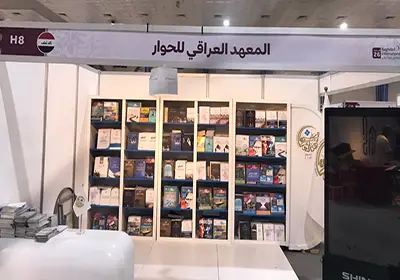
The Iraqi Institute for Dialogue, the logistical sponsor of the Baghdad International Book Fair, opens its own pavilion at the fair
Official agreement between Iraqi Institute for Dialogue and the Iraqi Media Network to sponsor The Seventh Annual International Conference of “Baghdad Dialogue” 2025
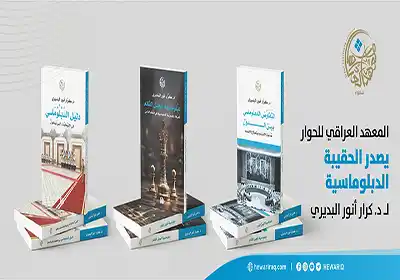
The Iraqi Institute for Dialogue publishes "The Diplomatic Portfolio" by Dr. Karrar Al-Badiri
Invitation to the 79th issue of Dialogue of Thought
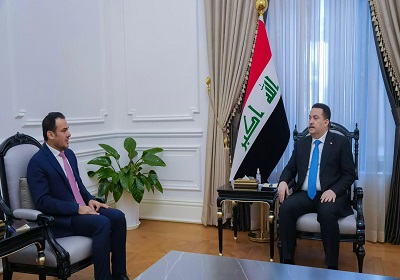
Prime Minister: The path of development will make Iraq a regional political and economic powerhouse
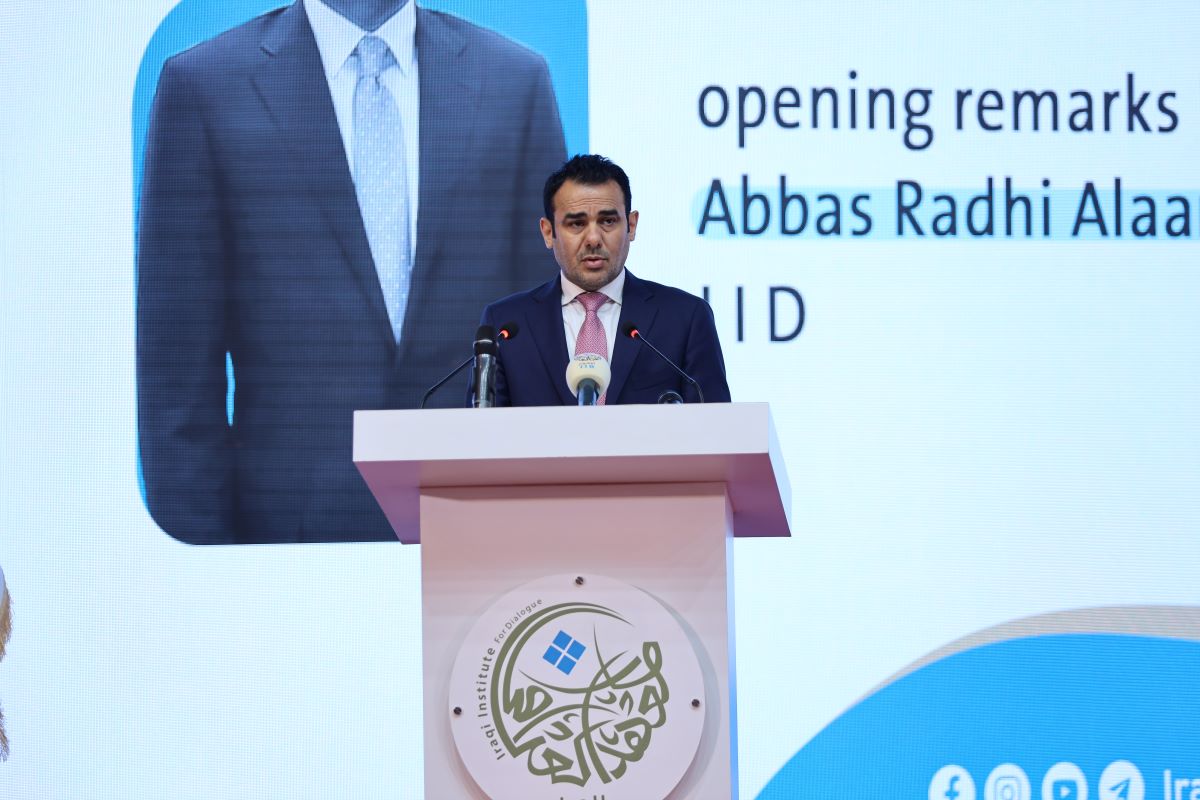
Speech of the Director of the Iraqi Institute for Dialog at the Sixth Baghdad International Dialog Conference
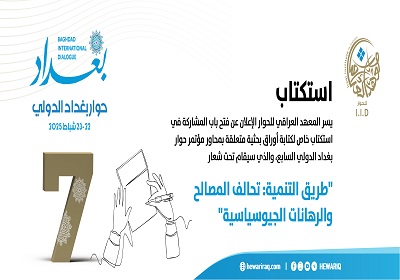
Seventh Baghdad International Dialogue Conference Call for Papers
Comments