

Iran's Strategy in Africa: Challenges and Capabilities
Iran has prioritized East Africa in its moves with the continent, focusing on the Horn of Africa; It sees a wide and fertile area for political, military and economic activities, especially in the countries bordering the Gulf of Aden, the Arabian Sea and the Red Sea. This is due to the geographical importance of the Bab al-Mandab area; This creates regional and international influence for Iran to control and affect the security and stability of the Straits of Hormuz and Bab al-Mandab together, and this comes within the framework of expanding the (geography of resistance) that enables it to manage conflicts and wars outside its geographical borders, a vision that intersects with the broader strategy (resistance government) developed by the Supreme Leader, Ayatollah Khamenei, with the Revolutionary Guards.
In the first two decades after the success of the Iranian revolution, Iran engaged in a large-scale war with Iraq for eight years, during which it faced regional restrictions sponsored by the United States of America, which made Africa not advance in its list of priorities, as its strategic calculations placed the Middle East region at the top of its priorities until its geographical security environment stabilized with the cessation of the war with Iraq. Iran worked to address the oppressed masses and reject Western influence in world politics, adopting its revolutionary model that it worked to export to Africa. Iran has been keen to focus its support for Muslim and marginalized communities to build a number of societal bases on which it can rely in implementing its strategy on the continent along the same lines as it does in the Middle East region by combining traditional tools of the state with non-traditional tools through religious and paramilitary groups.
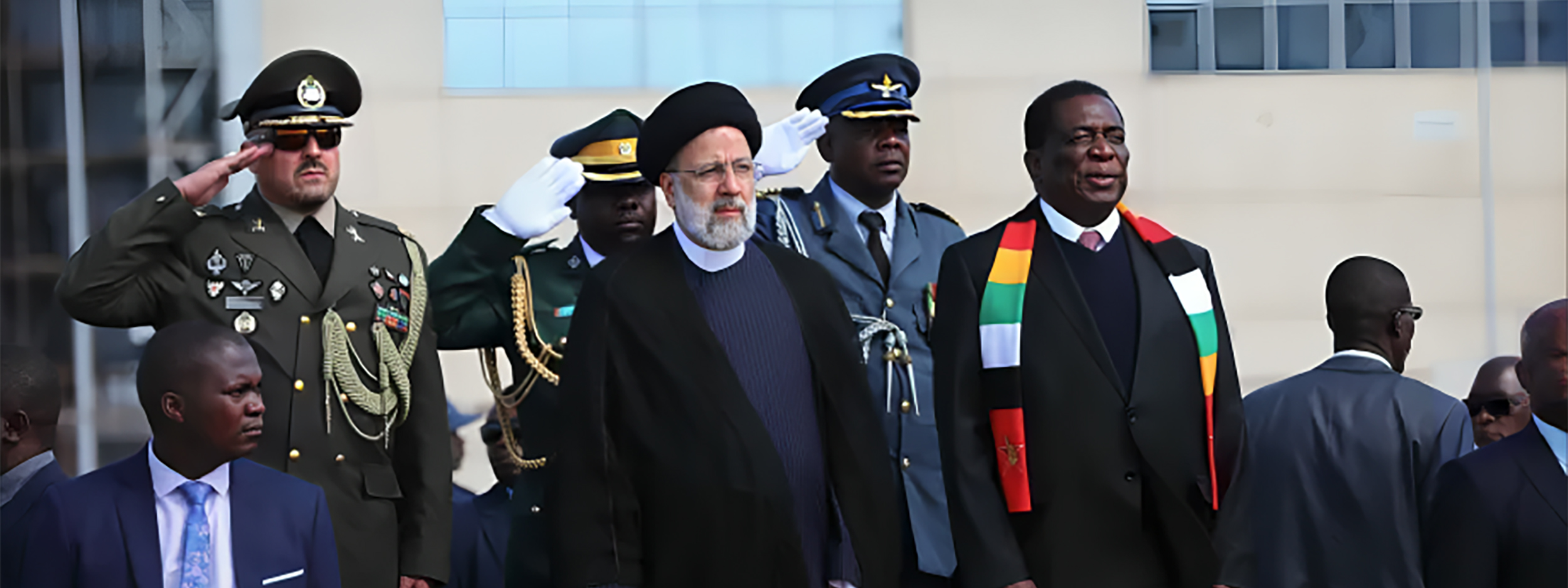
During his administration, Hassan Rouhani has not made a single visit to an African country out of 55 foreign visits in his eight years in office. However, the continent's presence in Iranian foreign policy re-emerged after the election of the current president, Ebrahim Raisi.2 Raisi has prioritized Africa in Iranian foreign policy, the first time an Iranian president has visited Africa in nearly a decade since Ahmadinejad was president. And there are nearly twenty embassies in Africa, despite the importance of Africa in compensating for its isolation in other places such as the European Union, for example, in 2008 it had about 17 embassies in Africa compared to 12 embassies of Turkey, leading Turkey by a margin of up to twice in 2022 with the number of embassies reaching 44 Turkish embassies compared to 22 Iranian embassies.
Iran's Rivals in Africa
The African continent is a great arena for international competition over its resources and strategic locations and is witnessing growing competition between China and the United States of America.4 We can find competition between China and Japan and between India, China and other countries on that continent and on it. And there is the rise of new players whose influence and presence began to appear effectively against the old players, especially here Turkey and Iran, as each has competitive advantages that distinguish it from the major powers. And when we talk about Iran, we can point out that its most important competitors in Africa are: Saudi Arabia and America in the first place, then Turkey in the second level.
(1) The United States of America and the European Union: The United States and a number of European countries led a diplomatic campaign and imposed economic sanctions on Iran after the success of its revolution, but it did not witness noticeable positive developments until after the conclusion of the nuclear agreement in 2015. And Tehran has strengthened engagement with Africa while seeking to build “strategic depth” across the continent to bolster Iranian influence. But it struggled again in 2018, after US President Donald Trump withdrew from the nuclear deal and reimposed sanctions on Iran.5 And this has led African leaders to deal selectively with Iran while securing stronger ties with other world powers that rival Iran on the continent. He also made Iran rearrange its priorities accordingly. Iran seeks to provide support to African countries that pursue a policy against the former colonial powers, especially those countries where France had high influence and where military coups had recently occurred, such as Burkina Faso.6.
(2) Saudi Arabia and some Arab countries: The rivalry between Saudi Arabia and Iran began to intensify after the Arab Spring revolutions since 2011, and it did not stop at the countries that witnessed revolutions, but extended to different regions in Africa.7 Both Iran and Saudi Arabia present themselves as leaders in the Middle East and the Islamic world, and the competition between them expanded to include Africa, and the rivalry and its reflection on African countries appeared clearly in 2016 against the backdrop of the crisis of storming the Saudi embassy in Tehran after the execution of Sheik Al-Nimr.8 Sudan and Djibouti severed their relationship with Tehran.9 This was due to the influence and pressure exerted by Saudi Arabia, as did Somalia.10 Somalia is also working to restrict the work of Iranian charities in Somalia after "fears of spreading Shiism.11
The escalating rivalry between Saudi Arabia and Iran in the Horn of Africa is being shaped in particular by the dynamics of regional politics in the Middle East over the past two decades. And yet, the strategic location of the Horn of Africa and its importance to the regional ambitions of both countries has made the region fundamentally attractive, especially to Sudan, Eritrea, Djibouti, and Somalia affected by the war in Yemen. In light of the dynamic changes in the political, economic and security contexts in the Middle East, which seem to have placed Iran as an active player in the Horn of Africa at present, yet cannot be described as sustainable12 as has happened with Sudan.
In 2018, Morocco severed its relationship with Iran after accusing Hezbollah of providing military and financial support to the Polisario Front, 13 which advocates independence for Western Sahara, 14 the second time that Morocco severed its relationship with Iran; It was severed in 2009 on charges of "Iran's intensification of the spread of Shia Islam in Morocco" and also because of a statement by an Iranian official questioning the sovereignty of Bahrain.15 In contrast, Iran has strong relations with Algeria that grew after the victory of the Islamic Revolution.16 This is evident in the Algerian-led mediation in 1981 to release the hostages in exchange for the unfreezing of Iranian assets and the lifting of sanctions.17
Relations with Egypt have not witnessed positive development since Egypt signed the Camp David Treaty with Israel and received the Shah after his escape from Iran, which lasted for about 40 years. The relationships experienced intermittent periods of rapprochement that did not lead to improved relationships. And recently, relations have witnessed positive and unstable developments between the two countries against the backdrop of the Battle of Al-Aqsa Flood and under the cover of the Saudi-Iranian rapprochement sponsored by China, in March 2023, 18 resulting in a decline in mediation of hostile policies between the two countries and their allies in the region.19
(3) Turkey is a historical and traditional rival, but in a new arena, the military and economic cooperation agreement between Turkey and Somalia has given Turkey “comprehensive authority” to protect the Somali coasts. And it opens the way for Turkish-Iranian competition in another geographical region, and the deployment of Turkish naval forces in the Gulf of Aden and the Arabian Sea may undermine the Iranian presence supporting the Houthi supporters group in Yemen, especially if Turkey, which is an extension of NATO, coordinates with a number of NATO members, engaged in operations against Houthi supporters after the Al-Aqsa Flood.20
Militarily, Turkey has one military base in Somalia, known as the TURKSOM Camp, which is a military base and a military college with a training and qualification program for Somali army soldiers, and it is the largest Turkish military base outside Turkey. This base is located in the capital, Mogadishu, and was opened in 2017. The Military College graduates about 1,500 soldiers annually, and the number of graduates reaches about 10,000 Somali soldiers.[21]
Economically, Turkey is investing about $3 billion in strategic infrastructure projects, the most important of which is a 400-kilometer central Japanese railway project linking northern, central and eastern Ethiopia with the port of Djibouti, which is worth about $1.7 billion.22
Turkey also has significant investments in Kenya, the most important of which is the $760 million industrial complex it is building.23 The signing of an oil exploration agreement between Turkey and Somalia on the coast of Somalia, which has approximately 200 billion cubic feet of proven natural gas reserves.24 Turkey will become a regional heavyweight in East Africa that will rival and constrain Iran's presence.
Iran's Strategic Priorities with Africa
Iran adopts two approaches to work to implement its vision with Africa: one in which it relies on the state and its official institutions, and another in which it relies on Shiite groups and paramilitary movements. The movements and priorities of Iranian state institutions and its strategy in Africa can be summarized in the following two axes:
Strengthening the security and military presence in the East of the continent with a focus on the Horn of Africa (strengthening the axis of resistance)
Iran's military presence in Africa is recent compared to international powers competing for its strategic resources and positions. And Iran is expanding its military presence in Africa through security and intelligence focus in the first place, by supporting the Houthi group in Yemen and the Palestinian resistance factions in Gaza, and the presence of Iranian tankers and ships, including military ships, began to appear in 2008, in the ports of Massawa and Assab in Eritrea and in Port Sudan in order to provide military shipments that help them meet their military and internal security needs and regional. And also to support the Palestinian resistance movements militarily by smuggling weapons to them other than providing support to the Houthi group in Yemen. The Iranian military base in Eritrea and its military activity are also equivalent to the Israeli military base in Eritrea.25.
And the United States faces challenges in assessing the effectiveness of its strikes against smuggling from Iran to Yemen. And although at least 18 interceptions have been conducted since 2013, in which shipments of machine-gun weapons and anti-tank missiles allegedly coming from Iran have been detected, the extent to which undiscovered materiel has passed through them remains unknown. This lack of intelligence makes it difficult for Washington to assess the impact of its recent strikes, especially in light of the additional smuggling operations taking place across the Horn of Africa.26.
And second is military support for countries that are fragile, especially those facing armed rebellions. A notable example of the military support provided by Iran to Ethiopia during the conflict in the Tigray region of northern Ethiopia in the summer of 2021 was the provision of drones to the Abiy Ahmed government, specifically "Mohajer 6" drones.[27] Ethiopia was not the only African country to receive drones, but also Sudan. With the decline in the Sudanese army's control on the ground in many Sudanese cities in the account of the rapid support, Iran has worked to exploit this decline by meeting the military needs of the Sudanese army, providing it with shipments of weapons and drones of the "Mohajer 6".28 Sudan's announcement to resume relations with Iran comes after 7 years of severing relations in April 2016 under former President Omar al-Bashir.
The flow of Iranian military equipment into Sudan can be seen as a competition for Western influence; The return of relations came with the continuation of the normalization with Israel that began in 2020, as well as in light of the Sudanese-Gulf rapprochement after decades of cooling. And this raises many questions and possibilities in light of the growing regional conflict between Iran's allies in the region against Israel and the US military presence in the region in the Red Sea, especially after the Houthi group targeted Israel and cargo ships heading to it through the Bab al-Mandab Strait. The return of relations also represents an opportunity for Iran to restore relations with African Union States after Saudi Arabia, Egypt, Sudan, Morocco and Nigeria pressured African Union States to sever ties with Iran.29.
However, this presence cannot be described as permanent or long-term as it is considered to fill a vacuum for the lack of regional support from Saudi Arabia and Egypt and may decline if countries agree to undermine this presence; And this is reflected in Sudan's refusal to establish a naval military base so as not to anger Saudi Arabia, Egypt, Israel and America in light of the internal challenges they face.[30]
Positioning in the Horn of Africa region is aimed at supporting the axis of resistance and its allies militarily and security, and focuses on providing support and building selective security and military partnerships, especially with countries that have geographical, maritime and strategic locations that can help them at the tactical and intelligence level against their regional competitors and enemies.
South Africa is a potential defense partner; Tehran has sought to leverage its long-standing relationship with South Africa to expand Iran’s naval presence beyond the Middle East, and Iran and South Africa have signed military cooperation agreements that would achieve a long-term strategic partnership.31
The second axis: economic relations are a priority for uranium and a new direction to remedy the shortcomings in its trade
Iran is actively expanding its trade relations with African countries and has made significant progress in recent years. Iranian exports to Africa reached $1.28 billion in 2021, compared to $579 million in 2020. This growth is especially noticeable in targeted areas such as technical and engineering services. Iran aims for a tenfold increase to $12 billion, starting with an initial target of $5 billion in two years. To this end, Iran signed 21 agreements in various sectors such as oil, energy, communications, information technology, agriculture and medicine during President Raisi's visit to Kenya, Uganda and Zimbabwe.32.
In March 2023, Iran organized the first-ever economic forum with ambassadors of West African countries in Tehran, with the aim of strengthening economic cooperation with them.33 Iranian Vice President Mohsen Rezai proposed the establishment of a joint bank with African countries with the aim of helping develop economic relations.34 And this is an indication of Iran's determination to exploit the French vacuum and take steps in the future to strengthen its relations with West African countries, as well as placing the recently overthrown military regimes among those that offer anti-French and anti-Western rhetoric and policies, such as the cooperation agreements it recently signed with Niger, in January 2024.[35]
The volume of Iranian exports with the African continent is the weakest compared to the volume of its exports with Europe and Asia. Between 2000 and 2021, Iran's total exports with Africa amounted to (33.9 billion dollars = 2.66% of Iran's total exports), compared to (1004.8 billion dollars with Asia = 80.8% of Iran's total exports), while it amounted to (200.73 billion dollars with Europe = 16.1% of Iran's total exports).36 These statistics reflect an important indicator of the strength of the economic blockade and sanctions imposed on it; Its trade with neighboring countries near its borders and within its territory is concentrated, and these figures represent a translation of Iran's priorities and the extent of its interest in Africa economically compared to the rest of the continents, as shown in the following figure:
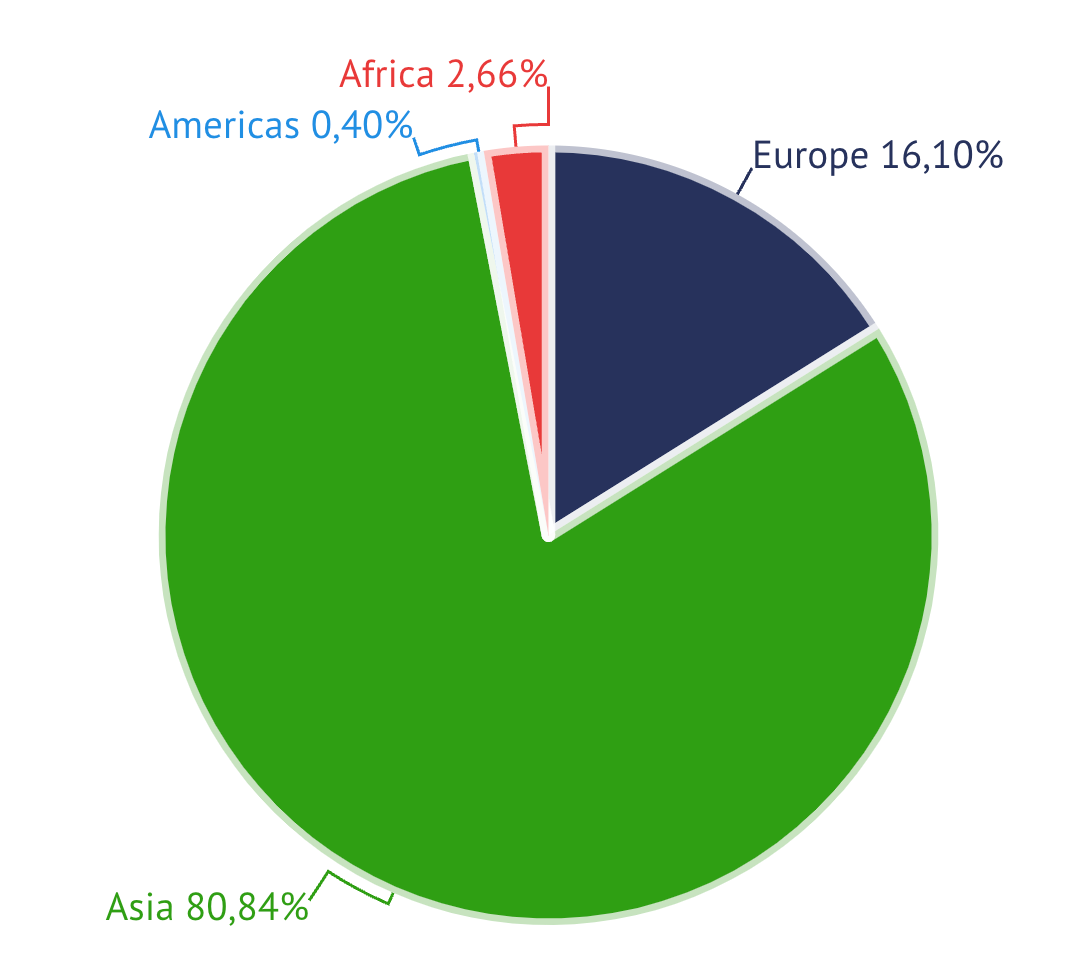
(1) The percentage of Iranian exports to the four continents of its total exports from (2000 - 2021)
And Iranian exports have witnessed a significant decline with Asia since 2018, which then amounted to $68.1 billion to reach $10.7 billion in 2020 and then $13.6 billion in 2021, and the volume of exports to China and Turkey together amounted to more than two-thirds (about 68.75%: Turkey [20.82%] and China [47.93%] for 2021) of the total exports to Asia. and 57.63% of its total global exports, equivalent to $9.32 billion, which indicates a great dependence on Iran's trade on them.
Therefore, Iran's determination to bring its total exports to the African continent to $5 billion within two years and $12 billion as a medium-term goal confirms its desire to open new markets and break its dependence on neighboring countries amid growing conflicts in the region. Figure 2 shows the value of Iranian exports with Asia from 2010-2021(37).
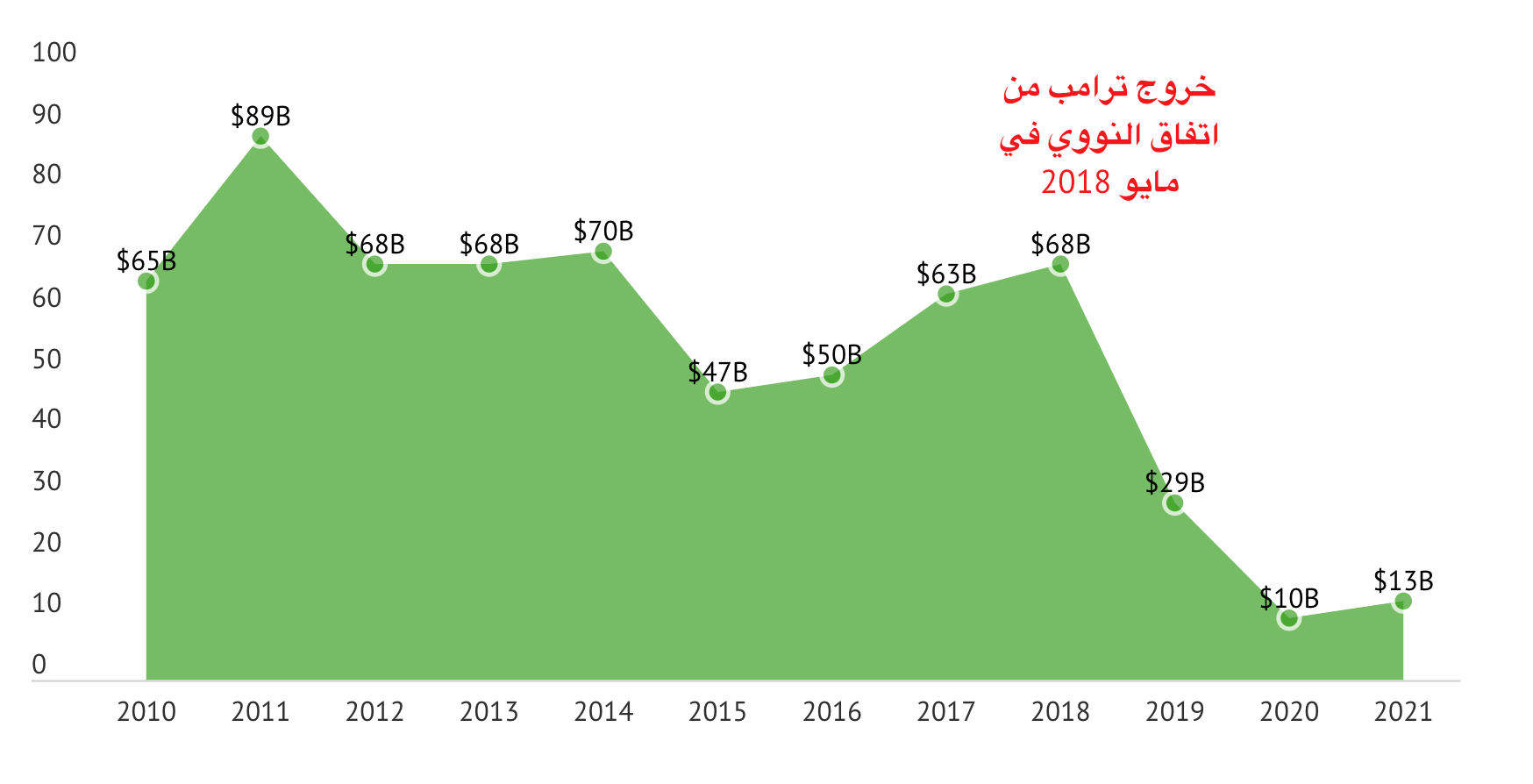
Shape (2) Value of Iranian Exports to Asia (2010-2021)
In addition, Iran faces logistical challenges in its trade with Africa due to the lack of sufficient direct sea freight lines, 38 as well as the lack of direct flights between Tehran and African capitals.39 And this is what drives Iranian traders to export to Africa through Oman or Turkey.
Given the surplus income from the sale of oil in Iran, the inflation caused by increased liquidity, the problem of unemployment, the need for raw materials and the market for the consumption of products, Iran has taken an interest in the unique characteristics of African countries.40 Despite a weak direct economic presence, Iran is focused on breaking the political and economic blockade imposed on its trade with Africa by:
(1) Using oil as a weapon against the blockade: Its oil exports with Burundi have also been used to expand its relations with other countries in Africa, including Cameroon, Chad and the Central African Republic, all of which have called for Iranian investments to develop their infrastructure.41.
(2) Putting uranium-producing countries at the top of their priorities: Iran places the African countries producing uranium at the top of its priorities in the economic file, especially countries facing Western economic sanctions in exchange for oil, such as Zimbabwe, where they allegedly exchanged uranium for oil since 2010, which has been evident in multiple statements between officials of the two countries.42 Iran has also tried to obtain phosphate from major producers along the coast of North and West Africa from Togo to Egypt, a substance that helps in uranium enrichment.43 Iran announced its discovery of huge quantities of uranium in September 2015, several months after the signing of the Lausanne nuclear agreement.44 This could cause them to reprioritize and invest in other avenues of cooperation.
(3) Entry into Africa with strategic investments: by expanding its economic cooperation with the Sahel countries, such as its pledge to build a new oil refinery in Burkina Faso;45; It is thus trying to fill the vacuum of France's retreat in the region.
Iran's economic strategy with the continent can be summarized as serving its immediate development interests such as producing nuclear energy, and then expanding its trade with countries facing economic sanctions as a second priority. And it is working with a methodology aimed at breaking the Western economic blockade in partnership with African countries facing a similar fate.
The Unconventional Tools of Iranian Influence in Africa
First: African Shiite groups
Former President Ahmadinejad's Africa policy was based on strengthening religious relations with Shia Muslim communities, investing in building ties with the countries of the South, and employing common anti-Western sentiments. Iran has worked to encourage Muslims across the continent to Shia. During this period, Iran strengthened its relations with West African countries and opened Shiite cultural and educational centers in countries such as Ivory Coast, Liberia, and Cameroon. It has also invested in infrastructure, building hospitals, setting up businesses and providing loans as part of its policy. Soft-power strategies have worked – and the payoff has been political; All West African countries supported Iran in the United Nations vote on the human rights situation in Iran in 2009.46.
Iran's revolutionary methodology in Africa has been an attraction for young people in the face of colonial powers in Africa, but it has also been met with resentment by a number of African countries and political systems.47 Iran is working to spread Shi'ism in Africa through its official and civil institutions, one example being the Islamic Culture and Communication Organization (Persian: Sazman Farhang and Islamic Links), which has a major role in spreading Shi'ism around the world and is an organization of the Ministry of Culture and Islamic Guidance in Iran and operates in five African countries (Nigeria, Ghana, South Africa, Uganda, and Kenya).48 Various ministries, institutions, and universities are involved in implementing these policies, and it is part of Iran's broader strategy to increase its influence in Africa through cultural, academic, and religious networks.
The exact number of Shiites in Africa cannot be known. There are no accurate reliable statistics, and their number is estimated at about 12% of the population of Muslims in Nigeria, 20% of the population of Muslims in Tanzania, 9% of Muslims in Liberia, 7% of Muslims in Uganda, and 3% of Muslims in Cameroon, according to a survey conducted by the American Peruvian Center in 2012.49 Nigeria is the most populous African country in terms of the number of Shiite Muslims, with an estimated population of 6.5 million, which is estimated at 3% of the total population.50
Shia groups in Nigeria are an effective model
One of the most important Shiite models active in Africa is the Shiites of Nigeria, Nigeria has witnessed violent unrest with the rise of the (Foundation of the Shiite Islamic Movement in Nigeria (IMN)) led by its founder, Ibrahim Yacoub Zakzaky. Al-Zakzaky first came out publicly in 1995.51 Some describe the movement as similar to the Lebanese Hezbollah, and Iran has allocated a lot of money to Africa in the field of building mosques, establishing schools, and providing scholarships to study in Iran, which opened the way for it to spread Shiism among Muslims there as there was no spread of Shiism in Nigeria before the Iranian Revolution of 1979. Shiites were able to attract members of the Muslim Students Association of Nigeria (MSSN) in the late seventies and early eighties before the Iranian Revolution, and the intellectual base of MSSN students was the Egyptian Muslim Brotherhood. Which led them to rally around Zakzaky to emulate what Khomeini did in 1979 as Nigeria was in the grip of successive dictatorships and military regimes: General Buhari (1983-1986), General Ibrahim Badamasi Babangida (1986-1993), and General Sani Abacha (1993-1998).52
"The Shia movement has remained largely out of reach of Nigeria's security services to counter Boko Haram and Sunni groups opposed to the government's security and economic policies, and in 2015, a massacre in Zaria in December killed some 300 people." The massacre coincided with a number of international events, the first of which was the signing of the Iran nuclear deal, and the assumption of power by the Nigerian President, Muhammadu Buhari, who has close ties to Saudi Arabia; The Iranian-Saudi rivalry in Nigeria was reversed and Zakzaky was subsequently arrested as a result. The Nigerian government has accused the organization of attempting to assassinate the Chief of Staff of the Nigerian Army, Tukur Yusuf Portai, so that the Nigerian Army would enter into bloody confrontations with the organization, which was later designated a “terrorist” group.53.
And before those events, the Nigerian security services, in 2010, uncovered an Iranian weapons ship in the port of Abuja. Subsequent investigations revealed that members of the IRGC were responsible for the arms shipment, which was aimed at arming jihadist groups in northern Nigeria, rebel separatist movements in southern Senegal in Casamance province, and against the regime of Yahya Jammeh in Gambia; In 2011, the two countries broke off diplomatic relations with Iran.54.
Shia groups in Nigeria are facing a crisis of recognition among a number of Sunni Muslim groups and their elites located in northern Nigeria; They don't consider the Shiites to be Muslims. Hezbollah has also been accused of training Nigerian Shiites to expand their influence in West Africa. These increased Shia and military efforts by Hezbollah towards Nigerians have raised concerns about the potential for sectarian conflict in the region.55 Non-African Shia groups, including Lebanese, Iraqis, Indians and Pakistanis, have also played a role in supporting Iranian influence in Africa. Shia communities facilitated Iran's contacts and activities in Africa through various means, including religious ties, cultural exchanges, and the opening of space for building political alliances with governments and ruling elites.
Paramilitary Movements: Hezbollah as a Model
Hezbollah has established networks in Africa, particularly in countries such as Nigeria, Kenya, and the Central African region, and these networks are part of a broader geospatial matrix that overlaps with Iranian influence in African space. Iranian arms smuggling is centered around the Horn of Africa and West Africa; This expands Hezbollah’s influence and activities in Africa. Hezbollah's infrastructure in Africa began to appear in the Lebanese diaspora communities in West Africa in the late 19th and early 20th centuries, and the party relies on Lebanese communities that came to West Africa and built businesses, factories, and banks, especially Lebanese Shiites.56 Their business activities are concentrated in Sierra Leone, Gambia, the Democratic Republic of the Congo, Gabon, and Ivory Coast. For example, Qassem Hajij, the leader of the Lebanese community in Gabon, who was placed on the U.S. Treasury sanctions list in 2015, is the owner of the Middle East and Africa Bank (MEAB), a major supporter of Hezbollah's Enmaa Group. The Tajuddin family also has a concession granted by the DRC government in 2012 of about 250,000 hectares for five years and is also one of the companies listed by America, and the businessmen' activities focus on diamond trading, government contracts and trade with South America.57 These networks play an important role in sustaining Hezbollah's activities.
And it is creating new fronts to counter Western and Israeli influence away from the Middle East, earning cards capable of threatening Western interests in difficult geographical areas if America and Israel expand their targeting of Iran or Hezbollah. And the Ethiopian intelligence agency had previously uncovered a 16-person cell that it said was monitoring the UAE embassy in Ethiopia and hiding weapons and explosives. U.S. and Israeli officials accused Iran of tasking the cell members with collecting intelligence on the U.S. and Israeli embassies, as part of a broader campaign to search for soft targets in African countries, in response to strikes carried out by America and Israel against its officers in Syria and Iraq.58
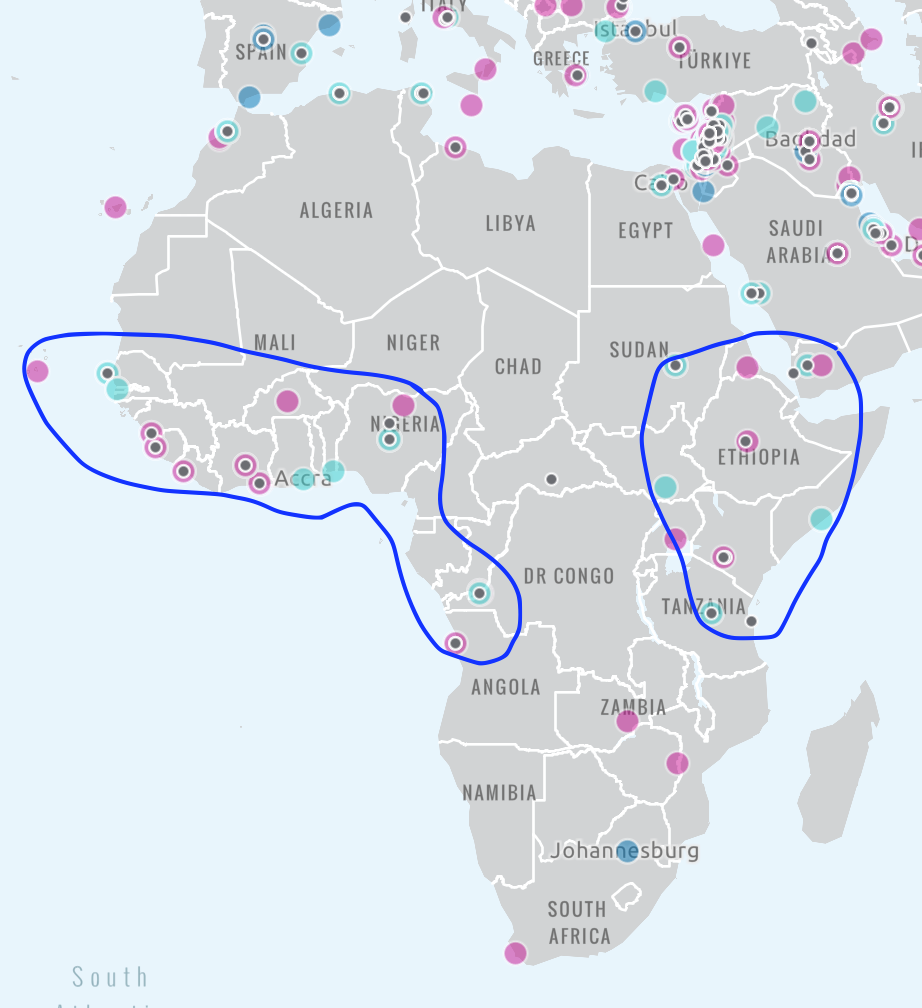
The following map shows the most exposed geographical locations of Hezbollah's activities in Africa from 1982 to 2024, and shows the Horn of Africa and West Africa in blue as the areas where the party has the most activities.59
Conclusion: Geographical dimensions and Iran's movements in the African continent
Iran has succeeded in its actions through its unconventional instruments of influence while facing shortcomings and challenges in dealing directly through its formal institutions. By analyzing Iran's policies with a comprehensive view of all areas with the African continent, we find its weight and military and security influence strong in East Africa, specifically in the Horn of Africa, to consider the conflicts involved in it in the Middle East. And it uses its naval weapon and security and intelligence deployment to increase and strengthen its positions to use them in broader maneuvers commensurate with the size of the threats it faces from America, Israel and its competitors. This positioning also contributes to enabling it to provide military, security and intelligence support to its allies along the coasts of the Indian Ocean, the Arabian Sea, the Gulf of Aden and the Red Sea. They are found in Tanzania, Sudan, Eritrea, Tanzania and Kenya in various forms. This diffusion makes the collision equation with it multi-frontal and creates a horror balance with its enemies.
Iran faces major challenges in the sustainability of its policies against its regional and international competitors, especially the United States, Saudi Arabia and Turkey, especially in the Horn of Africa and the Gulf of Aden, but it is working diligently to monitor and exploit opportunities to return to every site it loses, as it did in Sudan.
"In West Africa, it has been able to tap into the reach of Shia groups and communities that began their Shia business and advocacy activities over the past decades." In particular (Nigeria, Senegal, Ivory Coast, Cameroon, Gabon, Ghana). And this has given them influence and influence in their region. Relations with the Sahel countries are likely to develop against the backdrop of a shrinking French military presence. And it may take a similar approach to Russia’s approach in the Sahel. The difference here is that Iran is working to create a social depth that ensures the continuity and sustainability of its influence, while Russia tends to rely on providing military support and security services by selling military equipment or deploying Wagner groups in exchange for strengthening its influence against the West and obtaining gold and raw materials, such as the agreement that Russia recently signed with Mali.60 Russia and Iran are likely to enter into security coordination to maximize their presence against their competitors.
In North Africa, Iran has different policies than other regions, and has strong ties with Algeria dating back to the victory of its revolution. And perhaps the strength of relations with Algeria made it adopt cautious policies in North Africa, specifically with Algeria and Tunisia. In general, Iran has a strong presence in six major countries in different geographical locations: in the south with the state of South Africa, in the north with Algeria, in the east with Sudan, Kenya and Eritrea, and in the west with Nigeria and Senegal.
Shadi Ibrahim is a researcher at the Sega Center at Sabahattin Zaim University.
The Iraqi Institute for Dialogue, the logistical sponsor of the Baghdad International Book Fair, opens its own pavilion at the fair
The Iraqi Institute for Dialogue publishes "The Diplomatic Portfolio" by Dr. Karrar Al-Badiri
Official agreement between Iraqi Institute for Dialogue and the Iraqi Media Network to sponsor The Seventh Annual International Conference of “Baghdad Dialogue” 2025
Invitation to the 79th issue of Dialogue of Thought
Prime Minister: The path of development will make Iraq a regional political and economic powerhouse
Seventh Baghdad International Dialogue Conference Call for Papers
Praise for the Baghdad International Dialogue: Strengthening Iraq's pivotal role and a meeting point for visions
Comments