

The Road to Development: The Rugged Trail from the Gulf to Europe
The route from the Iraqi port of Al-Faw to the port of Mersin in Turkey attracted several forces that considered it a profitable opportunity, making them engage in the networks linking two centers of global wealth, Asia and Europe, and some of them use them to avoid exclusion from other networks that seek the same goal, while some other participating forces, such as the Gulf countries, exploit the opportunities available to diversify their options, and do not mortgage themselves to one network without another.1 The sponsors of this project may have called it the road of development, to give it an economic feature, and remove political caveats, in order to reduce the expected resistance from those who reject the project.
This project also combines several forces, it excludes other forces, or they may see it as harmful to them or a competitor to them, and may seek to hinder it, and to thwart it, for example, Iran does not participate in it, and it enjoys great influence in Iraq, as well as there is the Kurdistan Workers Party, which may strike the project to retaliate against Turkey, and Kuwait may also be wary of the project, because linking it to the port of Al-Faw, may reduce the attractiveness of the port of Mubarak Al-Kabir, which Kuwait is betting on to be an economic crane, so navigation traffic heads instead to the Iraqi port of Al-Faw.
In addition, there are other competing lines, such as the line linking India and Haifa and passing through the UAE and Saudi Arabia, the new Chinese Silk Road passing through the Iranian port of Chabahar, and the road linking India and the port of Bandar Abbas in Iran and heading to Russia through several Central Asian countries. Each of these lines disputes the other, reduces the likelihood of financial and political returns, some may not be complete, and some may fail after completion because of the intensity of competition.
Expected gains
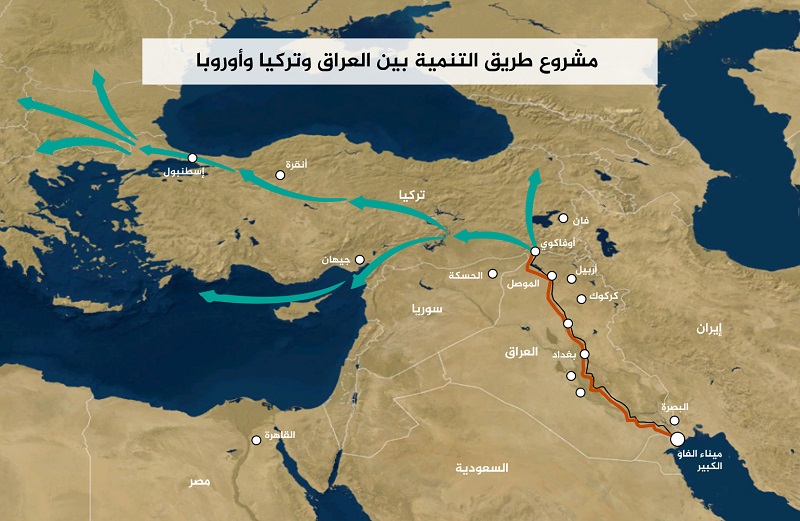
The idea of the project dates back to the eighties of the last century, and Iraq was the promoter of it, but it did not see the light, due to many circumstances, including the Iraq-Iran war and then international sanctions on Iraq, but the forces motivating it in the first place are Turkey, and the first project was called the "dry canal", and it is meant that this land road linking the port of Iraq and the Turkish port of Mersin, similar to the sea canal, but without water, but it is a land channel, transporting goods and people.
One indication of Turkey's desire to complete the project is the visit of Turkish President Recep Tayyip Erdogan to Iraq in April 2024, accompanied by a large delegation, and the two countries signed 24 memoranda of understanding, which varied between energy, trade and water management, all of which serve to provide the conditions for the success of the development road project.
Turkey's calculations vary in the keenness to complete this project, as it aspires to be a central node for several networks linking Asia and Europe, such as linking a number of Central Asian countries and Europe, or linking several oil and gas producing countries and Europe, and seeking to be also a node in the Eastern Mediterranean energy network that Greece and some countries have tried to exclude from it. Turkey calculates that turning it into a node in these networks gives it several economic and geopolitical advantages, such as permanent access to energy at preferential prices, but rather control over European countries' access to their needs. Because Turkey can respond to hostile attitudes or punitive measures with countermeasures, such as stopping the pumping of energy passing through its territory, countries associated with that network will be warned against harming Turkish interests. Also, this network allows Turkey to export its products to the markets of the associated countries; Because it will be required for reasons that may be political, such as this country's desire to strengthen its relationship with Turkey, in order to ensure the continuous flow of vital resources it needs, or even benefit from Turkish contracts in exporting its products.
Within this general orientation, Turkey may plan to use this project to tighten Iraq to it for many purposes, on the one hand, it needs Iraq's support in besieging the Kurdistan Workers' Party, which jumps between the Turkish regions and Iraqi Kurdistan, but the Iraqi regions use safe havens from pursuing Turkish forces, but because this project links the interests of the two countries, the Iraqi government will be keen to tighten the noose on the Kurdistan Workers' Party, preventing it from retreating to its territory, in light of the confinement of the mountainous regions of Turkey. And Turkey would also like to link Iraq to it in order to feed its energy needs, and may even be linked to the energy network that it weaves, so Turkey hits two birds with a stone, which is to secure part of its energy needs and hold the handle of an important pump of energy pumps in the region. There are also two major geopolitical objectives: breaking the wall that Iran surrounds in southern Turkey and stretches from Iran to the Mediterranean. because it connects them to the Arab Gulf states, and then to the Asian countries. Turkey's narrowing of the eastern Mediterranean from Western countries is pushing it to develop maritime alternatives to access the emerging Asia region, and the best alternative is the road linking Basra; Because it is shorter, Turkey and the Gulf Sea are separated by only one country, Iraq.
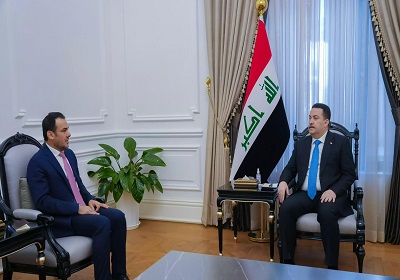
Iraq participates in the development road project with other accounts, as it is looking primarily to invest in projects that generate revenues that reduce its dependence on energy revenues of 93%, and then also aims behind this project to diversify its regional partnerships so as not to remain locked in the relationship with Iran, and this was the trend of the Prime Minister, Mohammed Shiaa Al-Sudani, and Turkey is the optimal regional power for this, with its economic weight, and geographical location makes it the node of connection between Europe, Central Asia and Russia, and the crossroads of a number of economic networks, and with its historical, cultural and security ties with Iraq.
Iraq's involvement in this project may seem incompatible with its close association with Iran, but Iran's Iraqi allies have not publicly criticized the project, and one reason may be that Iran is engaged in a project with India that extends to Russia, the North-South International Transport Corridor (NSTC) project, to which Iraq has not been included; Pro-Iranian forces cannot criticize the Iraqi leadership if their national interests dictate that they join the development road project that does not include Iran.
The UAE's geopolitical calculations have also multiplied, as its participation in this project is a hedge against the possibility of clogging the paths of the Strait of Hormuz in the event of an armed clash around it, as well as a hedge against clogging the only land route linking it with Saudi Arabia, as Qatar signed in 2017, and it needs this land corridor to remain in contact with the outside world. The UAE is also looking to diversify its economic partnerships to reduce its dependence on oil revenues and raise its revenues from sustainable economic projects. It is also keen to join the competing projects in order to remain in contact with various regional and international powers, and not to confine itself with one power over another, as it is a major party in the line linking India and the Israeli port of Haifa, a partner in the Eastern Mediterranean project, and with the new Chinese Silk Road. The UAE is also keen to focus its investment on ports, as it has expressed its desire to prepare the port of Al Faw, to be another link in the sprawling network of ports overseen by the UAE.
Qatar participates in the project with several accounts, it is also wary of the possibility of clogging the Strait of Hormuz, and clogging the only land line passing through Saudi Arabia, as happened in 2017, and is also looking to diversify its revenues from economic projects to reduce its dependence on energy revenues, but there are also other accounts: Qatar is keen on close association with its regional ally, Turkey, in order to cooperate economically and security, and to secure a permanent land line that provides it with supplies and needs in times of distress, as happened in 2017, when Turkey hurried to provide Qatar with its vital needs through a land line that passes through Iran, but the Basra line will be shorter and expand Qatar's options. This overland route could also be important in the high security situation if Turkey is forced to send troops into the region to support the Qatari ally. Qatar's security will also be enhanced if Iraq recovers economically and becomes more cohesive and independent in its decision-making; This balance has been witnessed in this region during the eighties of the last century, since the four powers, Iran, Iraq, Turkey and Saudi Arabia, take into account the balance among themselves, and some of them do not risk extending their control because it disturbs the balance, so the rest of the powers move to restrain it again.
Saudi Arabia is monitoring the project with caution. It participated in conferences on the subject, but did not announce its involvement. The Saudi caution may be to balance the project's gains against its chances of completion with other projects in which Saudi Arabia is involved, such as the Indo-Middle East-Europe Economic Corridor (IMEMEC).4.
Saudi Arabia may find the development road project useful; Because it avoids the risks of passing through the Strait of Hormuz if relations with Iran are strained, and it diversifies its access to Europe through Turkey, and may provide it with an additional entrance to Iraq in order to attract it away from Iran, but it may warn of the obstacles that stand in the way of the project, and it may be afraid of facilitating Turkey's access to the Gulf region, and it may fear losing its investments in the project from the troubled security conditions in Iraq and southern Turkey, and it may focus its attention on the India-Middle East-Europe project because it is sponsored by the United States, which is likely to achieve it and its returns will rise.
Visible and Invisible Costs
The project extends from the port of Al-Faw in Basra in Iraq to the Turkish border, at a distance of 1200 km, and consists of road and rail roads, at a cost of about $17 billion, and is completed in three stages, 2028, 2033, and 2050, and the first phase is supposed to end by 2028.
As usual, the UAE has expressed a desire to equip the port of Al-Faw, to be a new link in the network of ports under its supervision, in addition to investment, as Qatar is doing in the field of Iraqi energy and basic infrastructure. Iraq signed a contract with Daewoo Engineering and Construction Company from South Korea to help complete the first phase of the project. Turkey is also participating in the work of the base structure and contributing to the completion of the section on its borders.
The project has competitive advantages over the rest of the competing projects, for example, it will reduce the period of transport between Asia and Europe to 15 days compared to about 33 days through the Red Sea, which is about the same duration of transport through the corridor linking India and Haifa to Europe, and avoids potential bottlenecks such as the Strait of Hormuz and Bab al-Mandab, and troubled areas such as the Red Sea, which is witnessing many conflicts, and the capacity of freight trains is growing from 3.5 million containers at the beginning of the project's work to about 40 million tons of goods in 2050. All of this, Iraq is looking forward to the project employing 100,000 workers, and generating $4 billion in revenues annually.
The cost and duration of the project seems consistent with the average completion of similar projects, which are about $3 billion for the road, and $4 billion for the railways, in addition to an additional budget estimated at about $10 billion for various aspects, such as preparing ports and building bridges, and other surprises that do not occur to planners and implementers before embarking on the actual completion. The time allocated for the completion of the project is also consistent with the rate of similar projects, which is between 10 and 20 years, and the development road project has been allocated about seven additional years, in anticipation of uncalculated symptoms, but it is not an unusual extension; Because studies specializing in such projects have concluded that turbulent and dangerous conditions may prolong the estimated duration of completion by about 25% to 50%, which is a quarter or half of the previously estimated duration.
"However, there are several caveats: intra-state conflict between several actors, jostling for the largest share of the pie, may increase the bill, and even the scramble between the various forces may lead to the project's failure to complete, increasing its cost the longer it is completed." "Iraq, the project's main hub, was ranked 154th out of 180 countries on the corruption index, in the category of most corrupt countries such as Somalia, South Sudan and Venezuela." The project may also face sudden developments during these long years of its completion, as there may be security disruptions that hinder it, and changes may occur within partner countries, such as Iraq, so priorities change, or interest blocs change, so that they reconsider participation in the project. And with each increase in project costs, the percentage of profits from the estimated return of about $4 billion will decrease, because the deductible share to cover costs will increase.6
These caveats are not theoretical specifics, but as mentioned, Iraq has previously planned to complete this project, but the major opposition has decided to postpone it, and there are several external and internal forces that may move individually or collectively to thwart it in order to maintain or enhance its influence.
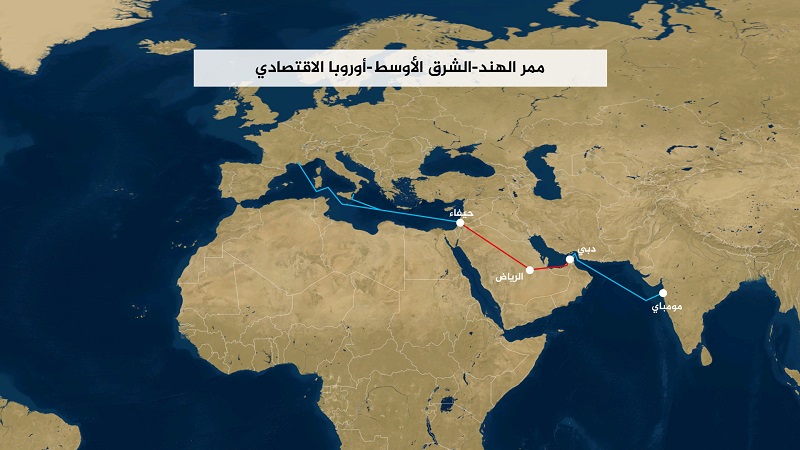
Disgruntled Forces
The project does not involve several neighboring countries and may be seen as a competitor to their own projects. Kuwait is counting on the port of Mubarak Al Kabeer to be a strategic investment that makes it necessary in maritime transport networks, and generates a growing income, starting from managing 1.8 million containers in the first phase, and then rising during the remaining stages. But these estimates may be deducted from the port of Al-Faw associated with the development road project, taking a share from the port of Mubarak Al-Kabeer, and this competition may raise the degree of tension between the neighbors, Kuwait and Iraq, and it may be fueled by reviving differences over the maritime borders between the two countries, and they may rise to the surface of relations, as happened in 2023 when the Iraqi Federal Court issued a decision to cancel the maritime navigation agreement in Khor Abdullah, which is located between the two countries and leads to the Iraqi port of Umm Qasr, and the development road project may suffer from stumbling, or the cost of its use may rise.
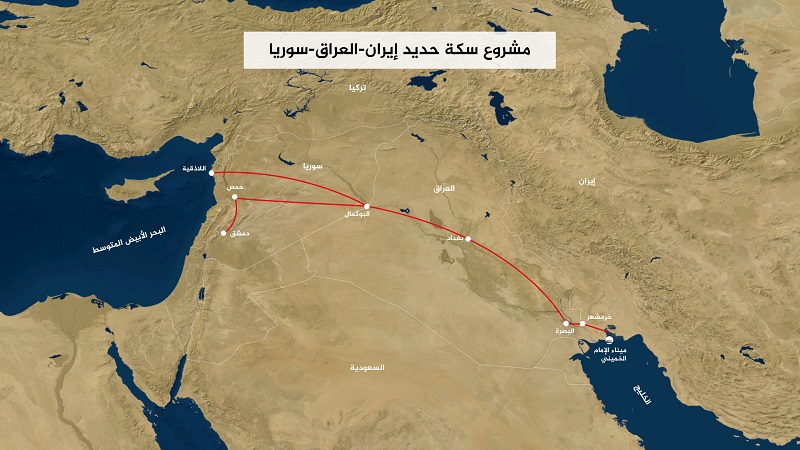
Iran fears this project because it contradicts its plans to be the link between Asia and Europe, but starting from the port of Imam Khomeini to Khorramshahr inside Iran, then extending to Basra, then Baghdad, then Albu Kamal on the Iraqi-Syrian border, then branching into two tongues, one extending north to the port of Latakia and the other south to Homs and then turning further south to Damascus.7.
It is as if the Iranian project is heading horizontally while the development road project is heading vertically, and between the two projects, Basra is disputed because it is a central node in the two projects. If it is linked to the Iranian project, there is no longer a need to link to the port of Faw, the distance between the port of Imam Khomeini and the port of Faw is very short. Because it embraced strong civilizations from the time of the Assyrians, and then because these areas are easy to move around because they are almost free of natural barriers, and then because the western Iranian regions are rich in wealth and linked to trade routes towards Central Asia and South Asia, unlike the eastern side of Iran, which is protected by natural barriers such as the desert and mountains, and there are no strong and expansionist cultural centers nearby. These calculations may make Iran desperate to make its project a success and thwart projects that violate it.
This project also weakens Iran's position in the New Silk Road project, or the Chinese Belt and Road project, which makes the Iranian port of Chabahar an important node in its network, and the two countries may join efforts to ensure profitable returns for Chinese investments in Iran directed to the Silk Road project, estimated at $400 billion, distributed over 25 years, in baseload energy structures such as gas fields, pipelines and refineries, in transport projects such as highways, railways and ports, and in communications technology to establish baseloads for digital interconnection within the Digital Silk Road project. The two countries share these investments because they believe that their revenues cover their costs and generate profits for them, and they will not tolerate competing projects that cause them huge losses, and Iran will be more keen on the success of this company; because it needs Chinese investment and engagement with the international economy to break America's and Western countries' isolation.
The Iraqi Kurdistan government expressed its indignation at the project because it avoids its territory, and passes through Nineveh, and saw in this a deliberate political weakening of the region so that it remains subordinate to the Iraqi central government, and does not have the capabilities to disarm again towards independence, and may be in his opinion Turkish estimates that fear the growing power of Iraqi Kurdistan that may make it drift again towards independence, forming a precedent that may inspire Turkey's Kurds to move on its track.
The PKK considers this project dangerous because it brings the Iraqi and Turkish leaderships closer, and cooperation between them will undoubtedly be at its expense, as the Iraqi government is lenient with the pursuit of the PKK militants by Turkish forces inside its territory, and may even cooperate in harassing them to prevent them from using its territory as launching bases to strike Turkish forces or withdrawal centers to shelter from Turkish military campaigns. The PKK may use its presence in the western side of Nineveh province that the project is passing through to be an imminent and ongoing threat to the project.
The Syrian Democratic Forces are also present in the Kurdish areas in Syria, and they are in a state of hostility with Turkey, and they have American sponsorship that represents a barrier that protects them from the Turkish invasion, but the situation is turbulent, and if a change occurs, such as the withdrawal of American forces, Turkey may decide to invade these areas militarily to establish an unhostile regime south of its borders, and these forces respond by targeting the development road to drain Turkish capabilities, and even the two Kurdish factions, the Workers' Party and the Syrian forces, may cooperate to attack the project from its eastern and western sides, stopping it or raising the cost of using it.
Collaborating amid the stampede
The United States sponsors the project linking India and Haifa with Israel, and China sponsors the Silk Road passing through Iran, and it also faces a very turbulent regional environment, as the armed Kurdish groups surround the project on its two sides, and the al-Qaeda group or the Islamic State group may also flourish, and the Popular Mobilization factions linked to Iran are active in Iraq, and the completion of the project is based on political leaders in Iraq who may change their priorities according to the change of their bases, it is not clear whether this project is the consensus of the Iraqi political forces or a project for the current Iraqi Prime Minister, Mohammed al-Sudani, and may falter or freeze with his departure and the change of the ruling political forces or political consensus.
The project is also characterized by an asymmetrical situation that may increase the challenges it faces, as the cost of the disturbances that may shake it may be minor, but their effects on it will be enormous, and hypothetical examples are many, if armed groups decide to bomb the project's facilities, it will not cost them much, but it may stop the project, which cost billions of dollars to complete one of its stages, or this attack may stop the use of this road in the event that the attack occurs after the completion of the project and the start of its use, so companies and countries avoid using this road, or the attack may raise the cost of its use because insurance companies raise their prices with high risks, and thus the companies and countries that take it.
It is also sponsored by the United States to block the Chinese Silk Road project, to strengthen Iraq and link it to a network of exchanges away from Iran, and the American contribution may be to prevent the armed Kurdish factions from exposure to the project.
The project remains attractive to the Gulf countries located north of the Strait of Hormuz because they will continue to fear the risk of clogging this strait, and look for alternative outlets, and their national security may require them to reduce their dependence on Iranian ports, and they are looking for other alternatives, the best of which is currently the path of development. As for the potential harm to Kuwait, the parties may agree on a partnership that brings benefits to the Iraqi and Kuwaiti ports. The project will be a factor to absorb the underlying tensions between the two neighbors, and may help enhance confidence between them, making Kuwait a major contributor to the success of the project and the development of Iraq.
Al-Hawas, a researcher at the Al-Jazeera Center for Studies.
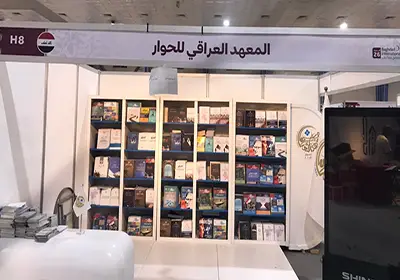
The Iraqi Institute for Dialogue, the logistical sponsor of the Baghdad International Book Fair, opens its own pavilion at the fair
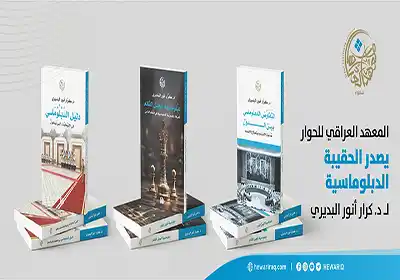
The Iraqi Institute for Dialogue publishes "The Diplomatic Portfolio" by Dr. Karrar Al-Badiri
Official agreement between Iraqi Institute for Dialogue and the Iraqi Media Network to sponsor The Seventh Annual International Conference of “Baghdad Dialogue” 2025
Invitation to the 79th issue of Dialogue of Thought
Prime Minister: The path of development will make Iraq a regional political and economic powerhouse
Seventh Baghdad International Dialogue Conference Call for Papers
Praise for the Baghdad International Dialogue: Strengthening Iraq's pivotal role and a meeting point for visions
Comments