



By Professor Alexander Dugin
The Second Front of the World War opened
There is a real war in the Middle East. After an attack on Israel using crude weapons, the latter launched massive rocket attacks and heavy aerial bombardment that covered southern Lebanon. And it seems that Israel has decided to go from being a victim to becoming an executioner, as it has followed the extermination campaign against the people of Gaza with a similar campaign against the people of Lebanon.
This could lead to the potential involvement of other Shia states and groups in the conflict, including Syria, Iraq, Yemen's Zaidi community, and most importantly, Iran.
And at a future stage, Sunni states may also be involved in this conflict. It is clear that Israel is seeking war — a big, merciless, brutal, and epic war. And such a conflict will not remain local. "Escalation is looming, and the possibility of using nuclear weapons is not ruled out, given Israel's possession and the possibility that Iran may acquire them." And while such use will likely be limited to tactical nuclear weapons or “dirty” bombs, which do not lead to global destruction, their repercussions for the region will be catastrophic.
"The Lebanese war can be explained in several ways, but there are two main explanations:
The first explanation: Akhrawi
It is necessary to understand what the State of Israel is seeking. Netanyahu's extreme extremism can be seen as a psychological reaction to Hamas's attack on Israel and the hostage crisis. Israel did not find a better response, and the response escalated to the point of genocide. I condemn the actions of Hamas globally, while the genocide committed by Israel against the people of Gaza has been condemned by all but the collective West and its orbit. These double standards are likely to apply to Lebanon as well. The West is protecting Israel, just as it is doing with Zelensky's Nazi junta in Ukraine. There is no reason to believe that this position will change, especially since Trump, while scorning Zelensky, is a strong supporter of Israel.
But what exactly is Netanyahu trying to achieve? Psychological stress alone does not clarify the real goals that continue to unfold for this war. Before the war in Gaza, the situation in Israel was relatively stable.
The main threat was demographic: Israel, surrounded by a sea of Arabs, remains a small ethno-religious enclave, even with high birth rates among both Orthodox Jews (Haredim) and secular families. This is still insignificant compared to the number of Palestinians in the autonomous areas, in Israel itself, and in neighboring Arab countries that are ethnically and religiously linked to the Palestinians.
In such a situation, strengthening Israel's position in the region, let alone colonizing Palestinian territory with Israeli settlers, is impossible. And if the situation continues as it is, it will eventually lead to the disappearance of Israel as a Jewish state due to demographic indicators.
The idea of implementing the right-wing Zionist project of Greater Israel, from sea to sea, seemed out of the question. These lands simply do not have a population to inhabit or develop, and are surrounded by a huge Arab bloc.
Nevertheless, Netanyahu initiated military actions in Gaza and extended them to southern Lebanon. In Gaza, we have seen the unveiling of the real goal: the physical genocide of Palestinians, with a parallel interpretation of survivors beyond Israel's borders.
As horrific as it sounds, this makes sense for Israel. Since it is unable to radically modify its demography, the only option is to eliminate the population that, by virtue of its existence and its ethnic and religious identity, impedes the realization of eschatological projects. However, such a path would be reckless and impossible if you did not expect something unusual after such a decisive trend. This extraordinary event is not a "black swan" but an expected event – the coming of Christ. According to Jewish beliefs, before the arrival of Christ (or after his arrival in some interpretations, which explains the position of some Orthodox Jews hostile to Zionism), Jews must return en masse from the diaspora to the Promised Land, declare Jerusalem as the capital, and then demolish the Al-Aqsa Mosque, Islam's second holiest site, to erect the Third Temple in its place. At this point, Christ will come, and all nations of the world will bow to Him, for His power will be absolute.
This represents the creation of a world Jewish empire, in which the Jews, as a chosen people, rule the rest of the nations with an iron fist.
This is roughly the program of the religious Zionists in Netanyahu's circle, including Itamar Ben-Gvir, Bezalel Smotrich, and their spiritual leaders – Rabbi Cook, Meir Kahane, and the contemporary rabbi Dov Lior. In this model, the Palestinian genocide is considered an unimportant side effect given the fundamental importance of the upcoming event. Netanyahu depends on this category.
The construction of Greater Israel and the accompanying eschatological wars make sense only in the context of the conditions necessary for the coming of Christ. And it is no coincidence that Hamas calls its terrorist invasion the “Al-Aqsa Flood.”
It is also worth noting that among Muslims, the scenario of the demolition of the Al-Aqsa Mosque and the final battle against the impostor (Antichrist) on the Holy Land is a common theme in conversations about the end of time.
In other words, the doomsday battle (Armageddon) is literally unfolding in the Middle East – the last-time war. This is how Netanyahu and his surroundings see it, and this is also how some religious Muslims understand it, albeit from the opposite side. Of course, secular Israelis, who believe only in problems and personal comfort, are demonstrating against their government.
Similarly, secular circles in Muslim countries – especially businessmen and youth – are indifferent to any eschatological hadiths. But, as we can see, history is now led by those who have a sharp awareness of the end of time and the events that accompany it.
The second explanation: geopolitical
Our era is marked by a major dilemma: the unipolar world, under Western domination, refuses to end, and fights for survival, at a time when a multipolar world emerges in which every civilization asserts its full sovereignty, leading to a struggle against Western domination. The first front in this war is Ukraine, where the Kyiv Nazi government, founded, armed and supported by the collective West, is waging war against sovereign Russia, a major pole in the multipolar world and a pioneer in the struggle against hegemony. The West, which is fighting Russia through proxies, is preparing to engage directly against it.
In this context, the Middle East is another theater of war itself: unipolarity versus multipolarity. For Netanyahu and other Zionists, Israel and the fate of the Jewish people are central to the emergence of Christ the Savior.
But for Western globalists, Israel is just a tool in the struggle to maintain their global dominance. The Muslim world, which rejects liberal values, is seen as a hostile civilization, with which the West is gradually being dragged into war. In this conflict, Shia Muslims are considered the intellectual vanguard of Islamic civilization, so Western power is mainly targeting them.
Through Israel, the West hopes to strike a blow against another pole of the multipolar world – Islam. Washington is now hurriedly strengthening its alliance with its Sunni followers, particularly the United Arab Emirates. Washington may not believe in the Antichrist (though no one knows), but the use of military Zionism and the Greater Israel project to open a front against Islamic civilization is a clear goal of the globalists.
Then comes the role of Taiwan, and a conflict with another pole of the multipolar world – China. Once again, the collective West will rely on regional proxies – Taiwan, Japan, and South Korea – and will try to lure India into this alliance. However, India is also a pole of multilateralism. In order to curb Delhi's movement towards anti-Western colonialism and increase and achieve more sovereignty, the West has recently supported a color revolution against the pro-India government in Bangladesh led by Sheik Hasina.
It is clear that there are other fronts of this same war being prepared – in Africa, Latin America, and various regions of the Muslim world. The fate of the future world order will be decided on all these fronts: will the West maintain its dominance, or will the multipolar world become a reality, with the West retreating to be just one of several civilizations – retaining an audible opinion, but stripped of its status as a dominant or leading power?
But for now, we are in the second phase – on the brink of a major war in the Middle East.
Before we decide how to deal with this second front in reshaping the world's broader geopolitics, we must clearly understand the goals of the main players in this conflict, and avoid false illusions about the vague rational and religious motivations of the main actors. Today, we need geopolitical realism – a calm and balanced assessment of all the fundamental factors in this complex situation in which we and all humanity find ourselves.
Emotions must be put aside in favor of a cold assessment of current events, including dimensions that we are not used to taking into account during the Soviet and liberal eras in Russia. Previously, everything was explained by ideology, economics, energy, and the battle for resources. While these factors still exist, they are no longer the most important.
Much more important are considerations of a global eschatological, civilizational and geopolitical nature. We have spent a long time focusing on material knowledge, neglecting the world of ideas, while ideas are what move the world.

The Iraqi Institute for Dialogue, the logistical sponsor of the Baghdad International Book Fair, opens its own pavilion at the fair
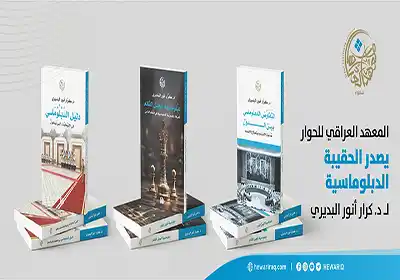
The Iraqi Institute for Dialogue publishes "The Diplomatic Portfolio" by Dr. Karrar Al-Badiri
Official agreement between Iraqi Institute for Dialogue and the Iraqi Media Network to sponsor The Seventh Annual International Conference of “Baghdad Dialogue” 2025
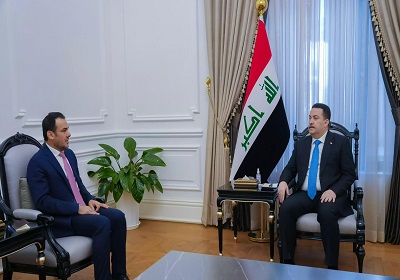
Prime Minister: The path of development will make Iraq a regional political and economic powerhouse
Invitation to the 79th issue of Dialogue of Thought
Seventh Baghdad International Dialogue Conference Call for Papers
Praise for the Baghdad International Dialogue: Strengthening Iraq's pivotal role and a meeting point for visions
Comments