
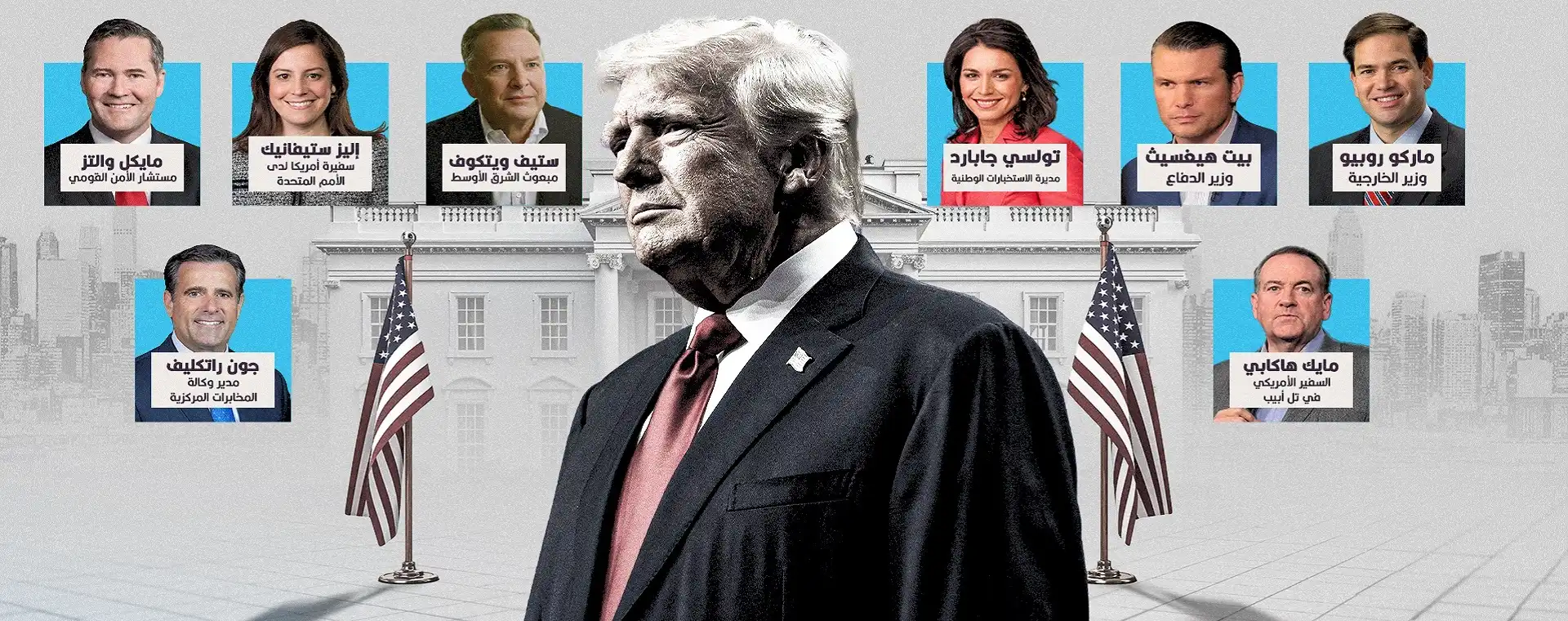
Learn about Trump’s foreign policy arms
Nearly two weeks after President-elect Donald Trump won the presidential election, the contours of his new administration have begun to take shape after the announcement of his choices to fill some positions in the new Republican administration of the White House, especially in the field of foreign policy.
Figures revealed to have taken on new assignments in Trump's team so far have included Mike Huckabee, who will take over as the new US ambassador to Tel Aviv, Lisa Stefanik, who Trump has chosen to be the US ambassador to the UN, Senator Marco Rubio, who is running for secretary of state, as well as the appointment of Tulsi Gabbard as director of national intelligence, the nomination of Pete Hegseth to the Pentagon, and finally the appointment of John Ratcliffe as director of the CIA.
What’s striking about Trump’s choices for foreign policy briefers is that most, if not all, of them are pro-Israel figures with hard-line positions on both Iran and China.
A New York Times-sized newspaper reported that Trump's Middle East appointments foreshadowed a pro-Israel policy.
The US newspaper's report focused on Huckabee and his pro-settlement approach, as well as Trump's Middle East envoy, real estate mogul Steve Witkoff.
It is the same meaning that was also confirmed by the British Financial Times newspaper, as it indicated that Trump's choices for his hardline members of his government supporting Tel Aviv are helping the Israeli right.
And the British newspaper quoted a diplomat who worked with Netanyahu as saying that the Israeli right did not dream of such appointments.
In this report, we review the most prominent figures that the elected US president will rely on to shape foreign policy in his second term.
1- Marco Rubio (Secretary of State)"The Palestinians are an obstacle to peace"
Florida Senator Marco Rubio is a hawkish hawk known for his hard-line policies against Iran and China, and his strong support for Israel.
This is evident in his statements when he was a senator since 2011, and a member of the Council's Foreign Relations Committee, according to a report by the Arab Post website.
In the Middle East, Rubio has a pro-Israel voting record in the Senate and recently pushed for the designation of a pro-Palestinian organization as a terrorist group.
Rubio also expressed support for Prime Minister Benjamin Netanyahu during Israel's war on Gaza and Lebanon, and accused the Biden administration of not doing enough to support Tel Aviv, according to a report by The Washington Post.
Rubio condemned decisions by some Western allies to suspend or restrict arms exports to Israel, citing concerns about possible violations of international humanitarian law.
And after the State Department imposed sanctions in August on Israeli entities it said were involved in “extremist settler violence” in the West Bank, Rubio said the department was “undermining” a U.S. ally.
And he wrote in a letter to Secretary of State Antony Blinken: “Israelis who truly live in their historic homeland are not an obstacle to peace; The Palestinians are the obstacle."
And with the appointment of Rubio as US secretary of state, relations between Washington, Tehran and Beijing are expected to witness tension, according to Anadolu Agency.
Rubio had called Tehran a "terrorist" regime, and in February, he said the "emerging rise of the Axis" led by China, Russia and Iran was the greatest geopolitical threat to the United States.
And in an op-ed published in the Washington Post in September, Rubio called China "the biggest and most dangerous adversary America has ever faced." He urged policymakers in Washington to prevent China from "overtaking" the United States by investing heavily in sectors of the economy vital to national security, imposing more tariffs and taking action to stop "Chinese espionage and intellectual property theft."
Trump supporters reportedly opposed Rubio’s appointment as secretary of state.
2- Pete Hegseth (defense minister)"There is no two-state solution, there is one state"
Trump announced he would nominate Pete Hegseth to the Defense Department, a former soldier, Fox News commentator and Israel supporter, one of the most important positions in the new administration.
Hegseth, 44, served in various units of the U.S. military in Iraq, Afghanistan and Guantanamo Bay at various times.
And Israeli newspapers monitored his previous positions in favor of Tel Aviv, where he had proposed the possibility of rebuilding a "new structure on the ruins of the Temple Mount," in a speech at the "Arutz Sheva" conference in occupied Jerusalem in 2018.
Hegseth is also a supporter of annexation of Israeli settlements. He also opposed a two-state solution to the Israeli-Palestinian conflict, saying, “If you walk around there today, you will realize that there is no such outcome as a two-state solution. There is only one country.”
He also defended the abuses of Muslim detainees at Guantanamo and defended the closure of the prison.
"If we are at war with radical Islam, with Islamism, there is no better place to house and interrogate these people than Guantanamo Bay, and we should not be afraid of this fact, and those who saw it understand that," Hegseth said in 2016.
Hegseth also defended U.S. soldiers accused of war crimes and, in previous cases, asked Trump to pardon those individuals.
Hegseth's nomination is considered "surprising" and unexpected, and he will be able to take office after gaining Senate approval following Trump's inauguration.
3- Tulsi Gabbard (Director of National Intelligence)"Extremist Islamic Ideology Fuels Terrorism"
In another surprise move by Trump, former Democratic Rep. Tulsi Gabbard has been named director of national intelligence. She is a veteran who has served in Arab countries.
Gabbard served in the U.S. Army twice in Iraq and Kuwait. She has a wide range of views on foreign policy.
And in 2020, when she was running for president from the Democratic Party, she was quoted by PBS News as saying that if elected president, her main focus would be to end the numerous U.S. military interventions around the world, including in the Middle East.
And she traveled to Syria in 2017 on a fact-finding mission, meeting with President Bashar al-Assad, who is under sanctions by the United States.
And in an interview with CNN after the trip, Gabbard said, “Whatever you think of President Assad, the truth is that he is the president of Syria. And in order to reach any peace agreement, and in order to reach any prospect of a viable peace agreement, a conversation with him is required.”
In her political career, Gabbard has also received high praise from groups with anti-Muslim views and from supporters of Hindu nationalism and supporters of Israel.
For years, she has claimed that “radical Islamist ideology” fuels terrorism, an argument common among the far right. President Former President Barack Obama for not using the phrase "Islamic extremism."
And for all her anti-war and anti-American interventionist views, Gabbard supported Israel's war on Gaza. cease-fire.
More recently, Gabbard has condemned the pro-Palestinian protest movement at American universities. hundreds Thousands of pro-Palestinian protesters branded them puppets of an “extremist Islamic organization,” a clear reference to Hamas.
4- Steve Witkoff (Middle East Envoy)"Trump's leadership has been good for Israel and for the region"
In choosing the U.S. special envoy to the Middle East, Trump decided not to turn to a traditional diplomat, and chose Steven Witkoff, a Jewish real estate mogul.
Trump said Witkoff is "a respected leader, and he will be a strong voice for peace and he will make us all proud of him."
Witkoff is known as a close friend of the Trump family, and according to US media reports, Witkoff was with Trump during his last "assassination attempt" while playing golf in Florida on September 15.
Witkoff is also a strong supporter of Israel and Prime Minister Benjamin Netanyahu, and has praised Trump before on how he has handled Israel and the region.
He attended Netanyahu's speech to Congress and said, "I felt spiritual," criticizing the Democrats' reaction to Netanyahu's speech.
Trump's first Middle East envoy, Jason Greenblatt, helped negotiate Israeli normalization agreements with the UAE, Bahrain, Sudan and Morocco.
And yet, the selection of Witkoff paints a picture of how Trump has handled his foreign policy in the Middle East. After Trump left office in 2021, his company struck several real estate deals in Saudi Arabia, the UAE and Oman, according to Middle East Eye.
5- Elise Stefanik (Ambassador of the United States to the United Nations) : "The United Nations is anti-Semitic"
Elise Stefanik has little foreign policy experience, but she is a staunch supporter of Israel. And in December 2023, she aggressively participated in a questioning session of university presidents for not doing enough to suppress pro-Palestine protests on U.S. campuses.
Stefanik, an Adelson Award winner for Defenders of Israel, has repeatedly stressed during the hearings that pro-Palestinian slogans “From River to Sea” and “Globalization of the Intifada” are tantamount to calls for genocide.
Since the beginning of the Israeli war on Gaza, Stefanik has attacked the UN and accused it of anti-Semitism for its criticism of the Israeli bombing of Gaza.
Last month, Stefanik called for a "complete reassessment" of U.S. funding for the United Nations, and pushed for Washington's withholding of support for the United Nations Relief and Works Agency for Palestine Refugees (UNRWA).
6- Michael Waltz (National Security Adviser)"We must put pressure on Hamas"
Trump has selected Michael Waltz, a former U.S. Army soldier and Florida congressman, as his national security adviser.
He has strengthened his reputation as a leading advocate for a tougher stance toward China within the House.
Waltz has played a leading role in sponsoring legislation aimed at reducing U.S. dependence on minerals imported from China.
Waltz is known to have a strong friendship with Trump, and has also expressed support for U.S. aid to Ukraine, while at the same time pushing for greater oversight of U.S. taxpayer funds earmarked to support defense efforts in Kiev.
Waltz is also a staunch anti-Iran and pro-Israel supporter. Throughout his career in Congress, he supported legislation aimed at imposing sanctions on Iran.
He was quoted by the Jawish Insider newspaper in September as saying that the United States should exert pressure on Hamas and its Iranian backers, and accused the Biden administration of exerting “unilateral pressure on Israel to conclude a ceasefire agreement with Hamas in Gaza.
Waltz also expressed skepticism about the US-proposed ceasefire plan between Israel and Hezbollah in Lebanon.
7- John Ratcliffe (CIA Director)China is the biggest threat to U.S. interests
Trump nominated former Director of National Intelligence John Ratcliffe to the post of director of the CIA.
And according to a statement from Trump’s team, former congressman Ratcliffe, who served as director of national intelligence in 2020-2021, will serve as director of the CIA in his new government.
Known as a name very close to Trump, Ratcliffe will be able to take office after getting Senate approval, and is known for his far-right views, like the other names Trump has nominated for his Cabinet so far.
Ratcliffe, a hard-liner toward China, has repeatedly sounded the alarm about China, calling it “the greatest threat to U.S. interests and the rest of the free world,” according to an Associated Press report.
In an op-ed published in the Wall Street Journal in December 2020, Ratcliffe wrote, "The intelligence is clear: Beijing intends to dominate the United States and the rest of the world economically, militarily, and technologically."
Ratcliffe served as deputy attorney general for the Eastern District of Texas between 2007 and 2008, later serving as mayor of Heath in the same state until 2012, and entered the U.S. House of Representatives in 2015.
8- Mike Huckabee (US ambassador to Tel Aviv): "Israel has a title deed to Judea and Samaria"
Trump chose former Arkansas governor Mike Huckabee to take over as the new U.S. ambassador to Tel Aviv.
Huckabee, 70, an evangelical Christian, has been an outspoken supporter of Israel throughout his political career, a longtime advocate of Jewish settlements in the occupied West Bank, and an opponent of the two-state solution.
"I think Israel has a title deed to Judea and Samaria," he was quoted by Politico magazine in 2017, using Hebrew terminology for the occupied West Bank.
He added: "There are some words I refuse to use. There is no such thing as the West Bank. It's Judea and Samaria. There is no such thing as settlements. They're communities, they're neighborhoods, they're cities. There is no such thing as occupation."
And Huckabee never supported a two-state solution even when Netanyahu endorsed the idea in 2009. He also never opposed any solution that would require the evacuation of Israeli settlers to establish a Palestinian state.
In an interview with the Associated Press in 2015, Huckabee, then running for the Republican Party chairmanship, said recognizing the West Bank as Israeli territory would be the “official position” of his administration.
And regarding the Israeli war on Gaza, Huckabee called for the forced displacement of Palestinians during the war.
Huckabee criticized President Joe Biden for pressuring Israel to ease its campaign in Gaza, and he also opposed the current Democratic administration's calls for a ceasefire there.
"If you're pro-Israel, how can you be pro-Biden because the Biden administration has made it very clear that it will make concessions to Hamas," Huckabee said in a March interview on News Nation.
The Iraqi Institute for Dialogue, the logistical sponsor of the Baghdad International Book Fair, opens its own pavilion at the fair
The Iraqi Institute for Dialogue publishes "The Diplomatic Portfolio" by Dr. Karrar Al-Badiri
Official agreement between Iraqi Institute for Dialogue and the Iraqi Media Network to sponsor The Seventh Annual International Conference of “Baghdad Dialogue” 2025
Invitation to the 79th issue of Dialogue of Thought
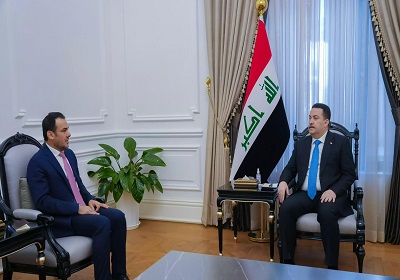
Prime Minister: The path of development will make Iraq a regional political and economic powerhouse
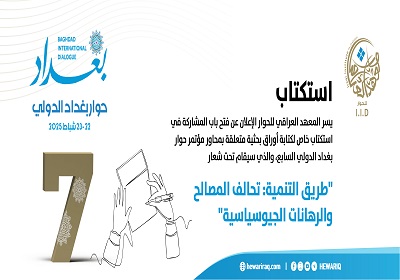
Seventh Baghdad International Dialogue Conference Call for Papers
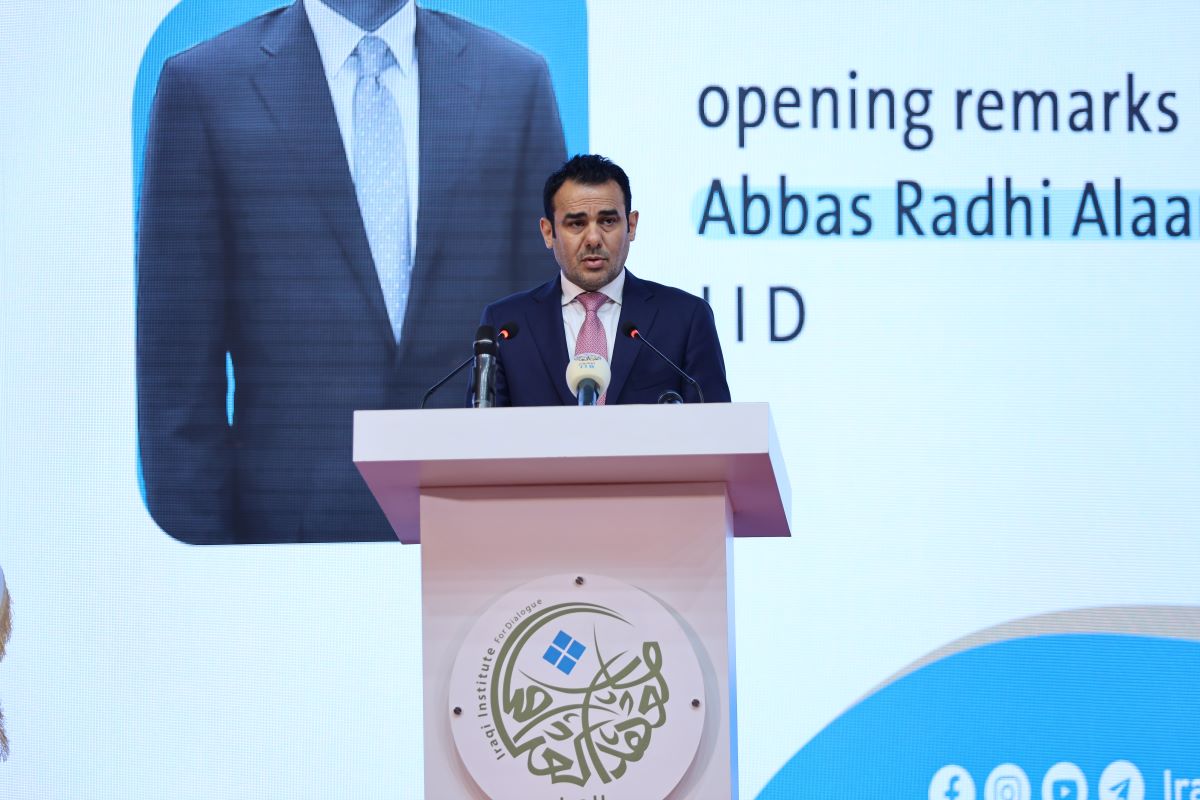
Speech of the Director of the Iraqi Institute for Dialog at the Sixth Baghdad International Dialog Conference
Comments