


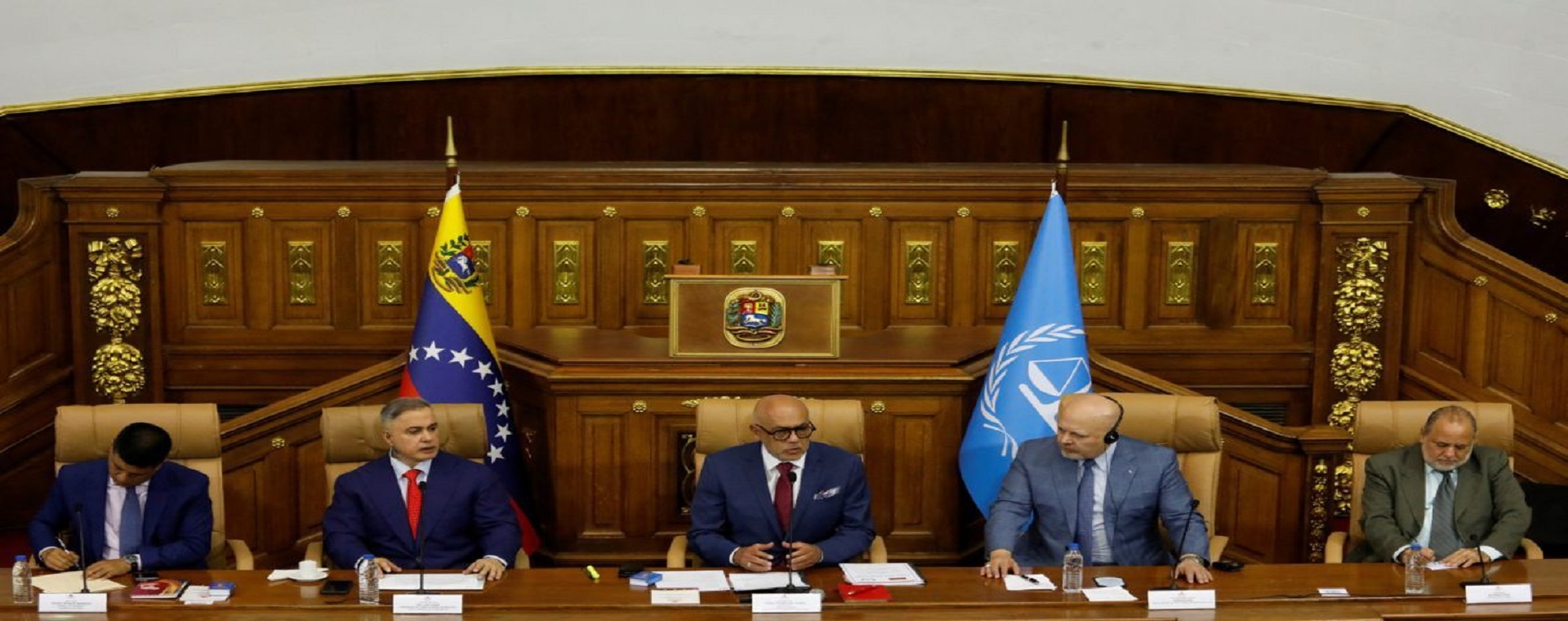
Rules on immunity under the International Criminal Court and international law
International reactions continue to follow the International Criminal Court issued arrest warrants for Israeli Prime Minister Benjamin Netanyahu and his former defense minister, Yoav Gallant, several days ago on charges related to "committing war crimes and crimes against humanity" during the ongoing genocide war on Gaza for more than a year.
States' positions on the ICC's decision varied between supporters and opponents.
While Malaysian Prime Minister Anwar Ibrahim called the arrest warrant a “great victory,” Hungarian Prime Minister Viktor Orban said on Friday he would invite Netanyahu to visit Hungary, adding that he would ensure the arrest warrant issued by the International Criminal Court against him would not be “implemented.”
And all 124 states parties to the Rome Statute, including all EU member states, are legally obliged to arrest the two men, especially since the trial cannot begin in absentia, and member states must hand over the accused to the court in The Hague.
But the court does not have executive powers, but relies on the cooperation of member states in arresting and extraditing suspects.
And in Israel, there is a debate about the legal arguments that Tel Aviv may resort to to prevent the implementation of the International Criminal Court's decision against Netanyahu and Gallant, who are now fugitives under international law.
 Karim Khan Prosecutor of the International Criminal Court
The legal avenues discussed included the principle of diplomatic immunity enjoyed by heads of state and government, which Tel Aviv may resort to to prevent the arrest of its officials, in addition to conducting a "serious and independent" investigation into the practices of the occupation army in the Gaza Strip and southern Lebanon.
and report to location Middle East The fact that Netanyahu and Gallant belong to a country that is not a party to the Rome Statute could be used as a pretext to establish immunity from prosecution, experts say.
In this report, we highlight the most important questions regarding the rules of immunity under the ICC system and international law in general, whether these rules may protect Netanyahu, Gallant, or other Israeli officials from prosecution, as well as the seriousness of an independent investigation by Israel into the military's practices.
What types of immunity exist under international law?
There is no treaty providing for the rules of immunity under international law, but these rules can be drawn from State practice, court rulings and legal opinions.
A State official facing charges of serious international crimes such as war crimes, crimes against humanity and genocide can invoke two types of immunity before national or international courts.
first", they may claim that they deserve functional immunity, which permanently protects them from prosecution for actions they have undertaken in their official capacity as state actors."
In theory, this protection applies both during and after leaving office. However, the jurisprudence of international criminal law following the Second World War made an exception to this rule in relation to serious international crimes.
The Nuremberg Trials, the Special Tribunals for the former Yugoslavia and Rwanda, as well as the Rome Statute, have always challenged the logic behind this type of immunity by entrenching the concept of individual criminal responsibility and the irrelevance of formality in cases of alleged international crimes.
And this is also the position of the committee international law", the main UN body of experts charged with developing and codifying international law."
either Type II Of the immunity, known as personal immunity, it is more controversial and may be used by states either to refuse to arrest Israeli leaders and hand them over to the ICC or to protect them from prosecution before their national courts.
Immunity ratione personae protects heads of State and senior officials, as well as diplomats, from prosecution while in office in order to maintain the proper functioning of international relations and the unlimited capacity of officials to perform their duties, including representing their States at the international level.
There are laws around the world that enshrine personal immunity for diplomats on official duties and for serving government officials, especially the head of state, prime minister and foreign minister. These laws apply when officials are formally present on the territory of another State.
In Netanyahu's case, this immunity may protect him when he travels to countries that are not party to the Rome Statute if those countries enjoy the principle of jurisdiction in relation to international crimes, such as the United States.
Universal jurisdiction is a legal principle that allows a State to prosecute persons for serious international crimes, regardless of where the crime was committed or the nationality of the victim or perpetrator.
But it is widely understood that the above types of immunity do not apply to the case of an arrest warrant from the ICC. This is because it is undisputed that government officials of all ranks do not enjoy immunity before an international court with jurisdiction, such as the International Criminal Court.
And the Rome Statute was intended to hold individuals accountable for the four crimes that fall within its jurisdiction — genocide, war crimes, crimes against humanity, and aggression — regardless of their official capacity as officials or leaders of the state.
Does Netanyahu enjoy immunity under the Rome Statute?
The rules of immunity are provided for in articles 27 and 98 of the Rome Statute.
Article 27 clearly states that the Statute shall apply equally to all persons without any discrimination on grounds of official capacity. The article adds that special immunities or procedural rules that may be related to the official capacity of a person, whether under national or international law, do not preclude the Court from exercising its jurisdiction over that person.
But the main loophole in the statute that states parties may exploit to refuse to arrest and extradite Netanyahu, as with states that have failed to arrest Sudanese President Omar al-Bashir or Russian President Vladimir Putin, is Article 98 clause 1, which provides an exception to Article 27 regarding the arrest and extradition of officials from non-ICC member states, such as Israel.
The clause provides that: “The Court shall not make a request for assistance or assistance requiring the requested State to act in a manner inconsistent with its obligations under international law with respect to State immunities or diplomatic immunity of a person or property of a third State unless the Court can first obtain the cooperation of that third State in order to waive immunity.”
"On the face of it, this rule applies to Netanyahu, who enjoys immunity under international law as the head of Israel's government," said Paula Gita, a professor of international law and an expert on immunity.
The immunity rule does not apply to Gallant, who no longer holds office, because former state officials do not enjoy the same immunities as current officials. Similarly, Netanyahu will not be eligible for any immunity from international crimes after leaving office.
 International Criminal Court
How have ICC member states violated their obligations by arresting state leaders?
You've been using Clause (1) in Article 98 by States that refused to extradite Bashir and Putin, nationals of States not party to the ICC.
For example, Jordan invoked Article 98 (1) when it did not arrest Bashir on March 29, 2017, and Mongolia refused Putin was arrested when he visited the country on September 3, 2024, saying he enjoyed functional and personal immunity.
In both cases, however, the ICC dismissed the claim of immunity as unfounded. Last month, the court ruled that Mongolia had violated the Rome Statute by failing to arrest Putin.
In its interpretation of its reasoning, the Court said that the reference to the immunity of a State under section (1) in article 98 concerned the immunity of the State and its property, not of its leaders or officials.
"It is reasonable to expect the Pre-Trial Chamber to take a similar position with respect to Netanyahu and Gallant," said William Chabas, a professor of international criminal law.
Julia Benzauti, a professor of international law at Leiden University, noted that Mongolia had sought to appeal the ICC's decision on its non-compliance.
"On the other hand, there are statements like the one made by the Dutch foreign minister in which he stated that the Netherlands would arrest the suspects if they entered Dutch territory," said Benzawati.
"This statement is very important in terms of state practice. It reinforces a view that is gaining ground among states. and that heads of state do not enjoy immunity before the ICC, regardless of whether they belong to state parties or non-state parties."
If States do not comply with the Court's request for arrest, their conduct will be referred to the Assembly of States Parties, the governing body of the ICC, as was the case with Mongolia.
And then the association can take the necessary measures to stimulate cooperation.
Can an independent investigation by Israel prevent the arrest of Netanyahu and Gallant?
 Netanyahu, the occupation army minister and military leaders
Netanyahu and Gallant, along with other Israelis who may be subject to future arrest warrants, are expected to turn to national courts to defend themselves against arrest.
An Israeli official said on Friday that the lack of a "serious and independent" investigation into the army's practices in the Gaza Strip and southern Lebanon contributed to the International Criminal Court's issuance of the arrest warrant against Netanyahu and Gallant.
And the official Israeli Broadcasting Corporation quoted the official expert in legal affairs, without naming him, as saying that "if Tel Aviv had formed an official committee of inquiry on the practices of the army in the Gaza Strip and southern Lebanon, before the issuance of the court's decision, this would have had an impact on legal procedures."
Legal experts told the daily Yediot Aharonot that they believe "there is an opportunity to change the decision, to launch an independent and serious investigation that may lead to criminal proceedings later."
The broadcaster's legal expert added: "The investigation must be convincing for the criminal court, with all proceedings that compromise the credibility of the judicial system suspended, and bills targeting the official commission of inquiry."
And without that, it may be impossible to reverse the decision.”

The Iraqi Institute for Dialogue, the logistical sponsor of the Baghdad International Book Fair, opens its own pavilion at the fair
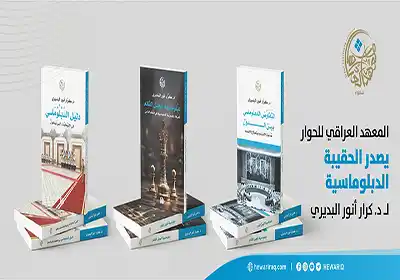
The Iraqi Institute for Dialogue publishes "The Diplomatic Portfolio" by Dr. Karrar Al-Badiri
Official agreement between Iraqi Institute for Dialogue and the Iraqi Media Network to sponsor The Seventh Annual International Conference of “Baghdad Dialogue” 2025

Invitation to the 79th issue of Dialogue of Thought
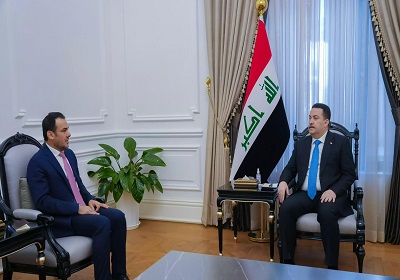
Prime Minister: The path of development will make Iraq a regional political and economic powerhouse
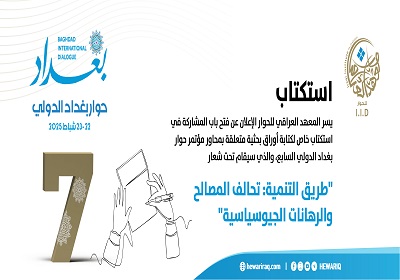
Seventh Baghdad International Dialogue Conference Call for Papers

Praise for the Baghdad International Dialogue: Strengthening Iraq's pivotal role and a meeting point for visions
Comments