


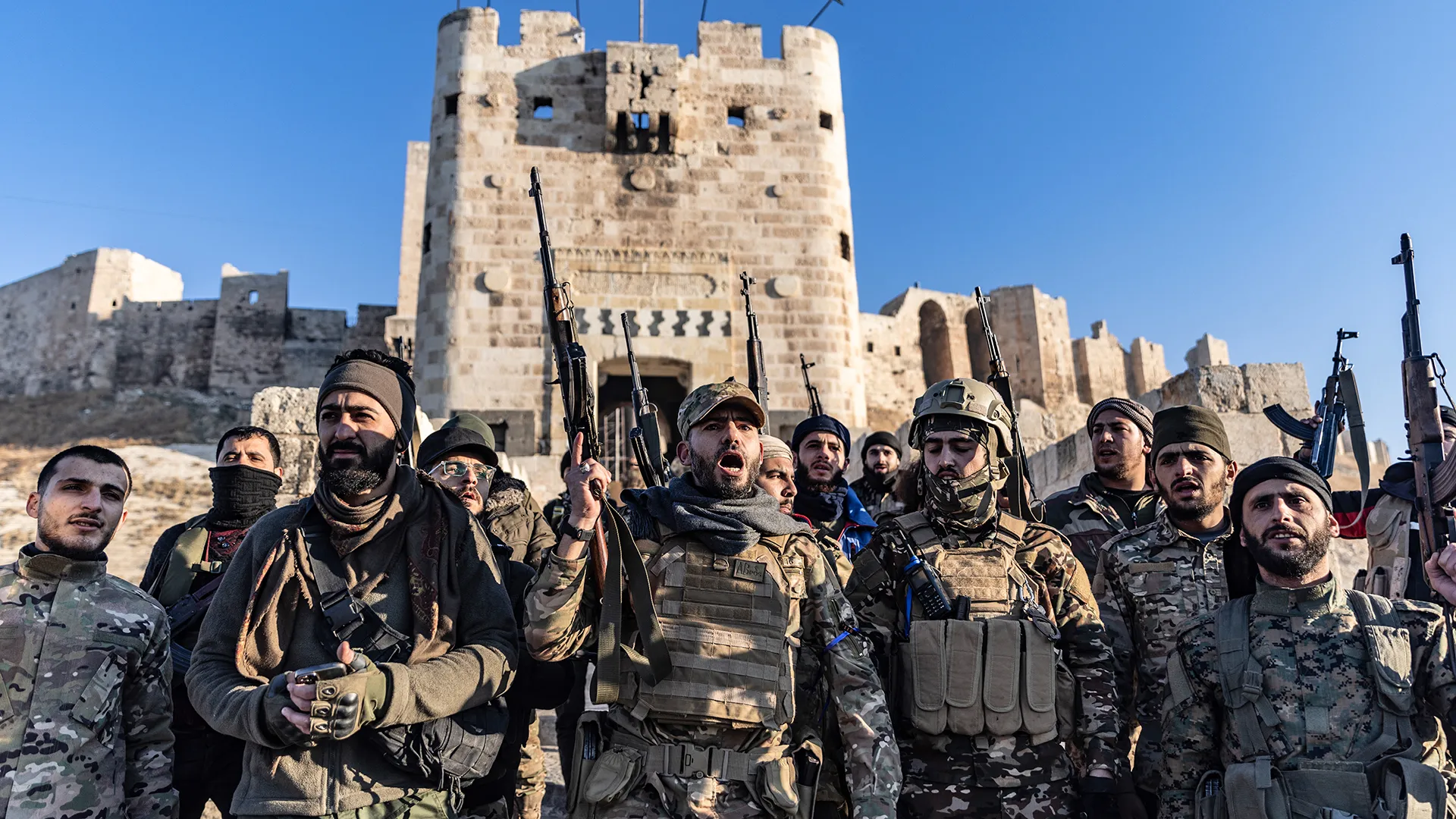
The Military and Political Significance of Aleppo?
The rapid advance in Aleppo came just four days after a surprise offensive by Syrian extremist groups, the most intense escalation in years in the civil war.
On November 27, 2024, the "Military Operations Management Room" representing several factions in Idlib launched Operation Deterrence of Aggression, advancing rapidly on several axes towards Aleppo city and its countryside, bringing the conflict in Syria into a new phase that threatens to change the current rules.
No rebel fighter has entered Aleppo since it was retaken by Syrian army forces with Russian and Iranian help in 2016, and Turkey, which has backed Syrian opposition groups, has failed in its diplomatic efforts to prevent government offensives, which were seen as a violation of a 2019 deal sponsored by Russia, Turkey and Iran to freeze the conflict line.
Aleppo has been the site of some of the most devastating battles of the Syrian civil war, with rebel groups and the Assad regime spending four years fighting for control of its streets.
Initially, the Military Operations Room said that the objectives of the operation were limited to "deterring the enemy" and stopping the regime and its allies from targeting northwestern Syria, in addition to enabling the displaced to return to their villages. However, the rapid collapse of the regime's defenses allowed the factions to advance unexpectedly and capture more than 60 towns and strategic locations, including the 46th regiment, the Scientific Research Center, and key positions on the M5 highway.
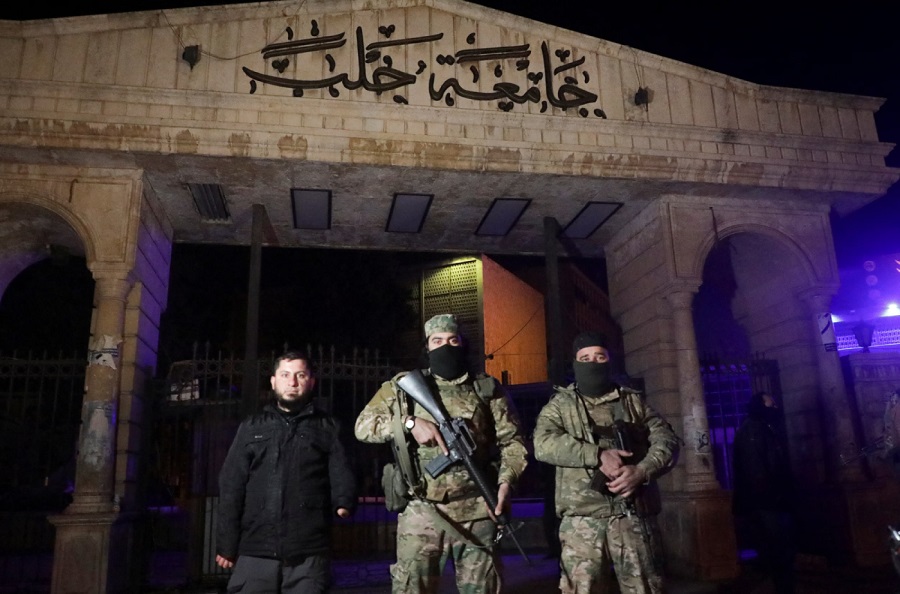 Extremist fighters at the gates of Aleppo University
The extremist groups also took control of the strategically important city of Saraqib in Idlib province after fierce battles with Syrian regime forces and their allies, while the factions are still breaking the defense lines of the Syrian regime forces in many other axes, and are preparing - at the time of writing this report - to enter the city of Maarat al-Numan.
Why is the Syrian opposition's capture of Aleppo such an unusual event, and what is the strategic importance of Syria's "economic capital," as it has always been called?
The strategic importance of Aleppo
Aleppo, the largest Syrian city in terms of population density and one of the oldest inhabited cities in history, enjoys a crucial strategic location and historical, political and economic importance that has made it the center of conflict between the parties to the conflict in Syria since 2011. There is no doubt that the Syrian opposition's control of the city on November 29, 2024 marks a major strategic shift in the Syrian war and redraws the contours of the conflict locally and internationally, raising questions about the implications of this shift on the conflicting parties: The opposition, the Syrian regime, and their international and regional backers.
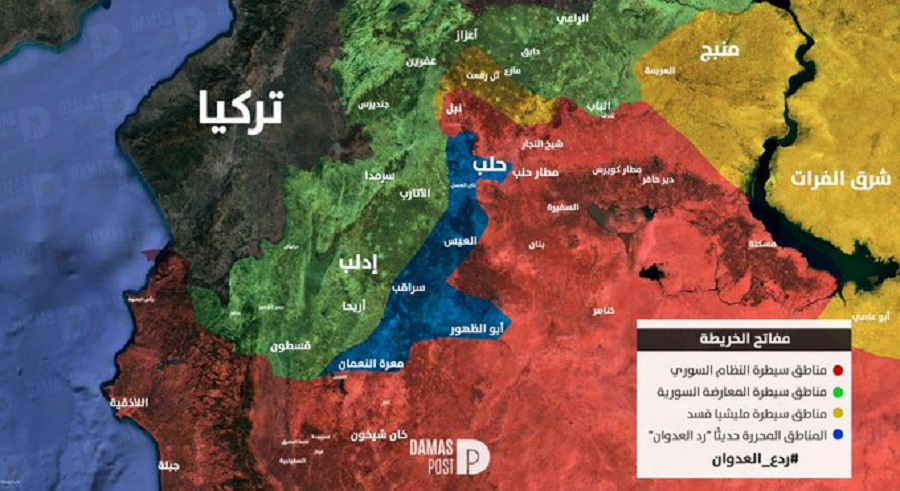 Military Situation in Aleppo
The city of Aleppo. Geographical location and strategic importance
Location and area: The area of Aleppo Governorate extends to 18,000 square kilometers and 190 square kilometers, while the area of its capital (Aleppo) is 190 square kilometers, and is characterized by the diversity of its terrain, including plains, hills and fertile lands, as it is located at the crossroads between the Euphrates and the Mediterranean Sea.
The gateway to northern Syria: Aleppo is located near the Turkish border, making it a link between the Syrian interior and the outside world. This location gives it importance in securing supplies and supporting military operations. Aleppo's strategic importance is due to the fact that it is a major link between East and West, and throughout its ancient times, it has been an important political, economic, religious and vital center due to its mediation between the eastern and western worlds.
Transportation network: Aleppo connects eastern and western Syria, making it an important logistical center. Its control by any party means control of trade routes and supply lines from the north of the country to the south, all the way to Damascus.
Population and historical weight: With its dense population and ancient history, Aleppo is a cultural and cultural center of great symbolic value. The population of Syria's most populous province is more than 4 million, according to the Syrian Center for Statistics in 2011.
Economy: Aleppo was the country's largest economic center before it was partially destroyed by war in recent years. It is the country's leading tourist city. Before the war, Aleppo accounted for nearly a third of the local economy, 23 percent of the country's labor force, 48 percent of wheat and barley production, and 30 percent of Syrian industries.
What is the military and political significance of Aleppo?
Aleppo has been an important base for regime forces since the beginning of the war. Controlling it helps strengthen its military positions and secures the surrounding areas. The loss of Aleppo would be a major setback for the Syrian regime, as it would mean the loss of control over the entire northwest.
When protests erupted across Syria in March 2011, the Syrian army did everything it could to ensure that the protests did not spread to Aleppo.
However, as the revolution evolved into an armed conflict, Aleppo was soon drawn into the war. In February 2012, two bomb attacks on military intelligence and police compounds rocked the city, killing 28 people.
Reports of clashes between armed rebels and regular forces began to emerge, and the battle for Aleppo began in mid-July 2012. The opposition made quick gains, capturing several areas in the northeast, south, and west of Aleppo. By the end of the month, the fighting intensified and spread to the city's historic center, where its historic 13th-century citadel was built.
In September 2012, a fire broke out in the Old Market after clashes in the vicinity, and in April 2013 the 11th-century minaret of the Grand Mosque was reduced to rubble. Within a few months, the battle for Aleppo turned into a war of attrition, with the front lines constantly shifting.
From the end of 2013 through 2016, government forces waged a deadly aerial campaign in Aleppo using barrel bombs, allowing them to make several gains with Russian air support.
Later, Aleppo became for the regime a symbol of regaining control after the battles of 2016-2017. Losing it now shows the regime's weakness in maintaining its military gains and could weaken Assad's legitimacy in the eyes of his supporters and international backers.
https://x.com/Charles_Lister/status/1862507049436803443
The capture of Aleppo today is a symbolic and strategic victory, strengthening its position in future negotiations. It allows the opposition to establish an advanced base of operations against regime positions in other areas.
The capture of Aleppo will allow the Syrian army and its allies to threaten the militants' centers of gravity in Idlib, strengthening their supply routes while simultaneously threatening other areas under regime control.
The capture of Aleppo is a major morale boost for the rebels and reshapes the political balance of power on the ground, strengthening the opposition's position in any upcoming political negotiations sponsored by Turkey and Russia.
International and regional powers:
For opposition backers (such as Turkey), capturing Aleppo fulfills their strategic goals of reducing the influence of the Syrian army and its allies in the region. Turkey may see a rebel victory as an opportunity to expand its influence, limit Russian and Iranian interference and force the Assad regime to compromise, thereby resolving the Syrian refugee issue in its areas of control in northern Syria.
For Russia and Iran, the loss of the city weakens their pro-regime axis and reduces their ability to maneuver. Aleppo has been of great importance to Iran militarily, as reflected in the years leading up to 2020.

The Iraqi Institute for Dialogue, the logistical sponsor of the Baghdad International Book Fair, opens its own pavilion at the fair

The Iraqi Institute for Dialogue publishes "The Diplomatic Portfolio" by Dr. Karrar Al-Badiri
Official agreement between Iraqi Institute for Dialogue and the Iraqi Media Network to sponsor The Seventh Annual International Conference of “Baghdad Dialogue” 2025

Invitation to the 79th issue of Dialogue of Thought
Prime Minister: The path of development will make Iraq a regional political and economic powerhouse
Seventh Baghdad International Dialogue Conference Call for Papers
Praise for the Baghdad International Dialogue: Strengthening Iraq's pivotal role and a meeting point for visions
Comments