



A study reveals: Political crises spur companies to innovate
Political uncertainty, often considered a barrier to economic stability, may have a positive side, according to a new study by the University of Nebraska-Lincoln College of Business.
The study shows that companies tend to increase their R&D investments during periods of high political uncertainty, especially during close elections.
In the paper titled "The bright side of political uncertainty: The case for R&D"Julian Atanasoff, associate professor of finance, found that companies see R&D as a strategic option for growth in times of uncertainty.
Atanasov said: "R&D acts as a growth option, allowing companies to explore potential future opportunities. If it increases its investments when uncertainty is higher, it has the option to invest more in the future if the results are favorable. If they don't invest, they will minimize their growth opportunities and fall behind their competitors in the future."
This finding contrasts with previous research that has mainly focused on the negative impact of political uncertainty on capital expenditures, mergers and acquisitions, initial public offerings, and other corporate decisions.

Atanasov explained: "R&D is one of the most important contributors to long-term economic growth. Therefore, by affecting R&D investments, political uncertainty has an abrupt impact on growth and development," Atanasov said.
To understand the relationship between political uncertainty and R&D, the researchers analyzed governing elections with narrow margins of less than 5%.
Atanasov said: "The advantage of using governing elections is that they are beyond the control of individual firms because they occur every four years, the election year cannot be changed by firms, and this allows us to make a causal statement that political uncertainty affects R&D investments rather than just documenting correlations."
Atanasov provided an example to illustrate this: A company considering an initial R&D investment in solar panels faces an uncertain future due to the differing policy positions of two gubernatorial candidates-one opposing incentives for green technology and the other supporting them.
Atanasov said: "An initial investment of $9 million in R&D in a stable environment would be worth $7.26 million according to the Black-Scholes model, making it infeasible. However, if political uncertainty increases - for example, during an election that could change environmental policy - the value of the R&D opportunity rises to $11.23 million, making it a profitable move," Atanasov said.
Atanasov and co-authors Brandon Julio of the University of Oregon and Ticheng Ling of the Harbin Institute of Technology in China highlight that firms in politically sensitive and high-tech industries are most likely to increase their R&D spending during periods of uncertainty. Instead of freezing investments, these companies use uncertainty to prepare for multiple future scenarios.
And between Atanasov: "This research has important implications for corporate managers, politicians and policymakers. "Our conclusion is that if investment is sometimes positively correlated with uncertainty, policymakers should be cautious when trying to reduce political uncertainty, as this may reduce R&D investments, which could have a negative impact on economic growth in the long run.

The Iraqi Institute for Dialogue, the logistical sponsor of the Baghdad International Book Fair, opens its own pavilion at the fair

The Iraqi Institute for Dialogue publishes "The Diplomatic Portfolio" by Dr. Karrar Al-Badiri

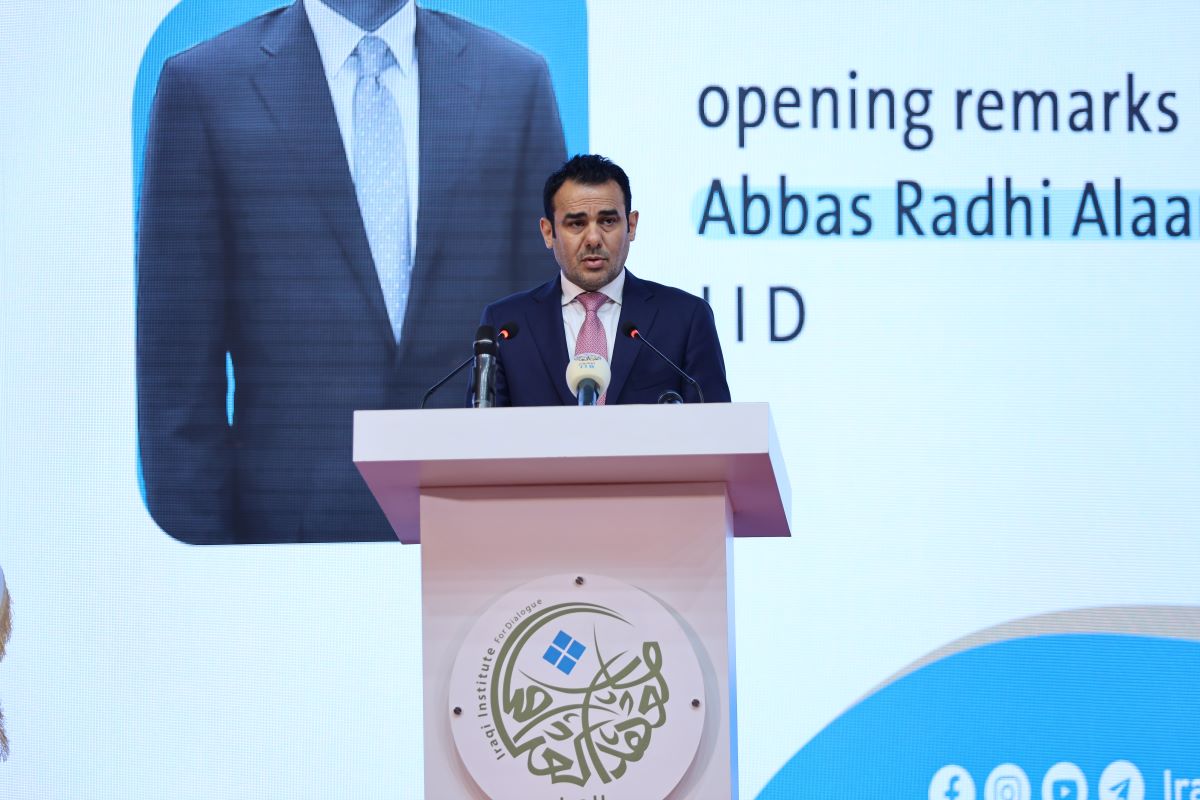
Official agreement between Iraqi Institute for Dialogue and the Iraqi Media Network to sponsor The Seventh Annual International Conference of “Baghdad Dialogue” 2025

Prime Minister: The path of development will make Iraq a regional political and economic powerhouse

Invitation to the 79th issue of Dialogue of Thought

Seventh Baghdad International Dialogue Conference Call for Papers

Praise for the Baghdad International Dialogue: Strengthening Iraq's pivotal role and a meeting point for visions
Comments