



How did Trump calculate the tariffs?
In a controversial new trade move, US President Donald Trump imposed a 10 percent tariff on most goods imported from more than 100 countries around the world, with higher rates for countries he described as "worst offenders" in trade with the US.
But behind these tariffs hides not only politics, but also an unorthodox math formula published by the Trump administration, which has raised the eyebrows of economists.
How were the tariffs calculated?
In announcing the decision, Trump displayed a large board with the names of the countries and the tariff rates imposed, suggesting that the rates were in response to similar tariffs or restrictions on U.S. exports.
Later, the White House revealed that the tariffs were not calculated on this basis, but according to a simple mathematical formula:
"Divide the U.S. trade deficit with a country by its total imports from that country, then divide the result by 2."
The example of China:
Trade deficit: 295 billion dollars
Total imports: $440 billion
Output: (295 ÷ 440) ÷ 2 ≈ 34% → A 34% tariff was imposed on Chinese goods.
In the same way, a 20% tariff was placed on EU imports.
Are these opposing definitions?
A number of experts argue that the calculation does not represent a "countervailing tariff," meaning it does not directly reflect the tariffs or restrictions imposed by other countries on U.S. goods.
The decision even targeted countries with which the US does not have a trade deficit, such as Britain, which was subjected to a 10% tariff despite the lack of a deficit.
Why is Trump adopting this policy?
Trump believes that free trade on its current terms is hurting U.S. industry. He says other countries are flooding the U.S. market with cheap goods, while placing restrictions on U.S. exports.
He hopes the tariffs will reduce the trade deficit and stimulate domestic production, especially in the automotive sector.
Analysts: "The trade deficit won't go away"
Professor Jonathan Portes of King's College London said: "Yes, the gap with some countries may shrink. But the overall U.S. deficit will remain unless the behavior of the U.S. economy changes."
The issue is the US spending and consumption pattern, where the US imports more than it exports, which cannot be solved through tariffs alone.
"Reverse engineering political rationalization?"
Thomas Sampson, a professor of economics at the University of London, believes that Trump's formula may be just a numerical cover to justify imposing tariffs on countries that want to be politically punished: "It's carefully engineered to look logical, but it's essentially a political decision."
Trump downplays concerns
On Sunday, the U.S. president downplayed concerns about the new tariffs, comparing them to a "cure" aimed at curing the ills of the U.S. economy.
As stock indexes were heading for a new low, Trump told reporters aboard Air Force One, "Sometimes you have to take medication in order to recover."
On his way back to Washington after a weekend at his residence in Mar-a-Lago, Florida, he was asked about the decline in financial markets since he announced tariffs of at least 10 percent on all U.S. imports on Wednesday.
The only way to solve the issue
According to AFP, Trump stressed that his country has become "much stronger" since the announcement of these measures, considering the decline in the markets was not a deliberate decision on his part. He said he wants to find a solution to "the deficit we have with China and with the European Union and other countries."
"I don't want a pullback (in any market), but sometimes a remedy has to be taken in order to recover," he added, referring to the US economy's dependence on imports, emphasizing that "the only way to solve this issue is through tariffs."
Trump emphasized that he spoke over the weekend "with a lot of Europeans and Asians and the whole world. They all very much want a deal," he said.
Europe made a fortune
Asked about the possibility of negotiating a tariff-free zone with Europe, as suggested by his adviser, Trump repeated that "Europe has made a fortune off of us and treated us very badly."
"They are coming to the negotiating table. They want to talk, but there will be no discussion until they give us a lot of money on an annual basis."

The Iraqi Institute for Dialogue, the logistical sponsor of the Baghdad International Book Fair, opens its own pavilion at the fair

The Iraqi Institute for Dialogue publishes "The Diplomatic Portfolio" by Dr. Karrar Al-Badiri

Official agreement between Iraqi Institute for Dialogue and the Iraqi Media Network to sponsor The Seventh Annual International Conference of “Baghdad Dialogue” 2025
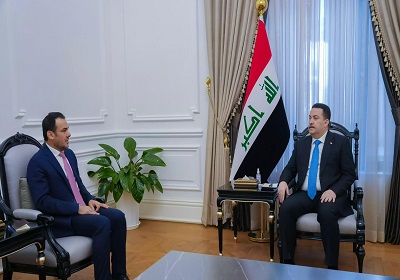
Prime Minister: The path of development will make Iraq a regional political and economic powerhouse

Invitation to the 79th issue of Dialogue of Thought

Seventh Baghdad International Dialogue Conference Call for Papers

Praise for the Baghdad International Dialogue: Strengthening Iraq's pivotal role and a meeting point for visions
Comments