


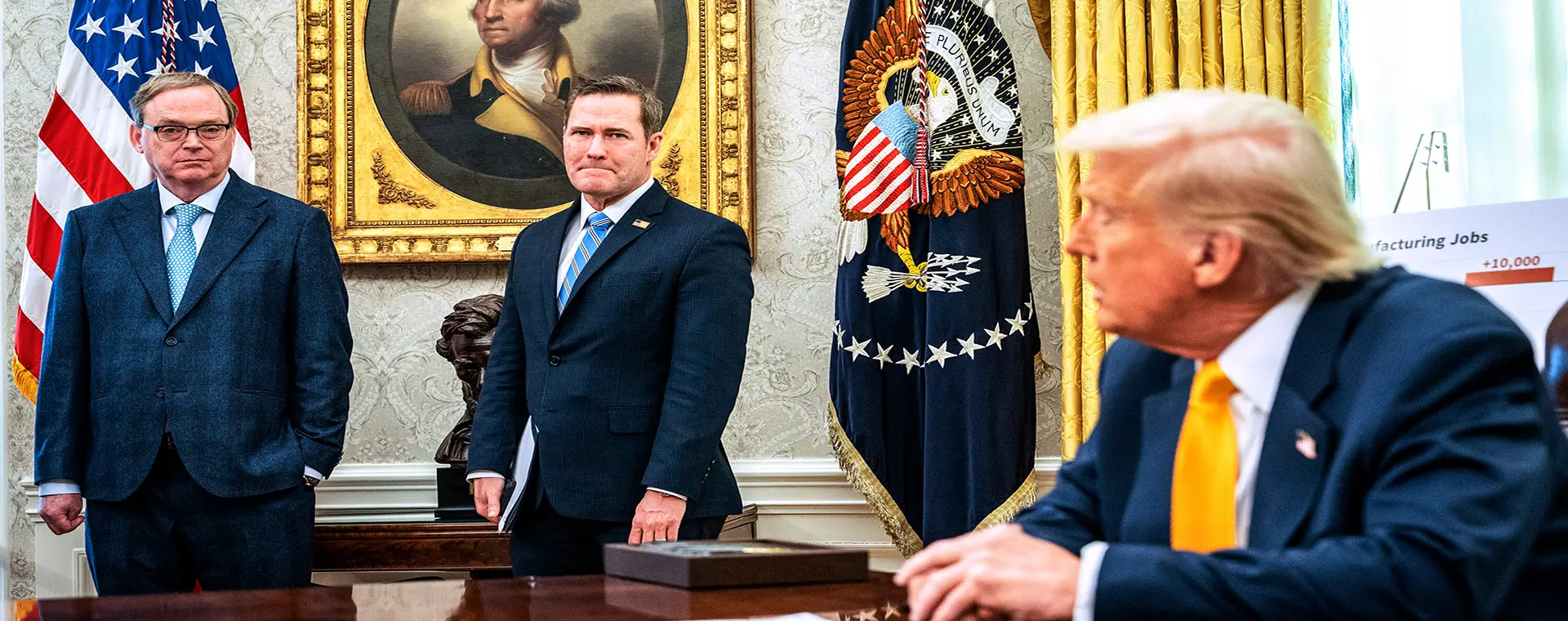
By: Doug Pando – Senior Fellow at the Cato Institute, specializing in Foreign Policy and Civil Liberties. He served as Special Assistant to President Reagan
Will Donald Trump refuse to go to war with Iran?
The Trump administration and the Iranian government ended another round of nuclear talks on Saturday. A "senior Trump administration official" described the discussion as "positive and productive," while Iranian Foreign Minister Abbas Araqchi said he was "optimistic but very cautious."
Much depends on how serious President Donald Trump is about reaching a deal with the Islamic State. He has long appeared to be under the influence of a diverse group of hardline hawks and neoconservatives, many of whom were promoters of the Iraq debacle and are now pushing for war with Iran. While Trump claims he wants a diplomatic solution, according to a report in The War Zone, he is moving "B-2 stealth bombers, fighter jets, support aircraft, a carrier strike group, air defense systems, and more" toward the Middle East.
Last month, Trump stated: "If they don't reach an agreement, there will be bombs. Bombs like they've never seen before." In an interview published on Friday, he brushed off concerns about Israeli Prime Minister Benjamin Netanyahu's ongoing campaign to drag the United States into a war with Iran, saying: "I would gladly intervene if we can't reach an agreement. If we don't reach an agreement, I will be at the forefront of intervening."
No doubt Trump, like China does with Taiwan, hopes that intimidation will produce favorable results. But just as Taipei resisted, Tehran has spent years resisting pressure. What if Iran rejects Trump's terms? Before he agrees to strike Iran's nuclear facilities, he should remember that haste is often followed by long regret - in his case, for the rest of his term and possibly beyond. Waging an unprovoked war on Iran would make George W. Bush's disastrous legacy look good by comparison.
The extremist forces that dominate the current Iranian regime are certainly malignant. But several previous U.S. administrations have helped turn Iran - the state and its people - into an adversary, if not an enemy. In 1953, encouraged by Britain outraged by Tehran's nationalization of oil, President Dwight D. Eisenhower helped overthrow elected Prime Minister Mohammad Mossadegh and consolidated the powers of Shah Mohammad Reza Pahlavi, a mostly symbolic figure. For a quarter of a century, Washington supported this autocratic and corrupt partner, as difficult as it was to deal with. Even President Jimmy Carter, who openly promoted human rights, held an embarrassing state dinner for the shah and made a sycophantic visit to Iran. Ironically, it was this ostensible American ally who started Iran's nuclear program.
As popular anger escalated, the Pahlavi dynasty collapsed, despite the Carter administration's support for a bloody crackdown. According to the New York Times report, the US special envoy to Tehran, General Robert Heiser, urged Iranian military leaders to kill as many protesters as possible to keep the Shah in power.
After ignoring the Shah's crimes, Washington gave him sanctuary as he lay dying. A militant Islamic state followed, but despite the initial American hostage-taking, Tehran never posed a serious threat to the United States. Rather, it was Washington that repeatedly threatened Iran. Successive U.S. administrations supported and armed the Shah's repressive regime. After its fall, the Reagan administration supported Iraq's bloody aggression against Iran and reclassified oil tankers to protect Baghdad's revenues. This resulted in eight years of war and more than a million casualties. The US has also armed Saudi Arabia and Israel, imposed sanctions on Tehran, repeatedly threatened military strikes, assassinated Qassem Soleimani, and supported Israeli attacks even against Iranian diplomatic targets.
It is natural, then, that Iranian decision-makers seek a deterrent nuclear arsenal. However, despite the IRGC's considerable influence, there are more moderate leaders who negotiated the Joint Comprehensive Plan of Action (JCPOA) with the Obama administration, which limited Iran's nuclear program. Moreover, successive Iranian governments have worked to improve relations with Saudi Arabia, despite Mohammed bin Salman's previous statements describing Khamenei as the "Hitler of the Middle East." In April, the Saudi defense minister visited Tehran, the first visit by a senior Saudi royal official in nearly 30 years.
Although war hawks in Washington are skeptical of Tehran as a negotiating partner, Iran has stuck to the nuclear deal. Washington has been the unreliable party. Even with Iran's commitment, Trump pulled out of the deal and reimposed sanctions, prompting Tehran to revive its nuclear program. Then came the Biden administration, and instead of reinstating the deal, it sought to impose tougher conditions.
After all, the United States is now threatening to use force. But war is not just a foreign policy tool; it is an extraordinary means of killing and destruction. The economic cost is also high. Imagine if America had not wasted thousands of lives and trillions of dollars in reckless wars in the Middle East over the past quarter century.
But even if war is theoretically viable, it is only justified when there is a serious and imminent threat to vital interests. Iran poses no such threat.
First, the nuclear deal demonstrated the effectiveness of diplomacy. Despite opposition from Riyadh and Tel Aviv, the deal reduced the potential for nuclear proliferation and removed the specter of war. But after Trump resumed economic sanctions, Iran reactivated its nuclear program, giving it a stronger position. Mohammed bin Salman has threatened to join the nuclear race, while Israel has launched direct attacks on the Iranian program.
Second, Iran is not an easy target. It has three times the population of Iraq and a strong national identity. Even young, freedom-loving Iranians will not welcome U.S. bombs. Iran could inflict significant losses on U.S. forces in the region. As Iranian commander Amir Ali Hajizadeh said: "The Americans have 10 bases with 50,000 troops in the region, so they are sitting in a glass house." Any strike would reinforce Tehran's conviction of the need for a nuclear weapon for self-defense. A long military campaign could require a broad coalition and the use of multiple instruments of U.S. power.
Third, Iran will not use nuclear weapons against the United States, as it recognizes America's formidable deterrence capabilities. It seeks deterrence in a hostile regional environment in which Israel is militarily superior. On the contrary, a regional balance of power would be beneficial.
Fourth, America's interests in the Middle East are no longer as vital as they once were. The Russian threat has diminished, U.S. energy production has increased, and markets have diversified. Even support for Israel no longer justifies military intervention. Tel Aviv's greatest danger today is internal, as it struggles to maintain both its democratic and Jewish identity.
Therefore, waging war on Iran would be another criminal act in the record of futile American interventions. Trump is aware of this, and he has opposed permanent wars and criticized Bush's invasion of Iraq. In 2019, he refused to respond militarily to the downing of an American airplane and the Aramco attacks. There is no reason today for war with Iran. If Saudi Arabia itself is calling for calm, Trump should listen.
Published in The American Conservative on May 1, 2025

The Iraqi Institute for Dialogue, the logistical sponsor of the Baghdad International Book Fair, opens its own pavilion at the fair

The Iraqi Institute for Dialogue publishes "The Diplomatic Portfolio" by Dr. Karrar Al-Badiri
Official agreement between Iraqi Institute for Dialogue and the Iraqi Media Network to sponsor The Seventh Annual International Conference of “Baghdad Dialogue” 2025
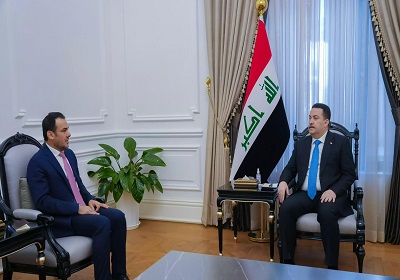
Prime Minister: The path of development will make Iraq a regional political and economic powerhouse

Invitation to the 79th issue of Dialogue of Thought
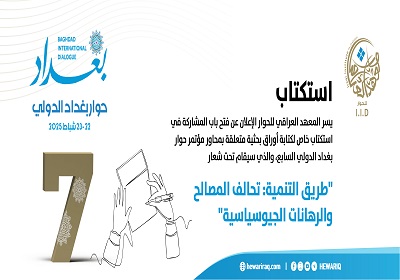
Seventh Baghdad International Dialogue Conference Call for Papers

Praise for the Baghdad International Dialogue: Strengthening Iraq's pivotal role and a meeting point for visions
Comments