


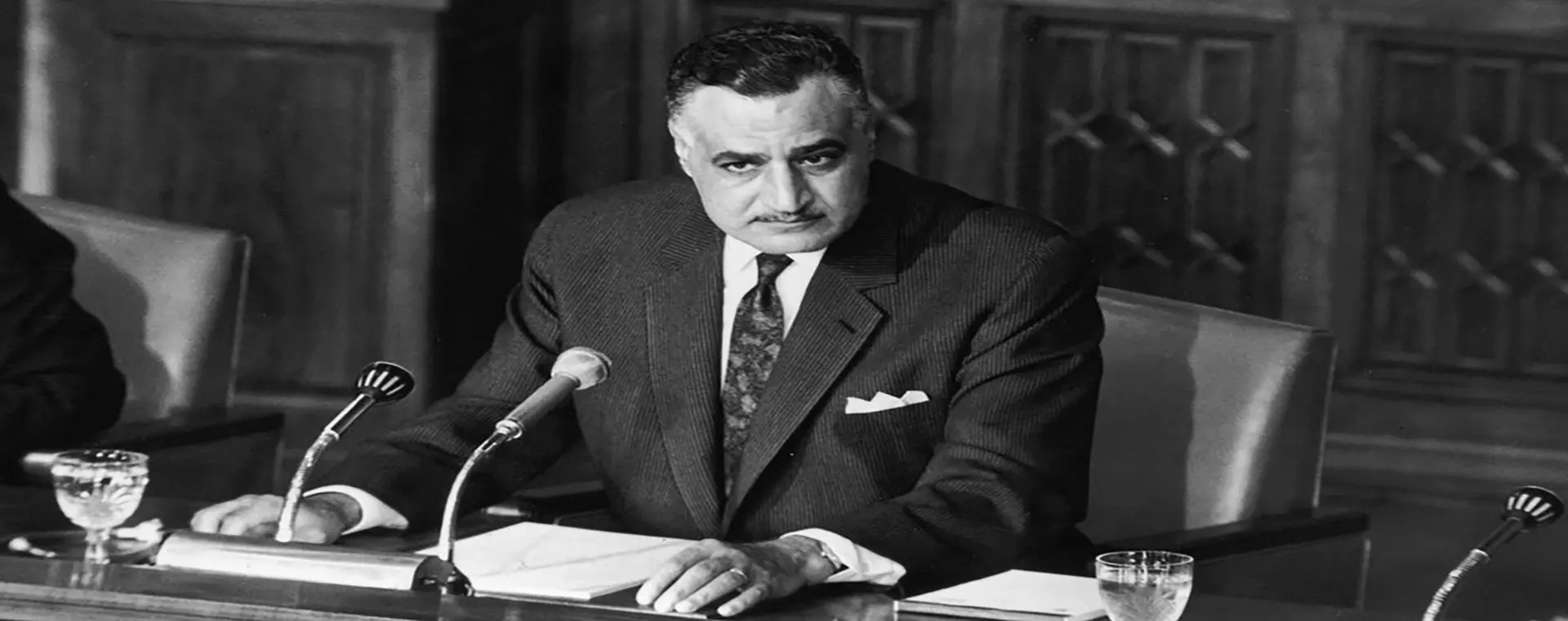
Nasser surprises Arabs half a century later: No new war with Israel
An audio recording attributed to former Egyptian President Gamal Abdel Nasser during a meeting with late Libyan President Muammar Gaddafi has sparked a wave of controversy on social media in Egypt and the Arab world.
The websites that republished the recording suggested that the conversation took place in August 1970, just a few weeks before Nasser's death on September 28 of the same year.
Contradictory to known rhetoric
The recording raised the eyebrows of many observers, as it shows Nasser talking about his willingness to accept a peaceful solution with Israel and warning that any new military confrontation could lead to a "catastrophe" similar to the 1948 catastrophe. This was considered by some to contradict his well-known speech at the time, which called for the liberation of Palestine "from the river to the sea" and the continuation of the armed struggle.
In the recording, Nasser attacked the Arab countries that were accusing Egypt of inaction, calling on them to fight the war themselves if they were serious about confronting Israel, adding: "If anyone wants to wage jihad, let him go and wage jihad... We are ready for financial support."
He also stressed the need to set realistic goals for any conflict with Israel, taking into account the balance of power and its imbalance in favor of US-backed Israel.
"Nasser TV and the full recording
The more than 17-minute-long recording was first published on April 26 on Nasser TV's YouTube channel, under the title:
"Gamal Abdel Nasser: Whoever wants to fight, let him fight and leave us alone" - a reference to his refusal to drag Egypt into a war that the Arabs don't actually support.
The channel, which claims to be "the official channel of Gamal Abdel Nasser," has been active since January 2018, has more than 90,000 subscribers, and has posted more than 520 videos, mostly of Nasser's speeches and activities.
Denial of a "leak"
Abdel Hakim Abdel Nasser, the son of the late Egyptian leader, refused to call the recording a "leak" or a "scandal," asserting that it has been in the Library of Alexandria for years, after the family donated Nasser's audio and documentary archive. He revealed that Nasser TV is run under his supervision, and he plans to publish more audio material.
Writer Amr Sabih, one of the channel's supervisors, said that the recordings were made under the supervision of Sami Sharaf, Nasser's director of information, and that they were transferred to the channel by Abdel Hakim Abdel Nasser.
For its part, the BA announced on its official Facebook page that it is not responsible for any recordings published in the media or social networks.
Calls to regulate the circulation of information
While some questioned the authenticity of the recording or the intentions of the timing of its release, others called for legalizing the release of presidential archives and linking it to its historical and political contexts.
Parliamentarian Maha Abdel Nasser (who has no family ties to the late leader) called for a "freedom of information" law that would allow researchers access to the full archives of Egypt's wars, arguing that this would contribute to a deeper understanding of the country's history.
Ihab Marjawi wrote on Facebook that "the entire legacy of a state is in the hands of individuals," questioning the logic of Nasser's family keeping documents that affect national security.
Nasser's family responds
Abdel Nasser's family has expressed annoyance at the "fragmented quotation" of the late president's words, arguing that reinterpreting his words without the political and military context of the time is unfair.
Huda Abdel Nasser, his daughter, said that her father never abandoned the Palestinian cause and that it was at the center of his nationalist project.
Regional context
Analysts suggest that the recording was made at the same time the United States offered what was later known as the "Rogers Initiative" ceasefire, put forward by US Secretary of State William Rogers in June 1970.
Egypt has fought a series of wars and armed conflicts since the 1948 Nakba, through the wars of 1956, 1967, and the War of Attrition, until the October 1973 war, which later paved the way for the Egyptian-Israeli peace agreement signed in Washington in 1979.
Despite the political changes, Egypt still maintains a pivotal role in the Palestinian cause, especially in mediating during the wars in Gaza and contributing to reconstruction efforts.

The Iraqi Institute for Dialogue, the logistical sponsor of the Baghdad International Book Fair, opens its own pavilion at the fair

The Iraqi Institute for Dialogue publishes "The Diplomatic Portfolio" by Dr. Karrar Al-Badiri
Official agreement between Iraqi Institute for Dialogue and the Iraqi Media Network to sponsor The Seventh Annual International Conference of “Baghdad Dialogue” 2025
Invitation to the 79th issue of Dialogue of Thought
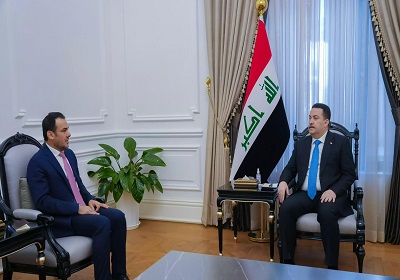
Prime Minister: The path of development will make Iraq a regional political and economic powerhouse
Seventh Baghdad International Dialogue Conference Call for Papers
Praise for the Baghdad International Dialogue: Strengthening Iraq's pivotal role and a meeting point for visions
Comments