

Translation: Iraqi Institute for Dialog
Between Erdogan and Sharia: Syria's Kurds struggle to survive
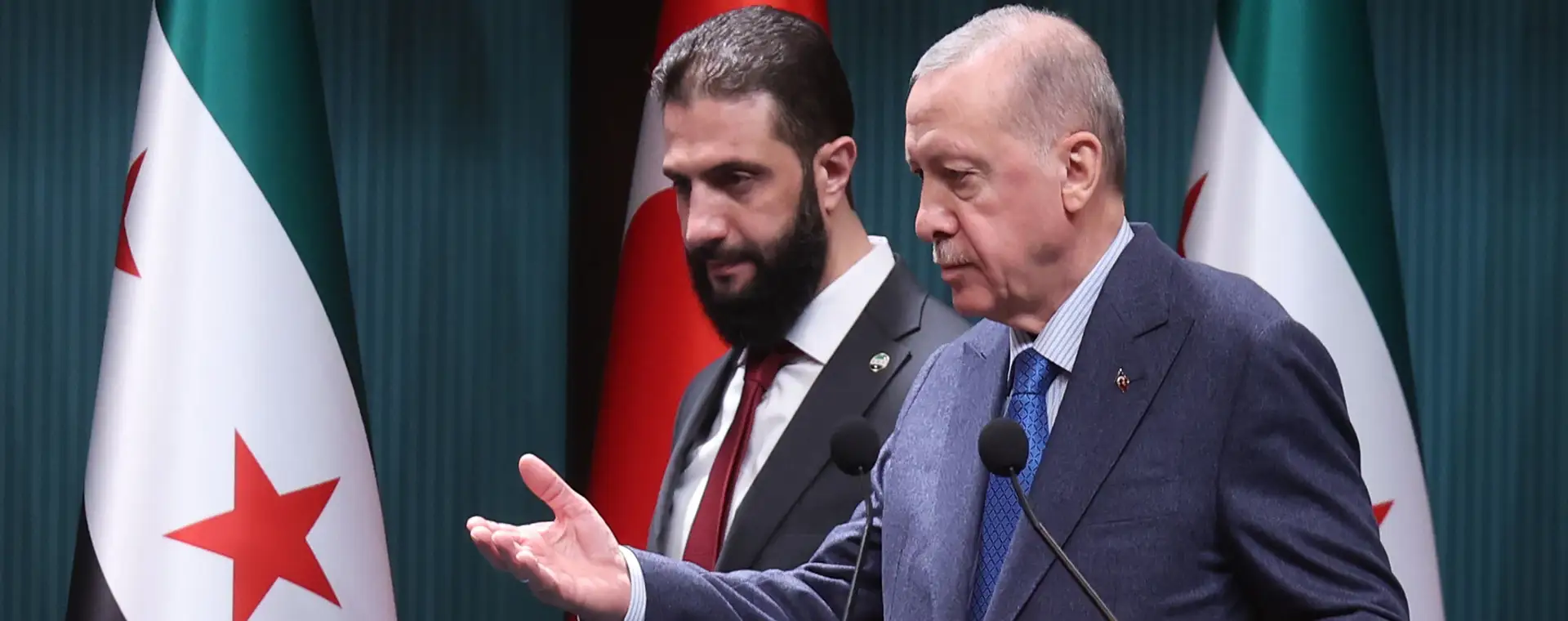
Despite President Ahmad al-Sharaa's success in holding a surprise meeting with US President Donald Trump in Saudi Arabia a few days ago, the political situation in Syria is far from stabilized. The country is mired in chaos, civil strife, and foreign interference, and for the large Kurdish minority, the future is more uncertain than ever. Their fate is shaped by intertwined regional conflicts, internal political fragmentation, and constant fluctuations in international attitudes.
Although the Syrian Democratic Forces (SDF)-the main military wing of the Kurds-and its political wing, the Syrian Democratic Council (MASAD), have made significant progress in building a decentralized governance model in northeast Syria, this project faces strong opposition from the Sharaa-led transitional government in Damascus, as well as from neighboring Turkey, which exerts considerable influence over the new Syrian government dominated by Hayat Tahrir al-Sham, the hardline Islamist faction formerly associated with al-Qaeda.
President al-Sharaa confirmed this deep rejection of federalism through his recent stance. On April 27, he explicitly rejected the SDF's proposal to create a decentralized state, considering it a threat to the country's unity and a violation of a previous agreement between the two parties.
His government decided to keep the name "Syrian Arab Republic," promote Islamic law, and adopt Arabic as the sole official language, marginalizing Kurds and other minority groups who had hoped the transitional framework would reflect Syria's pluralism.
Despite signing an agreement with the central government to integrate the SDF into state institutions, the Kurdish leadership remains committed to the demand for autonomy. Ilham Ahmed, a leading figure in MASAD, has stated that the model of self-administration developed in northeast Syria could be a model for the whole of Syria. In the eyes of the Sharia government, however, these demands run counter to the centralization espoused by the interim constitution, suggesting that, for now, Kurdish participation in the state reform process remains a distant possibility.
On the ground, the Kurds continue to face severe military and economic pressure. Turkish-backed forces are active in northern Syria, targeting Kurdish factions that Ankara accuses of collaborating with the outlawed Kurdistan Workers' Party (PKK).
On May 12, the PKK officially disbanded, ending more than four decades of armed insurgency against the Turkish state, following a call by its imprisoned leader Abdullah Ocalan in February for an end to the armed struggle.
Although SDF commander Mazloum Abdi has publicly offered ceasefire initiatives and demilitarized zones to reduce tensions, Turkey remains adamant. Ankara views any form of Kurdish autonomy on its southern border as a direct threat to its national security and is unlikely to back down unless it receives assurances that all PKK-linked factions will be dismantled.
The SDF continues to engage with the Sharia government in an attempt to broaden its political alliances and reduce hostility, but these steps also reflect a kind of desperation. The ongoing conflict and economic isolation have taken a heavy toll on the Kurdish regions, which are now suffering from closed trade routes, reduced oil sales, and declining Western aid. The escalation of the civil war has also led to significant destruction of critical infrastructure, such as the Tishreen and Tabqa dams, exacerbating water and electricity shortages and threatening food security.
Nevertheless, Kurds remain committed to their political project, especially in Rojava, where they continue to experiment with grassroots democracy and gender equality, relatively new concepts in the region. Rojava's governance model emphasizes participatory democracy, environmental sustainability, and women's rights.
But as the Sharaa administration tightens its grip on Damascus and Turkey's increasing involvement in Syrian affairs, these gains are in jeopardy. In areas like Idlib, where the transitional government has imposed a conservative form of governance that has stripped women of their most basic rights, Kurdish women fear that the decline in autonomy will undermine the progress made since 2013.
Internationally, support for Kurdish autonomy is waning, especially now that the threat of Assad is gone. The United States, which was a key ally of the SDF in the fight against ISIS, is busy withdrawing from Middle Eastern conflicts, especially under President Trump.
Saudi Arabia, another important player, sees the Kurds as a way to counterbalance Iranian influence, but has not offered concrete support, fearing that this would affect Syria's territorial integrity, leaving the Kurds with virtually no reliable allies.
A glimmer of hope may come from neighboring Iraq, where the Kurds are relatively stable. Iraqi Kurds have expressed symbolic and moral support, calling on their brothers in Syria to unite and pointing to their experience of autonomy as inspiration. However, with internal conflicts between the two main Kurdish parties-the Kurdistan Democratic Party (KDP) and the Patriotic Union of Kurdistan (PUK)-Iraqi Kurdistan itself is struggling to maintain its gains.
For now, the future of the Kurds in Syria appears to be fraught with uncertainty. While Kurdish groups have shown remarkable resilience, the new government in Damascus insists on a strictly centralized approach, while Turkey remains hostile and international support is waning. Unless there is a major political shift that allows for greater inclusivity and decentralization, the Kurds may gradually lose their hard-won gains.
By Ajesh B. Joy
He specializes in foreign affairs. He holds a PhD from Jawaharlal Nehru University in New Delhi (2011) and focuses his coverage on the United States, Europe and the Middle East. His other interests include emerging politics in the Indo-Pacific region and far-right populism
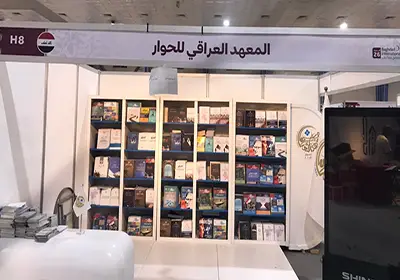
The Iraqi Institute for Dialogue, the logistical sponsor of the Baghdad International Book Fair, opens its own pavilion at the fair
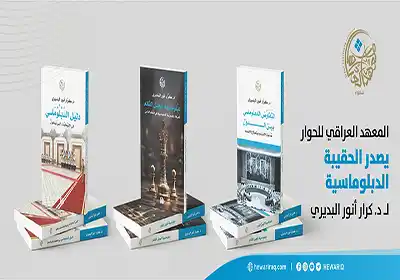
The Iraqi Institute for Dialogue publishes "The Diplomatic Portfolio" by Dr. Karrar Al-Badiri
Official agreement between Iraqi Institute for Dialogue and the Iraqi Media Network to sponsor The Seventh Annual International Conference of “Baghdad Dialogue” 2025
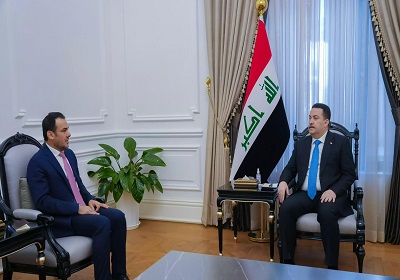
Prime Minister: The path of development will make Iraq a regional political and economic powerhouse
Invitation to the 79th issue of Dialogue of Thought
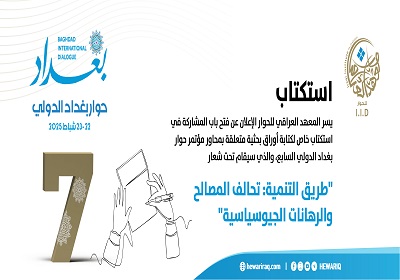
Seventh Baghdad International Dialogue Conference Call for Papers
Praise for the Baghdad International Dialogue: Strengthening Iraq's pivotal role and a meeting point for visions
Comments