


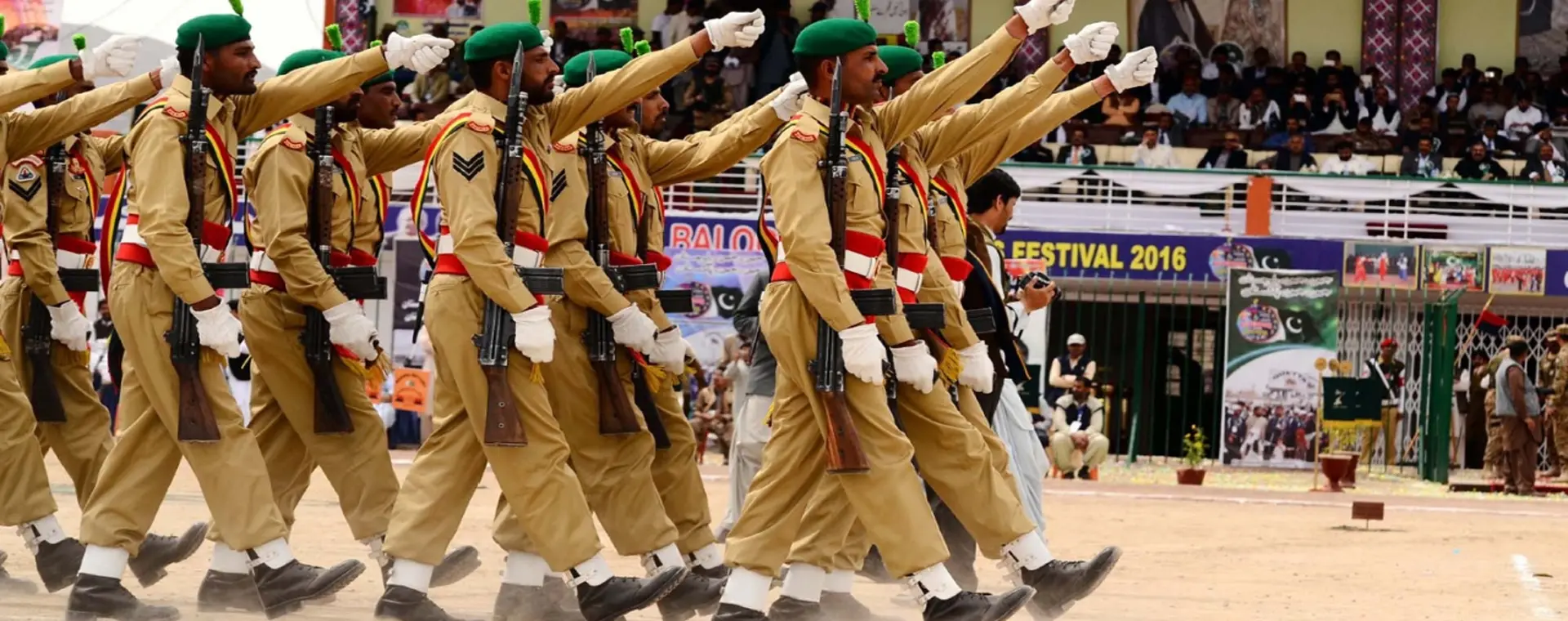
By Aparna Pandey and Vinay Kaura Translated by the Iraqi Institute for Dialog
Pakistan: Back to military rule
The recent crisis in Kashmir has reaffirmed and revitalized the military's dominance in Pakistan's political system.
On May 20, 2025, for the second time in Pakistan's 77-year history, a serving military commander achieved the rank of Field Marshal. For General Syed Asim Munir Ahmad Shah, this elevation is the culmination of his ambitions, but it is also a symbolic affirmation of military supremacy amid a fragile political system.
Pakistan has long been a classic example of a "praetorian" state, where political institutions are too weak to check or guide the power of the military, which has repeatedly stepped in to impose order, not by accident, but because of an institutional structure rooted in colonial centralization that prevented democratic norms from taking root.
Munir's rise is not just the advancement of an officer, but the culmination of a system. As the head of the Military and General Intelligence Services (ISI), he epitomized the fusion of censorship, religious narrative, and strategic leadership that has come to characterize the Pakistani military, which not only guards geographical borders but also sees itself as the guardian of Pakistan's "ideological borders." In his April 16 speech, Munir focused on the partition of India, the "two-state" theory, and the perpetual conflict, as he saw it, between Muslims and Hindus.
Although Pakistan was founded as a democracy, the ruling elites reinforced the colonial structure, allowing the military to fill a vacuum left by weak political parties, an entrenched bureaucracy, decrepit parliaments, and a politicized judiciary.
For 77 years, the military concealed every intervention, direct or indirect, under the slogan of "saving the regime." From Ayub Khan to Musharraf, there has been a succession of military rule. Even today, despite the presence of a civilian government, the real center of power is not in Parliament in Islamabad, but in army headquarters in Rawalpindi.
The army's legitimacy is built on the "illusion" of order and stability, and it presents itself as a symbol of discipline and national purpose, exempting it from accountability at a time when civilian institutions are eroding. However, the state needs institutional cooperation that the army cannot provide on its own, even if it tries to do so repeatedly, both publicly and privately.
This excessive intervention has not made Pakistan a strong but a "fragile" state. Society is ethnically divided, politics is radicalized, and the economy is deteriorating.
The title "marshal" brings to mind the reign of Ayub Khan, who epitomized raw military power. He does not topple governments, but creates them; he does not cancel elections, but directs their results; he does not censor publicly, but weaves media narratives. The tragedy is not the coup, but the continuity disguised as "reform."
The army treats any internal opposition, whether Baloch, Pashtun or Sindhi, as foreign-backed treason, especially from India or Afghanistan, rather than as legitimate demands in a multi-ethnic country.
The military's response to this opposition is not dialogue but exclusion, and this has become legalized with the Supreme Court's approval of military trials of civilians, a disturbing normalization of an authoritarian judiciary. This takeover of the judiciary is part of the military's expansion into the media and elections. In this climate, "sovereignty" has been redefined from legal authority to dominance by force.
In any state, the state is supposed to have a monopoly on violence, but when it allows non-state forces to use arms, it loses its legitimacy in favor of short-term interests. Since 1947, and more so after the 1970s, Pakistan's military establishment has relied on "jihadi" groups as an instrument of its regional policies, especially towards India and Afghanistan.
After the 1971 defeat, the military added two layers of deterrence: Nuclear weapons and proxy warfare. While militant groups have taken a heavy toll on India, their effects on Pakistan have been more severe, as former U.S. Secretary of State Hillary Clinton warned her Pakistani counterpart in 2011: "You can't breed snakes in your backyard and expect them to only bite your neighbors."
The military's bet on regional proxies has become a strategic liability. The world has come to view Pakistan as a haven for terrorism. Although the Pakistani interior rejects this characterization as "Indian and Western propaganda," this rhetoric will one day collide with reality.
If history teaches us anything, it is that nothing is inevitable. Countries that falter can find within them the energy for renewal. 77 years after its founding as a democratic state, Pakistan's decision-makers need to rethink: Either move further towards military rule, or return to constitutional federalism.
About the authors:
Aparna Pandey: Director of the Future of India and South Asia Initiative at the Hudson Institute.
Vinay Kaura: Assistant Professor, Department of International Affairs and Security Studies, Sardar Patel University of Police and Criminal Justice, Rajasthan, India.

The Iraqi Institute for Dialogue, the logistical sponsor of the Baghdad International Book Fair, opens its own pavilion at the fair
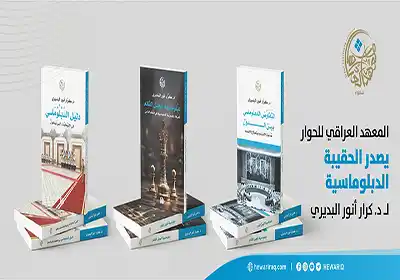
The Iraqi Institute for Dialogue publishes "The Diplomatic Portfolio" by Dr. Karrar Al-Badiri
Official agreement between Iraqi Institute for Dialogue and the Iraqi Media Network to sponsor The Seventh Annual International Conference of “Baghdad Dialogue” 2025
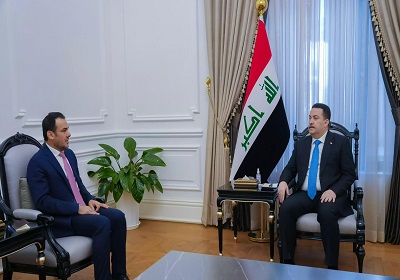
Prime Minister: The path of development will make Iraq a regional political and economic powerhouse
Invitation to the 79th issue of Dialogue of Thought
Seventh Baghdad International Dialogue Conference Call for Papers
Praise for the Baghdad International Dialogue: Strengthening Iraq's pivotal role and a meeting point for visions
Comments