



Translation: Iraqi Institute for Dialog
Trump should avoid war over Taiwan
The presence of 500 U.S. troops stationed in Taiwan, while undoubtedly useful from the insurgency's point of view, is dangerous for U.S.-China relations. They are also completely unnecessary.
In testimony before Congress by retired U.S. Navy Admiral Mark Montgomery, it was revealed that the U.S. military has approximately 500 personnel stationed in Taiwan. This number has been hotly contested within Washington, D.C., but it is likely accurate.
If the number is accurate, Beijing is now in a quandary. On paper at least, the United States and the PRC are bound by the 1978 Normalization Agreement that established formal diplomatic relations with China. This document explicitly prohibits the U.S. military from stationing any of its forces on the island.
China-Taiwan tensions have been rising for years The revelation of the presence of US troops in Taiwan also reveals a violation of the "one-China" policy, which, while uncomfortable and inconvenient for all three parties involved, has maintained a degree of peace that would otherwise not exist in the Indo-Pacific region. This comes on the heels of the U.S. Marine Corps' decision to place anti-ship missiles at a key strategic choke point between the Philippines and Taiwan. This point, the Bashi Strait, is where any Chinese fleet seeking to blockade the southern part of Taiwan would have to pass through to achieve its goal.
To put it bluntly, China and the United States are moving aggressively against each other in what some military theorists call the "gray zone," or the space between wars. China has also become more provocative toward its neighbors - and the U.S. Navy. This is not to mention the blatantly illegal islands that the Chinese military has built throughout the South China Sea in an attempt to achieve a dominant position in the region.
The important thing to remember, however, is that while the U.S. military is stronger than China on paper, it is a woefully stretched force globally. This force represents only one percent of the total U.S. population, and with a massive ship crisis in its navy - there are simply not enough warships and submarines to go around - a deteriorating warplane issue in its air force, insufficient troops in its army, and Marines still transitioning from very different circumstances in the Middle East, Beijing realizes that the balance of military power in its immediate surroundings - at least for now - is clearly tilted in its favor.
The purpose of the Barbed Wire force is to kill - and start a war. About 500 U.S. troops are stationed in Taiwan for two reasons: To serve as a staging point (Tripwire), and to help defend the island. If China decides to start a siege and invasion of the island, those US troops won't be enough to stop the attack. The idea, however, is that they would form the nucleus of any resistance movement that forms to combat a potential Chinese invasion. What's more, with those troops on the island, if killed or captured, these 500 men could become the spark needed to force the reluctant United States to send more troops to defend or liberate Taiwan from China.
But this is a ridiculous idea. The United States cannot afford a war right now. During a recent call between Chinese President Xi Jinping and U.S. President Donald Trump, Xi urged Trump to be cautious when dealing with cross-strait relations. While Xi's advice was undoubtedly self-serving in nature, given the painful realities of America's ailing defense infrastructure, this advice is appropriate.
Trump is not interested in going to war with China over Taiwan. He has made that clear. Moreover, Trump has made it clear that he wants to prioritize foreign trade over conflict. Although the trade relationship with China has been in desperate need of a reset for decades, Trump should continue to maintain this philosophy as his unifying principle when dealing with other key global leaders.
These 500 soldiers, while undoubtedly useful from an insurgency standpoint, are a danger to U.S.-China relations. They are completely unnecessary as well. Taiwan is a developed country with a modern military. If the Taiwanese are unable or unwilling to defend their freedom, why should Americans risk dying for them?
While the loss of the island of Taiwan would pose a serious threat to U.S. grand strategy in the near term, if America adopts a program of national rearmament and renewal in conjunction with regional defense, it would not be catastrophic.
The United States should immediately reorganize its strategy and buy time for the country's recovery over the next decade by avoiding wars and supporting diplomacy as well as trade. In the meantime, get those troops out of Taiwan.

The Iraqi Institute for Dialogue, the logistical sponsor of the Baghdad International Book Fair, opens its own pavilion at the fair

The Iraqi Institute for Dialogue publishes "The Diplomatic Portfolio" by Dr. Karrar Al-Badiri

Official agreement between Iraqi Institute for Dialogue and the Iraqi Media Network to sponsor The Seventh Annual International Conference of “Baghdad Dialogue” 2025
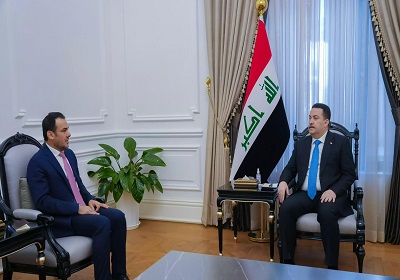
Prime Minister: The path of development will make Iraq a regional political and economic powerhouse

Invitation to the 79th issue of Dialogue of Thought
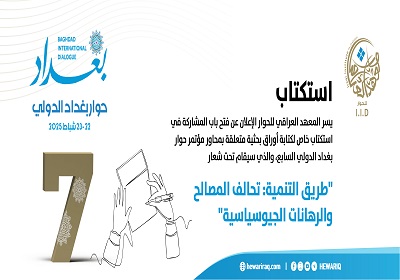
Seventh Baghdad International Dialogue Conference Call for Papers

Praise for the Baghdad International Dialogue: Strengthening Iraq's pivotal role and a meeting point for visions

Comments