


Translation by the Iraqi Institute for Dialog
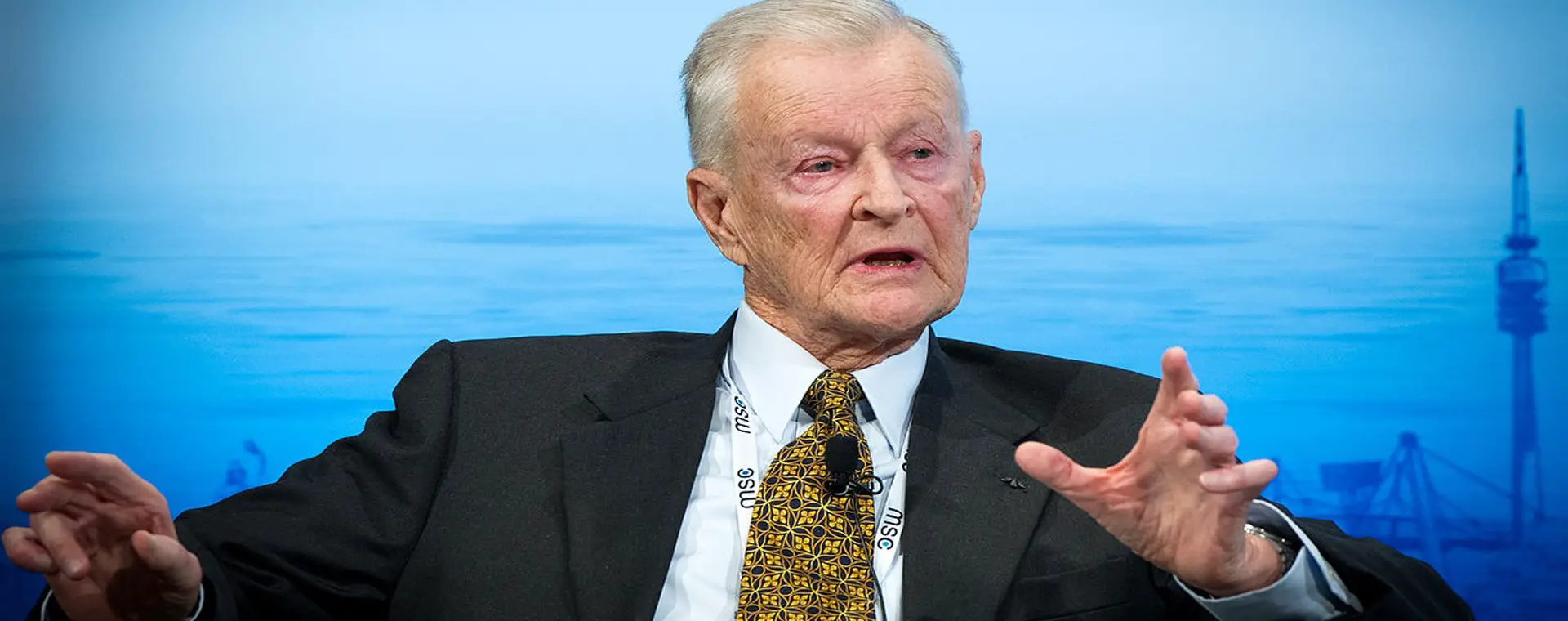
Brzezinski The foreign policy genius who predicted the shape of the world today
Since World War II, the United States has maintained a group of foreign policy elites who have kept their distance from partisan differences and focused on shaping the global order.
Henry Kissinger, George Kennan, Robert McNamara and James Baker. Zbigniew Brzezinski, a Polish refugee who escaped the horrors of war to become US National Security Advisor under President Jimmy Carter, stands out among them.
Brzezinski's life was full of history. From childhood memories of Germany and watching the rise of the Nazis, to his role in normalizing relations with China, advising on the Iranian hostage crisis, and playing a pivotal role in the Camp David Accords. He was one of the first to believe that the Soviet Union could not only be contained, but defeated.
In his later years, Brzezinski sounded a warning: Despite the collapse of the Soviet Union and a booming U.S. economy, a decline in American leadership would be a disaster for the United States and the world.
Journalist Katie Kaye spoke to Edward Luce, author of the new biography "Zbig: Prophet of American Superpower," who explained why Brzezinski's ideas are even more relevant in 2025.
What made Brzezinski unique?
Luce explains that growing up in Poland between the two world wars, and experiencing the Nazi and Soviet occupations, shaped his vision. Like Kissinger, who lost Jewish relatives in the Holocaust, he saw that human civilization is fragile, and that America is not immune to the harsh laws of history.
Luce says: "When we see the geopolitical retaliation happening now, we need to remember how much we need to understand the value of what we have before we lose it, just like health."
Fulfilled prophecies
Brzezinski warned early on about American hubris after the collapse of the Soviet Union and feared a loss of strategic compass. At a time when others were celebrating the "end of history," he saw the greatest threat as the American homeland.
One of his most notable achievements was convincing China to move closer to America in the 1970s, breaking its alliance with the Soviet Union. Ironically, as Luce explains, this decision later helped China rise to become America's greatest adversary today.
He also played a pivotal role in supporting the mujahideen against the Soviet invasion of Afghanistan, which contributed to the subsequent fall of Moscow but also sparked the rise of political Islamism and global jihad.
"History doesn't stop"
Brzezinski and Kissinger knew that history knows no final solutions. Every crisis creates another, and every strategy ends up with unforeseen results. They were relentless pragmatists, calling for dealing with reality, not dreams.
Do we have strategic leaders today?
American universities still produce excellent minds, but foreign policy has become more politicized. There is no longer a demand for big thinkers like Brzezinski or Kissinger. Foreign policy has become a tool of partisan infighting.
What about Trump?
Luce says that Trump doesn't have a "grand strategy", but rather practices big reactions. He sees the world as a jungle, where the strong eat the weak. For him, the Western Hemisphere is America's playground, Russia has a right to Ukraine, and China has a right to Taiwan.
Brzezinski, on the other hand, would have tried to invoke Russian fears of China to drive a wedge between the two adversaries. Trump, on the other hand, united them. "In chess, it is foolish to unite your enemies, it is better to keep them in mutual suspicion."

The Iraqi Institute for Dialogue, the logistical sponsor of the Baghdad International Book Fair, opens its own pavilion at the fair
The Iraqi Institute for Dialogue publishes "The Diplomatic Portfolio" by Dr. Karrar Al-Badiri
Official agreement between Iraqi Institute for Dialogue and the Iraqi Media Network to sponsor The Seventh Annual International Conference of “Baghdad Dialogue” 2025

Invitation to the 79th issue of Dialogue of Thought
Prime Minister: The path of development will make Iraq a regional political and economic powerhouse
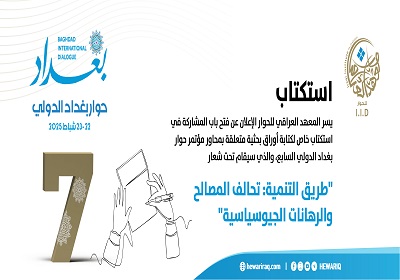
Seventh Baghdad International Dialogue Conference Call for Papers
Praise for the Baghdad International Dialogue: Strengthening Iraq's pivotal role and a meeting point for visions
Comments