


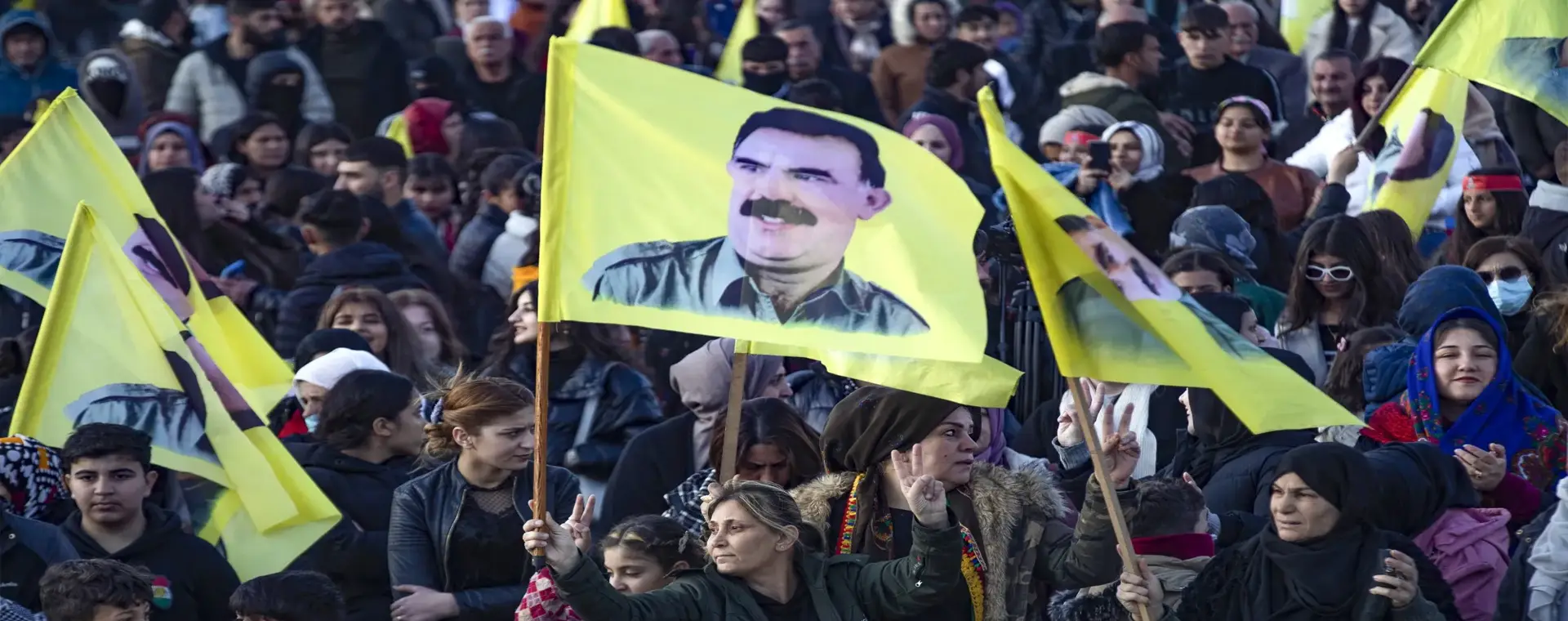
The Kurdistan Workers' Party (PKK): From Armed Struggle to Declaration of Dissolution
In May 2025, the Kurdistan Workers' Party (PKK) announced its official dissolution, ending more than four decades of armed and political struggle, during which its goals and strategies shifted several times, from seeking an independent Kurdish state to adopting the "democratic self-administration" model. This report traces its origins, transformations, conflicts, milestones, and dissolution.
First: Origins and ideological underpinnings
Date of foundation: The party was founded on November 27, 1978, in the village of Fes in Diyarbakir province, with a group of leftist Kurdish students led by Abdullah Ocalan.
Ideological reference: Started as a revolutionary Marxist-Leninist party seeking to establish an independent Kurdish socialist state in Turkey.
Political context: The party was formed against the backdrop of escalating repression against Kurdish movements in Turkey and the political vacuum left by the weakening of traditional Kurdish nationalist movements.
II: The Armed Struggle and Externalization Phase
Armed launch: On August 15, 1984, the PKK launched its first operations against the Turkish army, beginning what became known as the Kurdistan Liberation War.
Centralization abroad: Ocalan moved to Syria in 1979, and the leadership was centralized in Lebanon's Bekaa Valley, with the support of the Syrian regime. Hezbollah members were trained by Palestinian factions.
Rear bases: The group made the Qandil Mountains in northern Iraq its main strategic headquarters after the 1990s and began to expand its regional influence.
Third: Ideological and Tactical Shifts
Moving away from classical Marxism: In the early 1990s, with the collapse of the Soviet Union, the party began to move away from classical Marxism.
Becoming a "Democratic Confederation": After Ocalan's arrest in 1999, the party adopted the ideas of a "democratic nation" inspired by American philosopher Murray Bookchin, calling for democratic autonomy rather than independence.
IV: Milestones of Conflict and Negotiation
1. Arrests and Military Strikes (1980-1999)
This period saw a large-scale military escalation between the PKK and the Turkish state.
The Turkish response included the displacement of thousands of villages and international accusations of widespread human rights violations.
2. Abdullah Ocalan's arrest (1999)
From prison, Ocalan announced his call for a ceasefire and ordered the PKK to withdraw from Turkish territory.
The party began a series of name and composition changes, but continued military activity through multiple fronts such as the Popular Defense Forces.
3. Peace process with the Turkish government (2009-2015)
It saw an unprecedented opening through direct negotiations between the state and Ogalan.
It culminated in the "Dolmabagh Agreement" in 2015, but later collapsed with the resumption of armed operations after the Kobane protests.
V: The regional and international dimension
in Syria: The party founded the Democratic Union Party (PYD) and the People's Protection Units (YPG), which formed the core of the U.S.-backed Syrian Democratic Forces (SDF) to fight ISIS.
in Iraq: The party's influence has clashed with that of the Kurdistan Democratic Party (Barzani) and has sparked ongoing disagreements with the KRG.
in Europe: Its institutions have faced security restrictions, but its political activity has continued through Kurdish civil and human rights organizations.
VI: The stage of decline and disintegration
Security strikes: Since 2016, Turkey has conducted extensive military campaigns in northern Iraq and Syria, targeting PKK leaders.
Internal division: Currents have emerged within the party calling for a change of leadership and a reconsideration of armed options, especially after the decline in popular support.
Internal mediations: There have been initiatives led by Turkish Kurdish parties (such as the HDP) and European mediators to resolve the organization and end the violence.
VII: Declaration of Dissolution (2025)
In May 2025, the party officially announced its dissolution, emphasizing that the next phase would be led by Abdullah Ocalan from his prison in Amrali.
The final communiqué stipulated abandoning the armed struggle, ending the party's organizational structure, and transitioning to political activity through civilian frameworks.
This announcement is seen as the result of internal security pressures, regional and international arrangements, as well as shifts in the convictions of leading circles within the party.
VIII: Evaluation and analysis
Successes:
International spotlight on the Kurdish question in Turkey, Syria, and Iraq.
Building a self-experiment of Kurdish civil administration in northern Syria.
A long endurance in the face of a powerful military machine.
failures:
It caused widespread destruction, internal displacement, and the deaths of tens of thousands of people.
Failed to achieve independence or formal autonomy within the Turkish state.
Internal divisions and the absence of an effective diplomatic strategy.
The end of a path or a new beginning?
The dissolution of the PKK does not necessarily mean the end of the Kurdish cause in Turkey, but rather the beginning of a new phase of civil political struggle. With Abdullah Ocalan remaining a central figure and the possibility of alternative entities or the development of new structures, the future of the Kurdish movement depends on the extent to which the Turkish state responds to demands for identity and rights, and the ability of Kurds to unify their ranks within peaceful frameworks.
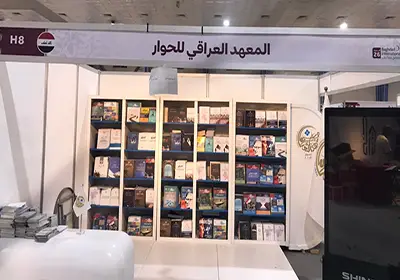
The Iraqi Institute for Dialogue, the logistical sponsor of the Baghdad International Book Fair, opens its own pavilion at the fair
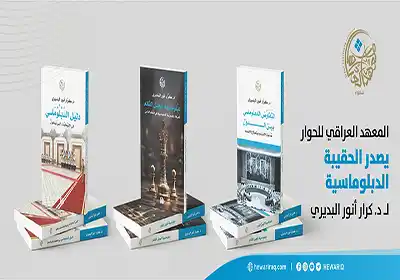
The Iraqi Institute for Dialogue publishes "The Diplomatic Portfolio" by Dr. Karrar Al-Badiri
Official agreement between Iraqi Institute for Dialogue and the Iraqi Media Network to sponsor The Seventh Annual International Conference of “Baghdad Dialogue” 2025
Invitation to the 79th issue of Dialogue of Thought
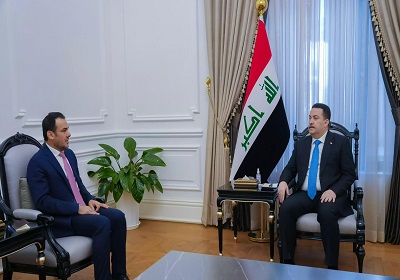
Prime Minister: The path of development will make Iraq a regional political and economic powerhouse
Seventh Baghdad International Dialogue Conference Call for Papers
Praise for the Baghdad International Dialogue: Strengthening Iraq's pivotal role and a meeting point for visions
Comments