



Hewar al-Fikr interviews Minister of Labor and Social Affairs Ahmed al-Asadi on the newly enacted Workers' Retirement and Social Security Law
In its sixty-sixth issue published in June 2023, Thought Dialogue magazine conducted a special interview with Minister of Labor and Social Affairs Ahmed al-Asadi, in which he discussed the main features of the new social security and retirement law for workers, which was recently approved by the House of Representatives.
Al-Asadi emphasized that the law represents a historic step towards rebalancing the public and private sectors, and aims to provide a fair and comprehensive protection umbrella for workers, earners and self-employed people, enhancing their dignity and reducing the continuous migration to government jobs.
The minister stressed that this legislation comes within the framework of the government's vision to address the legacy of decades of discrimination and activate the role of the private sector as a key pillar in supporting the national economy.
The following is a transcript of the interview
Iraq has a huge labor force that constitutes the largest segment of its population. The work of this labor force is distributed between two main sectors. The first is a public sector in which workers are employees and work within the state apparatus, which provides their living requirements in the form of salaries, retirement guarantees and end-of-service benefits, in addition to the facilities, privileges and guarantees that take the form of loans, residential plots of land, sick leave, maternity and maternity leave granted to female employees. The other sector that absorbs the labor force in Iraq is the private sector, in which workers are linked to the market economy and depend on the rents resulting from the sale of labor or trade exchange.
Despite the economic recovery that Iraq witnessed after the lifting of economic sanctions in 2003, the inflation in financial revenues resulting from the export of oil resources, the increase in the volume of internal and external trade exchange and the significant rise in the wages and incomes of private sector workers, the private sector in Iraq remained anxious, unstable, unattractive and susceptible to bleeding and the continuous migration of its workers to the public sector in a way that led to an unprecedented inflation in the size of the latter. The reason behind the continuous migration of workers in the private sector has never been economic and is not motivated by the desire to raise the level of income and improve the standard of living.
On the contrary, wage rates in the private sector and the liberal professions are generally higher than those of state employees. However, the reassurance and psychological stability provided by a government job is the main motivator behind the rush to get a government job.
Workers in the private sector live in chronic fear of losing their livelihoods if they are exposed to personal emergencies such as illnesses, work injuries, arbitrary dismissal, or public incidents such as the interruption of their economic activities due to epidemics, wars, etc. In addition to the worry that they will be unable to work and provide for their families as they grow older.
The policies of successive governments, which focused on distributing privileges and gifts to state employees to ensure that they do not join protest movements and win their electoral votes, have contributed to increasing the desire of Iraqi workers to join the ranks of the public service.
However, the new Iraqi government, which took over the reins at a sensitive historical stage in the country's life, is aware of the importance of adopting a balanced approach that takes care of the human dignity of the Iraqi labor force in both the public and private sectors. Hence the need for legislative and legal intervention that is fair to the segment of workers, the self-employed, the gainfully employed and even the unemployed, in a way that revitalizes the private sector, does justice to its workers and preserves their dignity while reducing pressure on the bloated public sector and reducing the demand for government jobs, the provision of which is at the forefront of the slogans of the various demand movements.
In this context, the editorial team interviewed Journal of Intellectual Dialogue Mr. Minister of Labor and Social Affairs Mr. Ahmed Al-Asadi to review the government's legislative policies and ministerial measures aimed at correcting the previous approach and removing the legacy of decades of burdens that weighed heavily on those working in the private sector, especially the Social Security and Retirement Law for workers, which was recently voted in the Iraqi Parliament, which some observers consider one of the most important legislations adopted in Iraq in many decades, as the effects of its implementation will be reflected on a huge and important segment of Iraqi society
Dialogue of thought: Before discussing the benefits of the social security and retirement law for workers, are there statistics on the number of workers in the private sector as well as the number of companies and the percentage of foreign workers?
Minister Ahmed al-Asadi: Regarding the number of workers, we have an estimated (approximate) statistic that the number of workers is not accurate, saying that the number of workers in the private sector in the organized and unorganized sector reaches about 6 million workers, while the number of those registered in the insurance is 600,000, or ten percent, while ninety percent are not registered in the insurance department.
Undoubtedly, the Workers' Retirement and Social Security Law is one of the most important laws enacted in the Iraqi Parliament, not in this session, but we can say throughout the past sessions, as it was enacted to amend the 1971 law, about 52 years ago, and no amendment has been made to this law since that date. The new law included many features, and perhaps the most important feature that entered into this law is the government's contribution for the first time to the retirement suspensions, so that the government gives workers in the sector 8% of the retirement suspensions at a time when the worker pays 5%, while the employer pays 12% so that the total retirement suspensions are 25% equal to the employee's retirement suspensions: Previously it was seventeen percent. As you know, the employee's pension suspensions are 25%, ten percent is deducted from the employee's salary and fifteen percent from the state, now a worker employed in the organized sector of the private sector also has his pension suspensions become 25%, eight percent from the state, twelve percent from the employer and five percent from the worker himself.
Dialogue of thought: Back to the main topic of our conversation, what are the advantages of this law? Did the law come to ease the burden of the demand for public sector work?
Minister Ahmed al-Asadi: What is very new is the inclusion of the unorganized sector, which we call the self-employed, such as taxi drivers, barbers, shop owners... For decades, this segment did not have any insurance, so we defined a guarantee for them called the Voluntary Insurance for Self-Employed Workers (VIS). According to this guarantee, the beneficiary pays 5 percent while the government pays 15 percent, about three times what the beneficiary pays, for a total of 20 percent. This is the most important achievement of the new law, as the self-employed person is now a guaranteed worker. For example, a woman who sells fish and milk, for example, can now register under this law, and if she pays 5,000 per month, the state will pay 15,000 per month for her, as well as if there is a worker with a monthly income of 500,000 dinars, he will be able to pay 25,000 dinars per month and the state will pay 75,000 (three times) on his behalf. After 15 years, he will receive a pension of no less than 500,000 dinars per month, which is the minimum salary.
Dialogue of thought: There are some concepts, terms and details related to this law that are ambiguous and need to be clarified as a matter of precision, for example, what is the definition of a worker, what are the categories covered by this law, and what is the organized and unorganized sector?
Minister Ahmed al-Asadi: Regarding the question about the organized sector and others, the organized sector refers to large and small companies, factories, factories, factories, hotels, malls and restaurants, while the unorganized sector includes everyone who works for himself, from construction workers to barbers, taxi drivers and porters, or the so-called self-employed.
Dialogue of thought: Is there a distinction between degree holders working in the private sector and those working in other trades?
Minister Ahmed al-Asadi: This depends on the salary, for sure, for example, someone who has a doctorate in computers, for example, and works in a company in the private sector and earns a salary of one and a half or two million dinars, for example, his retirement stops will definitely be larger and his retirement will not be less than 800 thousand or 900 thousand dinars, as for those who do not have a degree, and works for the minimum wage, which is 350,000 dinars, this figure will be raised by us to 450,000 dinars, and thus there will be a difference in salary, because the pension depends on the actual practical salary, the higher the salary he earns, the higher his retirement will be in the same proportion.
We also put in this law that the upper limit of the pension is two million dinars, which the state will pay. (The state will not pay him more than this figure from the pension guarantee), meaning that the minimum limit is three hundred and fifty thousand dinars, while the maximum limit is two million dinars.
Dialogue of thought: What mechanism does the ministry use to force employers and companies to register all their workers?
Minister Ahmed al-Asadi: The only mechanism is the inspection of factories, companies, restaurants and others, but this case is only ten percent effective, and this is due to two reasons: We have a severe shortage of inspectors, and I will give an example, for example, in Basra governorate, which is one of the most important governorates with companies, followed by Nasiriyah governorate, we have three labor inspectors in Basra, and Nasiriyah, which has gas and oil companies, restaurants, factories, malls and others, has three inspectors, the question here is how they can cover these companies, factories and others.
Secondly: In addition to the lack of inspectors, there is great pressure exerted on them, in addition to the temptations offered to them. For example, instead of registering a thousand workers in the company, the inspector registers a hundred people and leaves the other nine hundred, in exchange for a bribe, which has a very big impact.
What we did is that we asked the ministries that have excess staff to transfer them to the Ministry of Labor and Social Affairs, but no one was transferred to our ministry. In fact, the Minister of Electricity and other ministers circulated letters inviting employees working within these ministries who are willing to transfer their services to the Ministry of Labor. Of course, no one wanted to do this, as the salary allocations in these ministries are higher than those of the Ministry of Labor and Social Affairs. An employee receives, say, a million and a quarter or more in his ministry, while if he is transferred, he will receive about 600,000. Therefore, I will submit a proposal to the Council of Ministers in which I propose that the employee be transferred from his ministry to work at the Ministry of Labor and Social Affairs, provided that the employee continues to receive his salary from the ministry from which he was transferred.
In addition, the Ministry of Labor and Social Affairs' share of higher education appointees, whose number reached 74,000, was only 1,600 employees. Eight hundred and forty of them have the title of researcher, and the other eight hundred will be assigned to work in security and labor inspection, as far as inspection is concerned.
On the other hand, the ministry has put in place mechanisms based on carrots and sticks to discourage companies and factories from registering all their workers. For example, where we said that the employer who registers all his workers will be given incentives such as reducing fees, taxes and so on, on the other hand, the employer who does not register his workers and is discovered will be fined heavy fines not less than five million and not more than ten million this direct fine, as well as the period that the worker worked will be taken a fee and multiplied by five times, and will be a heavy fine on the employer, all in order to push them to register the workers, this is in order to push them to register workers.
Dialogue of thought: Can you clarify the method adopted by the law to reveal the correct salary figures received by the worker from the companies, to counter manipulation of the figures? What are the penalties for violators according to this law? Clarification (who earns one million but the employer registers him with a salary of 350,000 to reduce the 12%)?
Minister Ahmed al-Asadi: Of course, this is a big issue, we now have 600,000 workers who are all registered as receiving a monthly salary of 350,000 dinars, knowing that some of them are engineers and holders of degrees of various specialties. Of course, this matter is done after the agreement between the employer and the worker. Addressing this issue is by educating the worker and explaining that disclosing the correct and real number of your salary (although this will mean an increase in pension suspensions), but this will mean increasing the percentage of what is paid to you in the form of suspensions to reach what is paid from suspensions to the percentage of twenty percent and will be in favor of your pension and your family after you. The ministry has allocated three phone numbers to receive complaints from employees.
Dialogue of thought: According to what is being circulated according to statements that the pension is a minimum of 500,000 dinars, what is the upper ceiling of the pension in this law?
Minister Ahmed al-Asadi: As a matter of fact, previously, the pension for workers was 400,000 dinars, as everyone received a single salary. However, through this new law, we raised the salary of a retired worker to 500,000 dinars, which happened immediately after the publication of the retirement and social security law for workers in the Official Gazette, i.e. an increase of 100,000 dinars. With the start of this law, the minimum salary will be 500,000 dinars.
As for a worker who earns a salary of more than 500 thousand, let's say, for example, a worker who earns a monthly salary of one million or one and a half million dinars, he will definitely pay higher amounts for pension suspensions, according to his salary, in addition to state support, so of course his pension will increase. The upper limit of the suspensions imposed on salaries of two million dinars, on which the pensioner receives a pension of eighty percent of this figure, i.e. a maximum of one million and six hundred thousand dinars.
Dialogue of thought: Does this law play a role in regulating the economic market, and I mean even in terms of foreign labor? What are the penalties facing employers who employ workers who enter the country illegally?
Minister Ahmed al-Asadi: Of course, the law did not talk about foreign workers; because dealing with foreign workers is in the Labor Law No. 37 of 2015 and its instructions in force, which says that whoever employs a foreign worker must employ an Iraqi worker in return, and if it is proven otherwise, the employer will be subject to severe and harsh fines, as most employers in this regard are companies, so the fines are large, and we took a decision in the Cabinet two months ago regarding investment projects, whereby 30% of foreign labor was imposed to be matched by 70% of Iraqi labor, in other words, a foreign worker in investment projects is matched by two Iraqi workers to comply with the law. In other words, a foreign worker in investment projects must be matched by two Iraqi workers in order to comply with the law.
Of course, we emphasize that the lack of adherence to these laws is due to the shortage of inspectors, and God willing, we will gradually try to address this shortage.
Perhaps the most important paragraph in the law that helps to implement it is the obligation of the department to automate the Department of Social Security within a maximum period of one year. The good thing is that we started from the first day we received the ministry (Ministry of Labor and Social Affairs) to understand with Iraqi and international companies to automate all the ministry's departments, and they have already submitted their offers, and they have been working inside the ministry for three months. The departments have been divided among international companies, and God willing, next week they will start working.
God willing, by the end of this year, all the ministry will have completed the automation phase, especially the Department of Social Security, and this automation system will greatly facilitate work and performance monitoring. The company that will start with the Department of Social Security will adopt the fingerprint (eye print), so every worker from his home can access the application through his phone, register in the Department of Social Security, pay fees and conduct all electronic transactions while at home without the need to visit the department.

The Iraqi Institute for Dialogue, the logistical sponsor of the Baghdad International Book Fair, opens its own pavilion at the fair
Official agreement between Iraqi Institute for Dialogue and the Iraqi Media Network to sponsor The Seventh Annual International Conference of “Baghdad Dialogue” 2025

The Iraqi Institute for Dialogue publishes "The Diplomatic Portfolio" by Dr. Karrar Al-Badiri

Invitation to the 79th issue of Dialogue of Thought
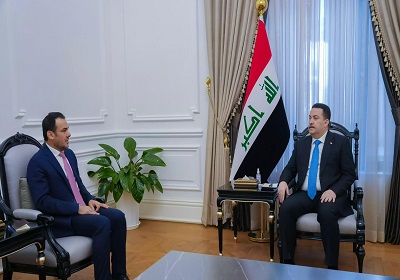
Prime Minister: The path of development will make Iraq a regional political and economic powerhouse
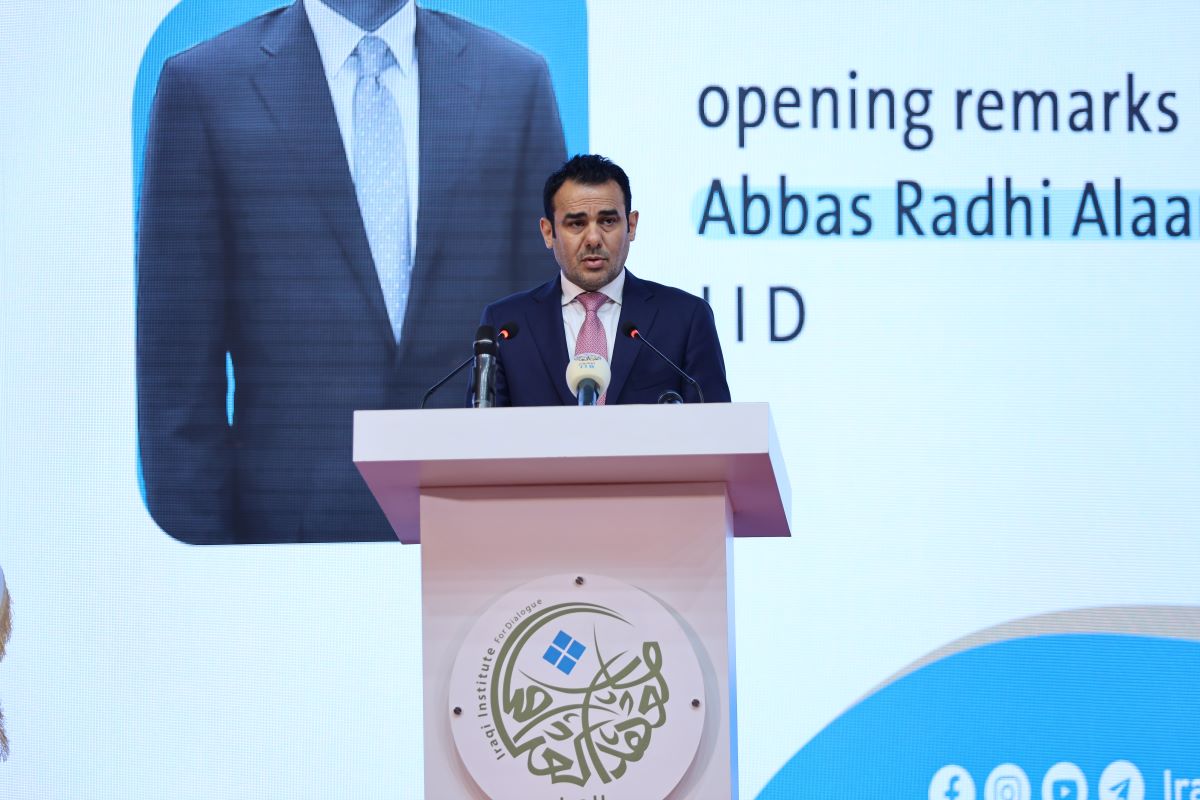
Speech of the Director of the Iraqi Institute for Dialog at the Sixth Baghdad International Dialog Conference
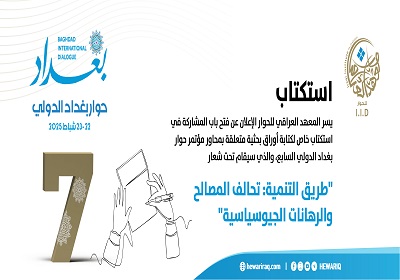
Seventh Baghdad International Dialogue Conference Call for Papers

Comments