


Translation: Iraqi Institute for Dialog
Why is Taiwan simulating a Chinese attack in 2027?
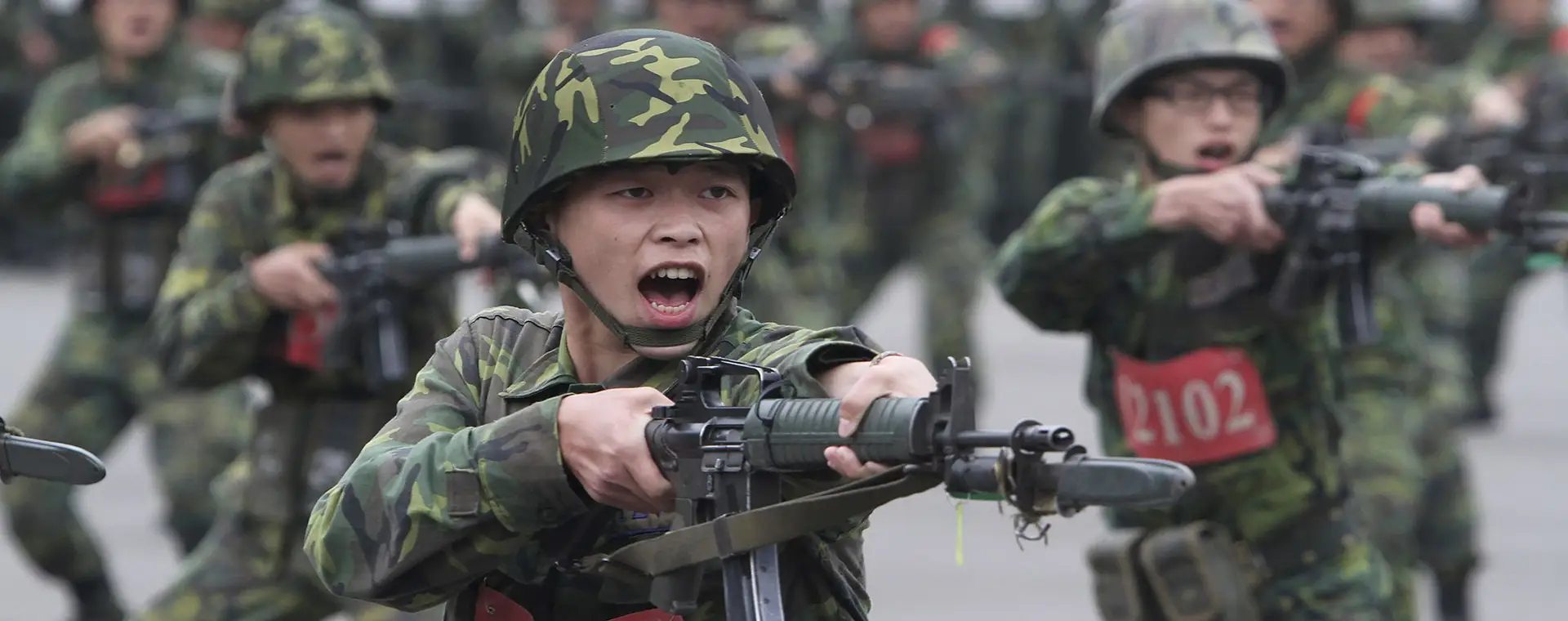
As Beijing continues to mount pressure on Taiwan, the island began its annual military exercise known as "Han Kuang" on July 9. However, this year's maneuvers differ in two key aspects from previous years:
1. Wider scope: The exercises will be larger than ever before, with live operations - using live ammunition - spanning ten days instead of five, and including unconventional aspects such as "gray zone harassment" (i.e., indirect provocative actions) and "whole community resilience" tests.
2. Focus on a specific date: This year, the maneuvers simulate a scenario of a possible attack from China in 2027.
What are Han Kuang maneuvers?
This is the 41st year of Han Kuang, Taiwan's largest annual military exercise, which focuses on how to respond to a Chinese invasion.
It was first launched in 1984, at a time when Taiwan was still under Kuomintang (KMT) military rule, while China had just begun its "reform and opening up" policy, which later catapulted it into the ranks of major economic powers.
Just five years before this launch, the United States had moved its diplomatic recognition from Taipei to Beijing, ending the mutual defense agreement with Taiwan.
Over the years, the nature of these maneuvers has evolved. Whereas in the past they were based on pre-prepared "Red Team vs. Blue Team" scenarios, last year's maneuvers were conducted for the first time without a preconceived scenario, so that attacks could occur "anytime, anywhere, and with any type of weapon."
What's different this year?
This year's field exercises will also be conducted without a script and will run from July 9 to 16, 24 hours a day, twice as long as usual.
More than 22,000 reservists will participate, compared to 15,000 last year.
Modern weapon systems will also be tested, including:
HIMARS mobile launchers.
TOW-2B anti-tank missiles (US-made).
Drones.
Indigenously developed Sky Sword II missiles.
According to Taiwan's Ministry of Defense, the maneuvers begin with "gray zone harassment" exercises, before moving into five phases that include:
The transition from peace to war.
repelling an all-out assault and a coastal landing.
Deep defense and a war of attrition in case the enemy penetrates into the island's territory.
Exact details about the "gray zone" exercises have not been made public, but this type of threat-which does not amount to war-is increasingly seen as a serious threat in Taiwan. One lawmaker stated in April that China's use of naval militia ships, illegal sand drilling, or drones could be the beginning of an actual attack, not just harassment.
On July 3, a Taiwanese admiral named Mei Chiachu categorized six types of "harassment": Legal Warfare, Cognitive Warfare, Attrition, Coercion, Deterrence, and Provocation.
Taiwanese President William Lai recently said that his country is constantly preparing for this "kind of war without gunpowder."
What about civil society resilience?
The exercises will also include tests on military-civilian integration, such as air raid alert, evacuation, shelter-in-place, and rescue drills. It has been reported that citizens who do not comply with evacuation orders may face a fine of up to $5,000.
An analyst at the State Defense and National Security Research Institute described these moves as "a turning point in Taiwan's defense strategy" and "a comprehensive attempt for the society to withstand the worst-case scenario."
In June 2024, President Lai established the National Defense Resilience Committee to coordinate community responses to emergencies.
Why does 2027 matter?
Another fundamental difference is the assumption that China may launch an attack in 2027, which Taiwanese Defense Minister Wellington Kuo has stated.
Those familiar with the "Davidson Window" know why this date was chosen. The theory is attributed to US Admiral Philip Davidson, former commander of the US Indo-Pacific Command, who said that Xi Jinping may be preparing for a possible attack in 2027.
The date coincides with Xi's plan to transform the PLA into a "modernized" force by its 100th anniversary in 2027 and marks the end of his third term as president.
Although this theory has lost some momentum in Washington recently, its use in the Taiwan maneuvers could give President Lai a political boost, especially since the next presidential election is in January 2028.
Domestically, Lai - from the pro-independence Democratic Progressives Party - faces challenges in his second term, such as a legislative stalemate as a result of opposition from other parties to his attempts to raise the defense budget to 3 percent of GDP.
The growing threat from China may turn this challenge into an opportunity to boost his political standing.
How does China view these maneuvers?
Taiwanese media published the opinion of Chinese scholar Cheng Yuli of the Chinese Academy of Social Sciences, who described the 2027 date as "fabricated" and intended to "increase arms sales, not promote peace."
Chinese state media attacked Han Kuang's maneuvers. The Global Times wrote that President Lai's goal with these exercises is to create "a military force that can be controlled, used and sacrificed for Taiwan's independence and his separatist fantasies."
On July 8, the day before the drills began, China's Defense Ministry called the drills a "DPP show" and accused the DPP of trying to "drag the Taiwanese people behind the independence bandwagon."
The Xinhua news agency said the pursuit of independence by force is a "dead end," adding that "no training and no weapon can beat the sword of the People's Liberation Army or stop the historic path toward reunification with the motherland."
Is an attack in 2027 really possible?
There are different analytical views. First, many doubt that Xi Jinping really wants to go to war.
The attack would cost China dearly, at a time of economic crisis and trade tensions with the West. Bloomberg estimates that in 2024, an invasion of Taiwan would cost the world about $10 trillion - 10% of global GDP.
Some believe that Xi prefers to achieve "reunification" by non-military means, such as pressuring Taiwan's ruling party, intensifying gray zone tactics, or even imposing an economic-naval blockade.
Other dates are on the table:
2035, when China aims to have a "fully modernized" military, and 2049, on the 100th anniversary of the founding of the People's Republic of China, when it plans to build a "world-class" military.
There are also questions about the readiness of China's military after an anti-corruption campaign that particularly affected the leadership of the missile and naval forces.
In a report issued by the US Office of the Director of National Intelligence in March 2025, the anti-corruption campaign was seen as evidence of concern that corruption could hinder the Chinese military's combat readiness by 2027.
Xi is worried about his international image, especially as he seeks to present his country as a "non-interventionist" unlike the United States.
Regional positions - such as Japan and the Philippines - also carry weight.
In the end, the unpredictability of Trump's behavior remains a sore point.
Its bombing of three nuclear facilities in Iran showed Taiwan that a military option is possible, and the Financial Times quoted a Taiwanese source as saying that this "could be a useful deterrent against China."
However, Trump has not made a definitive statement on whether he would intervene if China attacked Taiwan.
In a recent statement, Dennis Blair, former commander of the U.S. Pacific Command, told Taiwanese media, "2027 is just a date... "By then, Taiwanese and U.S. capabilities will have already surpassed those of the PLA.

The Iraqi Institute for Dialogue, the logistical sponsor of the Baghdad International Book Fair, opens its own pavilion at the fair

The Iraqi Institute for Dialogue publishes "The Diplomatic Portfolio" by Dr. Karrar Al-Badiri
Official agreement between Iraqi Institute for Dialogue and the Iraqi Media Network to sponsor The Seventh Annual International Conference of “Baghdad Dialogue” 2025
Prime Minister: The path of development will make Iraq a regional political and economic powerhouse

Invitation to the 79th issue of Dialogue of Thought
Seventh Baghdad International Dialogue Conference Call for Papers

Praise for the Baghdad International Dialogue: Strengthening Iraq's pivotal role and a meeting point for visions

Comments