



Dr. Abdul Amir Kazem Zahid in an interview with Dialogue of Thought: Toward a Rational Strategy to Confront Religious Violence
In this issue (77 - 78We interviewed Prof. Dr. Abdul Amir Kazim Zahid, an experienced professor at Kufa University who retired in 2018, and asked him a series of questions, and his answers were as candid as ever.
Dr. Abdul Amir Zahid holds three doctorate degrees in comparative international law, a doctorate in comparative religions, and a doctorate in philosophy of religion, from three universities: Baghdad University, Saint Joseph University of Beirut, and the Lebanese National University. Born in Najaf in 1950, he held various positions, including Dean of the Faculty of Arts at Kufa University, Advisor to the Prime Minister for Academic Affairs, Chairman of the Board of Trustees of the House of Wisdom, Dean of the Faculty of Islamic Sciences at Karbala University, Director of the Kufa University Studies Center, Chairman of the Graduate Studies Committee of the Faculty of Jurisprudence at Kufa University.
He is the author of more than 67 published works, including: Studies in Islamic Economics - Qur'anic Linguistic Issues, Islamic Political Thought, Criticism of the Religious Foundations of Contemporary Fundamentalism, Ibn Rushd's Jurisprudence: A Critical Study, Interpretation and the Problem of Interpretation, The Heritage Controversy and the Secularization of the West, and a complete exegetical code and books that became university courses and then two books that included his second and third theses.
His scientific approach is characterized by academic originality, with a mix of knowledgeable and deep knowledge of the seminary curricula, due to his upbringing in Najaf, and his relationship with the leading jurists in Najaf, at the forefront of which is the late Muhaqiq Sayyid Muhammad Mahdi al-Kharsan, who accompanied him from 1986 until his departure with a satisfied and satisfying soul.
Dialogue of thought: In fact, I would like to devote this interview to talk about a very important topic that has become the main concern of the world in general, the region in particular, and Iraq in particular and more precisely, which is the issue of extremism leading to violence, its contraindications and motives, which you discussed in two dissertations to deconstruct extremism, especially in your third dissertation on the precursors and contraindications of extremism among Imamite Shiites.
What was the motivation behind this thesis, or the book now that it has been published, and what events or developments influenced your decision to write on this topic?
Dr.. Abdul Amir Zahid: Greetings, admiration and appreciation to the literary brother, Dr. Ali al-Maamouri, I would like to express first of all my pleasure to dialogue with a leading mind and a critical mindset and a glorious and promising researcher. As for the story of the thesis, it began when I was defending my second thesis (the problem of understanding texts among contemporary Islamic fundamentalisms) at the Jesuit University, when one of the examining professors asked me about the extent of the existence of a Shiite fundamentalism that uses violence to impose its vision, and it was a big and puzzling question, perhaps a problematic question, and it requires I was so concerned that I discussed it with the brilliant sociologist Prof. Dr. Talal Atrissi, who was then the Dean of the Higher Doctoral Institute at the Lebanese University, and we discussed with clear concern until this became the subject of a thesis I registered in that institute, which is the third thesis supervised by the same Professor Atrissi in the corridors of the Lebanese University in early 2016.
During the epistemological preparations for writing the thesis, we had to suspend our subjective feelings and the accumulated ideological and cognitive accumulation, heading towards the formulation of screening and investigation criteria to answer the question: Is fundamentalism a product of history or of epistemological repercussions that coincide with all times? We ended up developing a criterion with five entries, which can be applied to all belief systems to conclude that (either they drive violence, welcome it, are silent about it, neutral about it, or reject it and prevent it). We put the criterion in the introduction of the thesis and applied it to the "Shiism system" to search for the existence of "structural" resistance that prevents it from slipping into violent Shiite fundamentalism, because I have concluded that (traditional religious thought), whatever it may be, can slip into extremism, radicalism, violence, cruelty and the elimination of the other, and in order not to fall into this trap, it needs to stimulate the elements of resistance that are among the five components of the normative system). The reason for stimulating them is to prevent the decline of the religious taste) towards violent extremism, which takes away "the adoption of humanity as an asset and a weighting factor when conflicts between texts arise".)
The impulse was:
First: A normative and objective examination of Shiite thought in the midst of the frightening escalation of other fundamentalisms, and considering the result as a preference for the option of tolerance, tolerance, dialogue, humanization and rationality, especially when we find within the Shiite path "violent extremist opinions", although they are very few with the fragility of their evidence
This coincided with the escalation of the takfiri wave in eastern Syria, the growth of the takfiri "tumor" and the completion of the preparations for the attack on Iraq in 2011-2014 under the pretext that (the majority of them) had strayed from their religion, which "they" understand in their own understanding. The research asks: Are Shiites really hostages to violence, extremism and revenge? Is it fair to accuse them, distort their existence, and fabricate justifications to keep the equation of historical injustice in force because they are different and rejected, once for their opposition to the authorities, or for going against the (authoritarian) consensus, and thirdly because they do not believe in what that consensus believes in, whose becoming was linked to the becoming of the authoritarian authorities and was a backing and incubator for them. All of these factors are sociological inputs to the Salafi imagination of Shiites
Dialogue of thought: On this basis, Dr., who is the target audience for this thesis/book, academics and researchers only, or the general public interested in religious and social issues?
Dr.. Abdul Amir Zahid: Usually university theses are (a scientific paper subject to examination and evaluation), but when it turns into a book like the rest of the books, its researcher thinks about the target, and I think that the thesis of resistance was addressing the Shiite mind, which confused (essence) with presentation, authenticity with fundamentalism, and thinking with takfir, and mixed in its accumulations This created an emotional reaction to some of the fatwas and opinions interpreting the narratives in a way that expresses (the contract of fearful retreat) from the opposing religious tyranny.
The second target group may be those non-Shia brothers who have adapted themselves with effort to aspire to understand the other, and to accept the removal of the veils of the other to understand the truth of the historical situation, a long and arduous goal that requires removing the distortions introduced by the books of mullahs and nahl or teams and articles for ten centuries.
Finally, I can say that I address any scientific mind, whether religious, secular, or agnostic, based on the criterion of the outputs of the philosophical, ideological, and systemic components that establish psychological responses to ideas, things, and people in order for those responses to be objective, moderate, and fair in order to provide itself with epistemological value.
However, I am not sure that the general public is haunted by a ritualistic religiosity in which religion and history, text and human experience, have merged into a "divinity over holiness".
I say: I am not sure that these concepts and ideas will caress his obsessions, his historical complex, his adoption of fallacy and hypocrisy, and his insistence on promoting hatreds through naivety and the banality of intellectual flattening, which - in all bitterness - I see growing in the absence of caring for the rules and principles of logical and organized thinking in our cultural atmosphere.
Dialogue of thought: What is the main message you want to convey to the reader through this thesis/book, and how do you see this book contributing to a deeper understanding of the phenomenon of religious violence?
Dr.. Abdul Amir Zahid: Perhaps the most complex thing that characterizes our current cultural scene is the intractability and atrophy of the positive reception of the Islamic intellectual heritage and the emergence of negative and destructive reception in its place under (religious titles), that is, the person who reads a religious heritage, or listens to a religious speech, his mind goes to what is negative in kind and effect because it is easier than thinking about what is positive, and this current is dangerous because the high noble values that are overcome in this pattern of reception are more difficult for the ritualistic mind This current is dangerous because the noble values of nobility that are overcome in this pattern of reception are more difficult for the ritualistic mind, so I found that this work may open a small gap in the wall that insulates our reality from the sun of proof-based immersion in knowledge.
Another issue is that when you look at religion, and your view of religiosity varies so that the white thread appears clear, you are in front of a social phenomenon and not (fixed religious sanctities), so I was keen to rely on the sociology of vision and treatment to dive deep into the phenomenon of the intellectual structure of the Shiite mentality that moves all the Shiite path towards a humanitarian, just, tolerant and friendly towards the other, leaving the methodology of relying on texts and traditional codification to those who improve it, as the world today is sociological in treatment.
Dialogue of thought: What challenges did you face during the research and writing process, and how did you overcome them?
Dr.. Abdul Amir Zahid: Perhaps the biggest challenge that stood in front of the research was the uncertainty of my ability to achieve the robustness of weighting when the opinions of the Imamiyya jurists are multiple, and their understanding of the texts varies, because what I know is that the taste of the jurists after the time of the father narrators (Sadduq the father, al-Kalini, and Sadduq the son) was multiple according to the age and nature of the narrators and jurists, the policies directed against them, the nature of the society they deal with and the extent of their society's awareness and its degree of acceptance of the jurists' understanding - despite its multiplicity -. I can say that the most prominent challenge is the Shiite news path, which had opinions that do not help us to prove the peaceful path of the Imamite Shiites, especially since there are some jurists who were influenced by them and tended to their way of understanding religion, which required me to mobilize evidence of the preponderance of the rational and enlightened line in their times or after, as the task is more difficult than establishing the fatwa.
Dialogue of thought: What does this book offer that is new compared to previous studies in the same field, and what do you consider to be the most important and original points in this work?
Dr.. Abdul Amir Zahid: Perhaps talking about the novelty of the thesis in the full sense is difficult, as most human studies are accumulations of previous studies, but the capable researcher selects from them what is more profound, accurate analysis and more reliable in its data, and by accumulating these abstracts, he places himself between these studies, either he discovers a loophole that has not been worked on and becomes his goal at the same time or he criticizes the mainstream and reserves it or completes a deficiency in it or sets a new path. I can say that the novelty of the thesis is "that fivefold criterion that we called the engines of takfir on page 21 of the book, then the attempt to quantify the emergence of the general fundamentalist phenomenon among extremists (stages of intellectual Salafism) in addition to the fundamentalist reference of Salafi thought plus extremism and its consequences such as violence, and I claim that my attempt to differentiate between multiple fundamentalisms was a new inductive research.
I also think that it is new to draw conclusions from the Shiite heritage (p. 164) and interpret the interjected additions to the narratives in the books of the middle age - such as Bahar al-Anwar, for example - and reproduce the ideas of the zealots and sort them from the general narratives of the moderates, "although I found that most of the Shiite exaggeration was a psychological reaction to the oppression and power of the authority and its attempts to eradicate Shiism.
The thesis evaluated Sayyid al-Khoei's Sindhi methodology in producing the Dictionary of the Men of Hadith and its six introductions at the beginning of the encyclopedia, which put those aspiring to understand Shiite narratives on a rigorous methodological path.
The most important conclusion is that I did not find a "frequency of understanding" among the Shiites that carries a purifying content for the other, as is the case with most Muslim jurists, although if it existed, it would have justified the cruelty and exclusion they have endured historically, but their heritage remained determined to produce a peaceful, coexistent, merciful, and epistemological heritage.
In addition to bold positions in narrowing the space of "those covered by fraud" (p. 211), there may be other places that I think are from detailed innovation rather than total innovation, which I leave for those who read the thesis in all its joints.
Dialogue of thought: How does Dr. Abdul Amir Zahid define religious violence in his book/thesis, and in your opinion, what are the factors that lead to the transformation of religion from a source of peace to a source of violence?
Dr.. Abdul Amir Zahid: The introductory research in the thesis was a conceptual introduction that entered the corridors of "jihadist" thought. It concluded that the merciful, missionary tendency, which carries the torch of guidance to enter the spaciousness of divine approval, is the basic and even fundamental tendency in the "religious content" of Islam, but human representations or embodiments of religiosity "human understanding" left this content to another path, namely the path of dispute over the ownership of the subsequent vision-making, for example the position of the early caliphate on the rebellion in the periphery of the island, which was called the "apostate" war, and the understanding of a "group" that opposing Uthman ibn Affan required assassination and murder. and the understanding of a "group" that opposing Uthman bin Affan requires his assassination and killing him, or that the Kharijites' understanding of the verse (the rule is except for God) in an interpreted understanding that led to the transformation of a circumstantial vision into a radical theory to confront the Republic of Ali, peace be upon him, and cause its end to become the order of the nation for Muawiya, if things are according to their consequences and results, then that violence that was attached to religion is a desert understanding of the text devoid of any amount of dew, then if we walk with this history we will not find - except very rarely - the policies and hands of For example, Al-Barbari's group in the fourth century in Baghdad, Ibn Taymiyyah's violence, and the Brotherhood of Muhammad ibn Abd al-Wahhab as a series that combined religion and violence, religion and history, and religion and the confiscation of human rights.
As for peaceful groups such as philosophers, Sufis, Ikhwan al-Safa, Shiites, and all Rahmanis, they were between exclusion and displacement, repression, defamation and takfir, and this vision has too many evidences in our history, so it has prevailed over tolerance and centered in the current mind and was "a contemporary acceptance of violence."
So the nutrients of violence in our historical personality are "the race for power and booty, and the primitive understanding that cannot leave a historical human experience" that thinks it is the only embodied model of religion, and the corrective standard for the behavior of subsequent generations.
The most important means of becoming violent are the Salaf, the story of consensus, the sanctity of the Salaf, preventing rationality, stopping scientific criticism and analysis, and criticizing the ambiguous interpretation of texts, these means affect the social mind, pulling it from the spaciousness of a compassionate Islam to an aggressive Islam.
Dialogue of thought: Having addressed religious factors, it is perhaps important to ask what role social and political factors play in fueling religious violence, and how do these factors interact with religious factors?
Dr.. Abdul Amir Zahid: For example, the policies of discrimination between Arabs and Mawali were declared policies even when they were Muslims, Arabs and Quraysh, and gave Quraysh preferential privileges, then the group of the Caliphate chair, and their opponents, then the terms (Ahl al-Sunnah) versus (Ahl al-Bidaa) appeared, then the terms (Ahl al-Sunnah) versus (Ahl al-Bidaa) appeared: Mu'tazila, Ash'arites, Maturidis, Sufis, Shiites, Kharijites, etc.) and the emergence of (those whose Islam is good and those whose Islam is suspect), and in this fissile form of society, social power was lost, and then this society will have the ability to fall into the trap of reciprocal violence, the violence of the authority against its opponents, and the violence of groups against others and the state, and clearly in the eighties we found those who declared the takfir of the state, army, police and state employees in the speeches of the jihadists.
From the above, it is clear that the idea of Islamic internationalism was more of a political slogan than actual policies committed by rulers and scholars, and perhaps the preoccupation with social divisions made science and knowledge a monopoly for non-Arab Muslims, leaving the Arabs to govern, administer, and lead the legions of "conquerors!"
The fading of the "tendency towards dialog, understanding, and knowledge: In light of the systematic repression adopted by the experience of governance after the Prophet, many people resorted to the easier path of imposing a religious reality or a specific reading of the text on everyone through soft violence and coercive means.
The social retreat from the environment of dialogue, coexistence and understanding did not remain on (ideological groups), but the extremists convinced the sultans to create a single-visioned social reality, perhaps as an example of the policy of Al-Qadir Allah (420 AH) who issued (Manifesto) for the state's policy, doctrine and opinion that its citizens should not go beyond it or else be punished. The cooperation between Ibn Taymiyyah and the authorities of his time in getting them to invade Mardin and exterminate all its people as apostates, and thus extremism jumped from the space of society to the platform of political decision-making.
Otherwise: The rule of loyalty and baraa is not a purely religious rule as much as it is a rule for engineering a shackled society (by baraa!!!) from all those who disagree with them, and the doctrine of the surviving band is the legal justification for killing (72) groups of Muslims because they are all in the fire according to the text of the hadith that they developed called the hadith of the surviving band.
I conclude that (social engineering) gradually injected all the prerequisites for mental acceptance of extremist thought and violent behavior from early times to the end of the twentieth century and beyond.
Dialogue of thought: With these complexities, do you think there are practical solutions to the issue of religious violence, and what are the mechanisms through which the spread of religiously motivated violence can be curbed?
Dr.. Abdul Amir Zahid: In my opinion, this is a difficult question because strategy-making is the work of (scientific thinking incubators) and research centers, but I will refer to an initial set of ideas to confront the waves of violence:
A. At the doctrinal level: I believe that spreading the methodologies of the relativity of religious knowledge and convincing people of it may be a methodological solution in the face of violence, and that religious institutions should take into account the methodological reference in those studies (comparative study, critical approach, rationality and proof), so that the religious mind is founded on solid foundations.
B. Paying close attention to national and moral upbringing through a study subject at all stages of schooling that promotes the value of the homeland and places ideologies on the criterion of the happiness they offer to human beings and homelands and firmly establishes moral values, the highest of which is (the value of the human being), his innate rights and basic freedoms, including the right to choose his faith without prejudice to other faiths, mastering the positive expression of beliefs and criminalizing the abuse of others.
C. Creating research centers (which conduct studies to measure public opinion) that monitor intellectual and religious trends and work to build an objective scientific mind that takes into account the requirements of our current times, and dealing with old experiences as if they were the product of their time with full respect for them, but they are not experiences that are corrected for subsequent times after them.
D. Inviting Najaf and Al-Azhar to form a joint scientific council similar to the Council of Elders, the Council of Civilized Religion, and to take advantage of it in guiding societies towards construction, innovation, rationality, development, sobriety and progress in all fields, and activating comprehensive ijtihad in all fields of knowledge, because fanaticism, sectarianism and violence can only grow in a backward society and a fragile state: Building an open-minded and tolerant society that distances itself from violence and considers it a shameful and rejected value means (closing the doors) to an environment in which this behavior grows.
There may be other mechanisms and ideas that are too numerous to list here, but they may have another chance.
Dialogue of thought: How do you think this book can influence contemporary Shiite thought and do you expect it to contribute to changing some of the prevailing perceptions?
Dr.. Abdul Amir Zahid: If we review the history of the multiple waves of influences on Shiite thought, we find that this society is "a society that receives, benefits and is influenced." After being committed to narration and narrations, it moved to ijtihad, theory and comparison in the fifth century (400 to 500 AH), where Ibn al-Junayd, al-Mufid, al-Murtada and al-Tusi were the founding fathers of ijtihad, rationality and wisdom.
We note that at the time of the Mongol invasion, the Shiites did not engage with the invaders, and were busy restoring the Shiite house in the position of Ibn Tawus, and the community was influenced by him, and this community welcomed the methodological innovation of Allama al-Hilli in his fourfold division of narratives, although this raised great reservations from the "Ahl al-Hadith" and solidarity with al-Bahbahani in his methodological debates against the al-Khabari behavior in the eleventh century AH. These developments are very important because they are pivotal shifts
The most important thing that stands out in the Qatifi Sheikh's reluctance to go along with the direction of Sheikh al-Karaki in the theorization of the projects of the Safavid Shah Tahmasb's authority to maintain his strategy of building society before building the authority, I say:
These intellectual waves that affected the Shiite community more than other Islamic groups due to the continuation of ijtihad here and its cessation there, and that the society that is governed by the doctrines of following the clerics is affected by their data, so; I believe that a number of enlightened Shiite scholars have disclosed their position rejecting the use of violence even if there are temporal justifications for its adoption, such as Sheikh Muhammad Mahdi Shamsuddin, Sayyid Fadlallah, Sayyid Sistani, Sheikh Montazeri, Nematullah Najafabadi and others.
The Shiite public is historically subservient to the clerics, and perhaps the need for them is most urgent in the circumstances of the secondary title "societal crises, structural disruption, state collapse, intra-state conflicts...etc." When that happens, it is rationally necessary for influencers to intervene to devise a vision for treatment, as violence is a devastating social and political issue, and one of its most prominent drivers is sectarianism.
Therefore, influence does not only come from a book or research, although it achieves progress in the pace of awareness, but when leading institutions adopt its approach, it will be influential, and what characterizes the paths of this influence is that the mujtahid's beliefs in the Shiite mind are treated as categorical science.
A thorough study of the practical imitation studies that have recently emerged as a pattern of the post-World War I era will reveal that they followed the mechanisms of social control. It is said that Sayyid Kazim al-Yazdi was the first to include the topic of imitation in his book (Al-Arwa al-Wathiqa) and to elaborate on it in detail.
Interestingly, taqlid has moved from fatwa in the realm of worship to the realm of politics, so the individual Shiite will look to the position of the mujtahid to adopt it.
We conclude that the Shiite system has mechanisms to control the social response to any political or social event.
I believe that the renewal of the religious mind is not achieved by the first attempt, as the contributions of writers, critics, followers, scholars and their movement will contribute in a smooth way - perhaps imperceptibly - to the occurrence of important changes in the Shiite mind, as the Shiite position on the need for rapprochement and understanding with religions and sects came as a shift from the position of the ancients from the prohibition of dealing with them to the mandatory dialogue and fruitful cooperation with them and finding a ground for coexistence, as well as their position on absolute human purity, a shift from the doctrine of uncleanness of the infidel, scribe, Nasibi, etc.
The rejection of violence, extremism, sectarianism, and radicalization can be a paradigm shift in thought and practice.
Dialogue of thought: How can this book contribute to promoting interfaith and intercultural dialog, and what role can it play in building more tolerant societies?
Dr.. Abdul Amir Zahid: The history of the world has known dozens of wars under religious motives and hundreds of battles and fights (for ideological heterogeneity), and this may still be centralized even in the European and American mind, but the transformations of comprehensive development and the inventions of information and communication will establish a space for understanding the necessity of human coexistence with the existence of belief pluralities.
In the fourth chapter of the thesis, the thesis focused on the effects of the ruling on the purity of all human beings, the positivity of the command to practice good deeds and rational means in the dialogue of beliefs, and the positive legal regulation of jihad as a mechanism to repel aggression, not to impose religion on others, and other rational approaches to accept religious diversity in the world at large and in the homeland at large.
The behavior of Shiite scholars during the Lebanese civil war and the rejection of its adoptions opened paths for communication with the religious other, and here I mention an example, the thought and behavior of Sayyid Musa al-Sadr, who became a link between the Shiites of Lebanon and the Druze and Christians and remained an advocate for tolerance.
Dialogue of thought: How can your findings in this book be applied to contemporary realities and what policies can be adopted to curb religious violence?
In contemporary practical applications, we find the homogeneity between the Shiites and the Vatican, the most prominent event being the reception of the supreme Shiite authority to the world leader of the Catholic Church, (Pope Francis) and Najaf is awaiting the visit of the Grand Imam of Al-Azhar.
Among the applications is the call for cooperation and rapprochement, contributing to the festivals and occasions of people of other faiths and looking for commonalities and consensuses.
It is important to note that the thesis found compatibility between Shiite jurisprudence and Shiite belief or with the overall structure of Shiite thought, and this compatibility creates a peaceful and tolerant heritage that rises above unjustified radicalism, both mentally and morally.
This is incompatible with any call for violence and destruction, and this is where the responsibility of religious institutions is focused. The call to purify the heritage from incitement to discrimination, violence and aggression has found its way to groups of young people, and the issue is not religion but the understanding of religion, and the adoption of the bad heritage of historical experience is the one that must be dismantled.
Perhaps most notably, this approach minimizes the role of ideologies and focuses minds on human development, so that transformation in the Islamic world will be a transformation towards human life
Social formations will be distinguished by their projects for human happiness and not by guarding religious identity. The concept of justice becomes not only an ethical concept but a cosmic law, and justice is a psychological value against aggression and crushing the other, so that a philosophical pattern is formed to save religious thought from dehumanizing tendencies.
There is a serious consequence:
The modern Shiite understanding of faith is knowledge of God and knowledge of the laws of creation and the values of human happiness. It is said that the first faith is knowledge of God, and those who are outside the circle of faith are in need of knowledge, not forcing faith on them.
Dialogue with the followers of religions now needs to adjust facts, hierarchies and priorities. Shiite thought has set the first priority, which is "the preference of coexistence over competition" and leaving ideological comparisons to focus on the natural innate human need to live in security and dignity: The second is the coexistence of beliefs instead of their existential conflict, the third is the discovery of commonalities, and the fourth is the establishment of a humanitarian charter for cooperation and exchange of benefits for justice and against aggression from wherever it originates.
Dialogue of thought: In conclusion, what advice would you give to young researchers interested in studying the phenomenon of religious violence?
Dr.. Abdul Amir Zahid: Our world is troubled and confused, and the means of communication and information have done an excellent job of opening horizons for the information seeker, but human nature (the evil self) has exploited the means of communication to promote fabrications, lies, and quackery, because we are now almost addicted to electronic applications, so the first advice I give is the need for careful verification of data when we try to deconstruct a complex and complex phenomenon: When we try to dismantle a complex and complex phenomenon, and when we monitor the transformations, make sure that the highest pattern in the positive transformations of the individual is the acceptance of the other, because the exclusion and contempt of others is an inhuman attitude, and it reduces the space for tolerance, as difference is one of the laws of existence, and self-esteem leads to the illusion of greatness, although the state of the self-esteem is fragile and weak.
If we leave it, any nation without heritage is like a tree without roots, but we must choose what enhances our present, and we must respect our heritage when we have made it a motivation to achieve great opportunities for progress and power, and this can only be achieved by using the language of science and the logic of objectivity as an expressive tool to express our love for heritage, which is as much as our love for new ideas from whence they came if they contribute to our salvation from misery.
In conclusion, I express my love and pride in my brother Mr. Ali Al-Mamouri and the high-end blog he works on, as it is a blog for intellectual dialogue, and I thank you for the trust that is dear to me, and I hope that I have provided something useful.

The Iraqi Institute for Dialogue, the logistical sponsor of the Baghdad International Book Fair, opens its own pavilion at the fair
Official agreement between Iraqi Institute for Dialogue and the Iraqi Media Network to sponsor The Seventh Annual International Conference of “Baghdad Dialogue” 2025
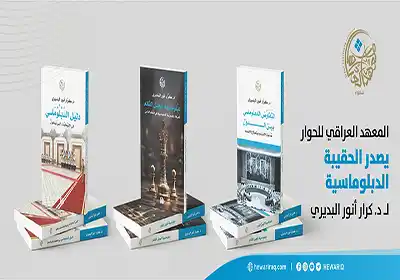
The Iraqi Institute for Dialogue publishes "The Diplomatic Portfolio" by Dr. Karrar Al-Badiri

Invitation to the 79th issue of Dialogue of Thought
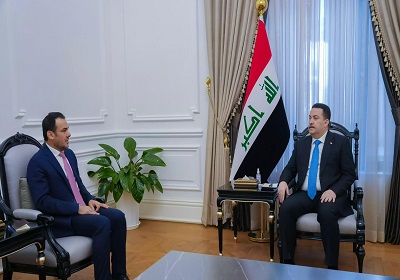
Prime Minister: The path of development will make Iraq a regional political and economic powerhouse
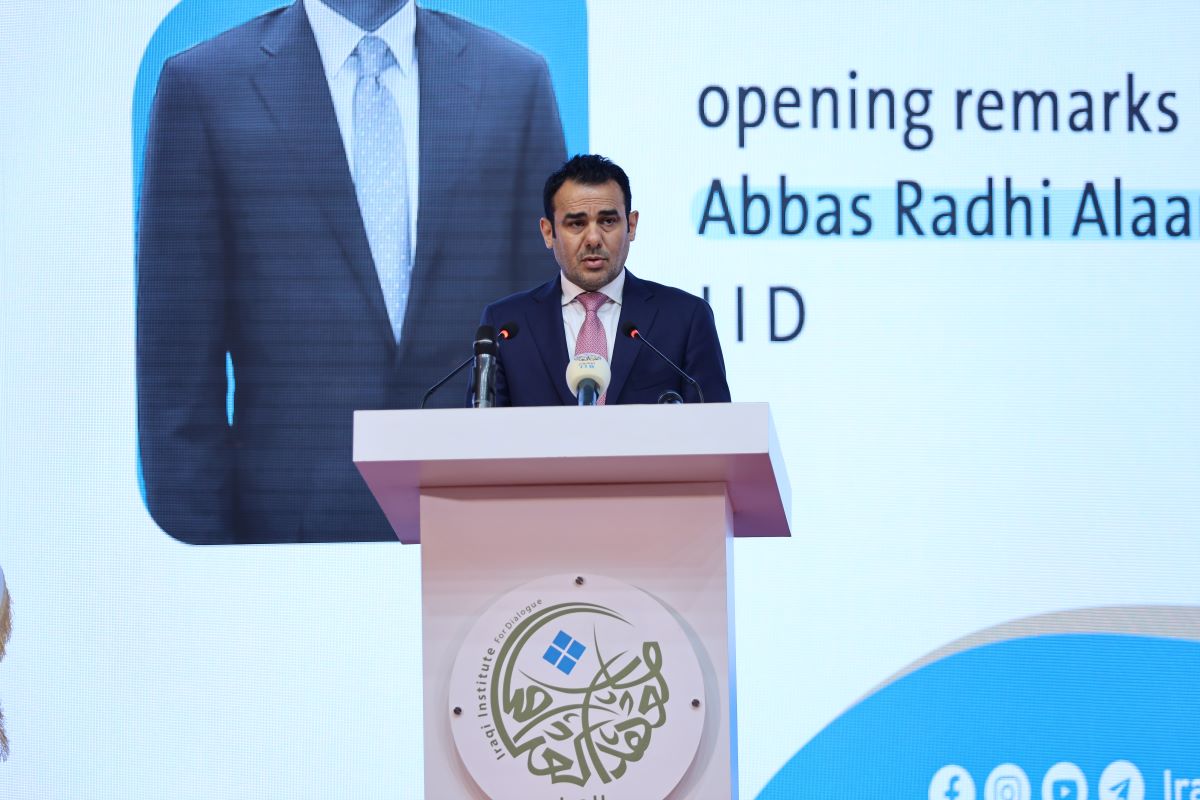
Speech of the Director of the Iraqi Institute for Dialog at the Sixth Baghdad International Dialog Conference
Seventh Baghdad International Dialogue Conference Call for Papers
Comments