


Former Prime Minister Adel Abdul Mahdi's first exclusive interview after his resignation: The deep state ... Crossings strategy
In his first interview since his resignation as prime minister at the end of 2019, His Excellency Mr. Adel Abdul Mahdi dedicated a lengthy interview to the Iraqi Institute for Dialogue's Dialogue of Thought magazine, which was published in the double issue (52-53) issued in December 2020, revealing unprecedented aspects of his governing experience and his personal assessment of the paths of the Iraqi state from its founding to the present.
The conversation was conducted in an open-ended, two-way dialogue, where Abdul Mahdi was able to provide a comprehensive and in-depth reading not only of his government's tenure, but also of the structural shifts in the identity of the Iraqi state, the faltering national project, the conflict between inside and outside, and the issues of the constitution and the political system.
In the background, Iraq was facing multi-level pressures at the time: The fallout from the Tishreen protests, the test of popular legitimacy, the fragility of the political and economic structure, and a changing international context in which rising powers were leading and traditional powers were losing ground.
In this context, Abdul Mahdi presented what can be considered a historical testimony and a reflective mirror, reviewing successive Iraqi attempts to establish a cohesive national identity and deconstructing the reasons for their failure, warning against the danger of ignoring Iraq's geopolitical dimension in the regional equation and the absence of a realistic understanding of the meaning of the inclusive state.
The following is a transcript of the interview
Dialogue of thought:How do you view the international scramble and the lack of maturity of an Iraqi project, especially when you took office?
Mr. Adel Abdul Mahdi: I think that what happened is a very rich experience that we have to deepen and take a lot of lessons from it, because the internal and external variables are not integrated. Is there a balanced relationship between inside and outside? So that when we talk about the inside as if it is integrated, and the outside as if it is neutral, as if we have a system of values and rules that are effective and unified, we only have to be inspired and apply them in our countries? It is difficult to delve into the issues of identity, state building, establishment, constitution and political system, as Iraq was formed after Sykes-Picot in 1917 as a contemporary Iraq, but the Iraq we know historically (Iraq of the Caliphate) has a system of values and rules in governance, power and concepts (population), different from the concepts after World War I and Sykes-Picot.
After World War I, in fact, in my opinion, there were no serious attempts to establish a constitution. The 1925 constitution, which defined the form of government as a constitutional monarchy, makes the king inviolable and unaccountable, and is inspired by the Western model in general in the organization of the modern state. However, this system did not have enough opportunity and the necessary conditions to be established so that we can talk about the establishment of an integrated Iraqi identity, or an integrated Iraqi system. The reason, in my opinion, is not for lack of trying. The global center of power itself was weakened in a short period of time. Great Britain from the 1920s to the 1950s weakened and its international role declined, especially after World War II.
The first foundations, from the early 1920s to the early 1930s, specifically in 1932, were the Mandate period. In general, the British mentality and legislation was the ruler in Iraq in terms of political backgrounds and general approaches, whether educational, organizational, administrative, etc. After that, some German influence began to influence Iraq, especially in the government of Bakr Sidqi and the Mays movement, which is a reflection of a European conflict within Iraq, then came the Second World War and its impact on the decline of the role of Britain, France and Germany globally, and the subsequent escalation of the role and influence of both the United States and the Soviet Union in the international system.
If the founder and the global center were weakened and cracked, this would definitely reflect on the internal mind and project, which was inspired by many of the principles of British political life, even the Iraqi parliament building that was supposed to be completed at the time (the current Ministry of Defense building), was inspired by British architectural designs. Time, the rootedness of experience, and the continued state of weakness and disintegration did not contribute to the establishment of something integrated, so that we can say that Iraq has the characteristics of an integrated Iraqi identity and these are its limits, unlike Turkey and Iran, Iraq in particular and the Arab countries in general have not really succeeded in fully acquiring such qualities.
The 14 July Revolution came with new concepts, namely the republic and the revolution, and with the republic came the emergence of modern nationalist ideas, such as Arab nationalism, which was considered by the Arab nationalists and the Baath, which became the official policy of Egypt, especially under the leadership of former Egyptian President Gamal Abdel Nasser, as well as Iraq and Syria, and the ideas of Kurdish nationalism also began to take other dimensions that differ from the old dimensions of the multilingual people who lived in the Ottoman and Abbasid caliphates and other differences and before them. The republican period was also short and almost devoid of any serious attempts to establish a constitution. The constitution remained temporary. The same was the case in the first Baathist phase and then the Arifi phase. Yes, there were attempts with the second coming of the Baath to establish some kind of identity, albeit under the rule of tyranny, oppression and one-party rule. But the facts of history, as you know, are alternating and overlapping between justice and injustice. The facts establish themselves and become stable, at least over a certain period of centuries and decades, so that it can be called a stable system and identity with acceptable "legitimacy", by coercion, subjugation, or acquiescence, as they say. The United States is a country of immigrants that was unjustly established at the expense of the indigenous population, based on oppression, injustice and slavery, but over time and time it took its "legitimacy" and this system took its identity and role and established a state with strong and clear foundations, and even became a model for many globally. History will judge how long it will last, just like other civilizations and nations, progressing or regressing.
The Ba'athist attempts (2003-1968) to establish a new state also had serious foundations, but they could not reach a level of acceptance and maturity that met the demands of the Iraqi people, or at least the people living on Iraqi soil. The granting of autonomy to the Kurds is an attempt to place the Kurdish question of nationalism within the framework of Iraq. In the definition of the Iraqi constitution during the Baath period, the Iraqi people consist of two nationalities, which is also an attempt to establish certain characterizations of the Iraqi identity and system of government. But the truth is that the Iraqi model entered into a conflict with other compounds and components, neither able to conquer them and dominate itself over them, nor to internalize them, especially in the sectarian, national and human rights dimension, so the opposition to Saddam Hussein raised a triple slogan: "The regime is a dictatorship. The regime is a dictatorial, racist and sectarian regime.
Dictatorial, affecting all the Iraqi people; racist, referring to nationalist issues; and sectarian, referring to sectarian issues. The former regime was unable to establish, despite its tools, desire and dream of doing so, and then the post-2003 stage came. When the American came, he had an integrated project to build the society and the state as he called it, but he faced internal and external resistance. He wanted to establish a new system based on electoral assemblies that prepare the constitution for the country and on a model based on Western values in general, especially the new American values and concepts.
You all know Imam Sistani's fatwa rejecting these measures and methods and not accepting the occupation and any constitution, except for the return of sovereignty and that the constitution should be prepared by an assembly elected by the Iraqi people. This was the case, which took more than two years of struggle. In these circumstances, the constitution was written and before that the State Administration Law was written, which contains many modern ideas that are not without the fingerprints of the American vision. It is not true that everything was prepared in offices abroad, especially with regard to the constitution. The State Administration Law has a clear and strong American imprint. The constitution, on the other hand, is less so, even though it harmonizes with many (but not all) of the concepts used in the United Nations Organization. The constitution was based on extensive consultations among Iraqi institutions: more than 600,000 letters were sent to the constitution-making committee, and there were extensive consultations and discussions about the constitution... etc. There were many times when the United States objected to more than one paragraph in the constitution and in key formulations. These include the relationship between religion and the state, the relationship of the components with each other, whether the system is centralized or decentralized, the parliamentary or presidential system, human rights, especially the first and second chapters, as well as the separation of powers, the rights of citizens and many basic principles that are advanced basic concepts suitable for establishment, but were not completed in two respects. On the one hand, the laws that were supposed to implement the constitutional principles, and more than 55 laws remained unlegislated or were enacted in a hurry and contrary to the basic principles contained in the constitution, and on the other hand, some principles remained unable to provide solutions and work contexts, because there were no endings to them. There was no clear vision on how to put an end to these matters, so things were written without endings and left to laws that were not enacted. Because the process was not completed, we continued to govern through a constitution, written by Iraqi hands in general, but not without direct and indirect external influences, which allows everyone to interpret the principle as he wishes, and this is what created great differences between political parties in the interpretation of constitutional articles, such as Article 140, the issue of the largest bloc, if the prime minister resigns and the caretaker government, identity issues and their consistency with reality in practice and not in theory.... etc., from certain principles that were not finalized and remained loose, or were referred to the Federal Court, which played a reference role to which the parties returned and succeeded at times, and at other times its interpretation was influenced by the pressures of the moment, keeping it suspended as an interpretation that grabs the stick from the middle, not giving a solution in this direction or the other direction, so many voids emerged in the Iraqi political experience.
Today we have reached this stage and I think we have accomplished great things. All global experiences took centuries and decades to stabilize certain societies. Iraq has moved in this direction, and it will be difficult for it to establish a solid internal equation for itself without at least stabilizing the situation around it. We cannot talk as if we are in a vacuum. There are Kurds who say I want to secede, Shiites who want to extend with the Shiite crescent, Sunnis who want a region, and Turkmen who have their own map, but all of them do not answer basic questions about recognizing coexistence in practice, not in theory, and the practical and acceptable economic, security and logistical philosophy of the system and the relationship with others.
Our relations with the periphery, at least with neighboring countries, are an organic relationship, not just that of one neighboring country to another, but an intertwined relationship; religious, cultural, relativistic, economic, etc. For centuries, Iraq was part of the Ottoman Empire and defended it against the British invasion, and Iraqi fatwas were issued in this regard. So were the rivalries between the Safavids and the Ottomans. Are Iran, Arab countries, and Turkey, for example, just relations, like Portugal, for example? These are important questions.
The internal situation cannot be discussed without the external situation and vice versa. Especially since Iraq was for centuries the center of the region, not a country on the periphery, but in the center and heart. That is why Baghdad was called Dar al-Salam, the City of Peace, the City of Peace, Wisdom, etc. Before Islam, Iraq was the seat of rule for many major empires, and in the Islamic period, especially the Abbasid caliphate, it was the center of the caliphate and was always at the heart of the project in the region, and therefore it is not "with the stroke of a pen" that we talk about Iraq as if it took this form, and we just have to look from this position. I think this will backfire on us, in the sense of not understanding it well. The demands and pressures will come back to us in one form or another. Like if we want to neglect the Kurdish question and the Kurdish geopolitical reality and its different connections internally and with other countries, or the sectarian reality that exists in Iraq and the region, or the cultural reality and the real currents in the region. These are all intertwined and have extensions that affect the Iraqi interior. Part of the demonstrations we have witnessed or the repercussions and the positions of various countries have regional accounts, and Iraq also has regional accounts with others. Iraq will remain weak and vulnerable unless it discovers its strengths internally and with its region and uses them to strengthen its position and play the role that suits its nature and interests, which it has historically played.
Dialogue of thought:The important strategic question, which is related to your foreign movement, and in terms of opening up to neighboring countries, it was a very successful movement. Talking about China, the tripartite summit (Egypt, Jordan, Iraq), the Islamic depth, and the Arab depth, but it also collided with a great will, which is the United States of America. Mr. Adel Abdul Mahdi knows and is not far from the international conflicts in the region, but everyone is talking about the Iraqi-Chinese project with the Belt and Road Initiative that kept Mr. Abdul Mahdi away from attempts to build the state and the institutions of law.
You have a vision that the form of the unilateral international system has been broken, as today the roles of other actors have increased, such as the European Union, the Russian Federation and China. On the other hand, the United States had a key role in standing in the way of purely Iraqi projects, including opening up to powers that can be considered non-dominant but influential powers in the international system; how do you read the role and influence of the United States in the form of the system, is it still the dominant or super power or has the form of the system been broken and the equations have changed?
Mr. Adel Abdul Mahdi:Our government did not come because we had a parliamentary bloc. I left the Supreme Council in 2015. The wave that we witnessed by looking for independents represented, in my opinion, a solution for others and not a solution to the crisis that the country stood at in 2018. Others tried to reach a result to overcome the closure of the paths of explaining the largest bloc, or to reach balances acceptable to the political forces. We were a temporary solution for them, a solution to a political crisis that exists in the country, even though I was abstaining and wrote several articles stating that the conditions were not available. They said that the country was on the brink of a cliff and a major sedition, so we agreed. Once the government was formed, it was left exposed and without real political cover, as the government did not have a political and parliamentary base, but only had historical relationships with this or that personality or force, rather than commitments to a major project such as the project of governance and the state.
The rivalry that existed before the formation of the government found an umbrella to continue, especially since the government was not vindictive or authoritarian. The factors of obstruction and bidding began again from the first days, and these factors became the governing factors, more than the factors of support and facilitation in procedures and political equations.
When Mr. Muqtada al-Sadr raised the proposal for early elections several times, we said the opposite in written letters: Come up with a candidate, and the government will resign the next day. There is no desire to cling to any form. After the resignation, five months passed and we made great efforts to help the appointees and did not obstruct, whether with brother (Mohammed Tawfiq) Allawi or brother (Adnan) al-Zurfi and finally brother (Mustafa) al-Kadhimi. In our circumstances, the formation of a government in Iraq depends, in my opinion, on two main factors:
The first: The internal balance, as the candidate must have the support of the active and political Shiite majority. Not necessarily all, but those who have a say in the center of the majority. And then the support of other compounds and components such as Sunni, Kurdish, Turkmen and others. The endorsement of the other components is necessary, but it is subsequent to the majority's choice of candidate. This is an important point that I hope we can take note of. Without any sectarian or confessional dimension, the existence of an internal Shiite majority population has always existed, but the country could have been governed in other ways, either by compromise, as happened during the royal period, as King Faisal I tried to compromise with others. We all know that Sheikh Muhammad Rida al-Shabibi was the one who went to bring Faisal I, and we all know that the Marja'iyya blessed Faisal I despite the fact that he was not of its sect, although it stood against the occupation and mandate in general, and led the Twentieth Revolution, which was conquered.
This did not pose any issue for those who disagreed with King Faisal I in terms of sect, nationality or religion. Therefore, King Faisal I came on the basis of consensus and was pledged by leading Shiite and Sunni scholars. The disagreement was with the occupation, the mandate, and the British, who also contributed to the installation of the king. But it was not the same for many of the elite who came with him, who carried with them specific sectarian affiliations, and did not distinguish between their sectarianism and the fact that they became rulers who must respect the culture and affiliations of the majority, without talking about others as well. There are many examples, applications and repercussions, but we will quickly refer to the issue of nationality.
When Iraq broke away from the Ottoman Caliphate, the identity of the Iraqi had to be defined. Nationality is the most prominent title. The 1925 constitution defined an Iraqi as (a) a holder of Ottoman nationality, or (b) a resident of Iraq on a specific date and period. The 1925 constitution did not specify any distinction or privilege between (A) and (B), as the hierarchy is only for enumeration and not for any other purpose. However, the elite parties began to act as if (A) is the original and (B) is the subordinate, or what later became known as "dependency." In the early 1940s, the Ministry of Interior's instructions reinforced skewed concepts of identity and nationality. Millions of Iraqis were deprived of their rights, citizenship and property, and the repercussions of this distortion continued in many parts of the life of this people and caused suffering that many Iraqis suffered - and are still suffering - from. In any country in the world, if the interests of the majority are not guaranteed, countries cannot stabilize. This is a fact in all countries (secular or religious.) Today, it is rare in France, for example, to expect a Protestant president, nor in America a Catholic president, except for the case of Kennedy, and the president-elect (Biden), although they are all countries that have gone a long way in changing their previous identities, whether sectarian or religious, and the case of Obama with (colored) skin is still an exception in America's history, because of the white majority.
Yes, things may change over time, naturally and gradually, or forcibly and violently, and be accepted or submitted and surrendered (as in the case of the indigenous population in colonies and new settlements), but these things do not happen in a single moment or by elite decisions, it requires a process of digestion or social surrender to become acceptable or mainstream.
In any country in the world, if the majority does not guarantee the interests of the minority, then there is a problem. On the contrary, the majority will not stabilize if it does not guarantee the interests of others. Thus, everyone - and society - remains tense, conflicted and vulnerable to each other.
Today, when it comes to choosing a prime minister, Kurds, Sunnis, and others say, "Shiites choose," this is a simple example, after the equation changed after 2003. Shiites are not just a sect, and they are not just a demographic majority. Shiites have a great weight in the general culture, in history, in traditions, not to mention other things. Saddam, for example, tried to attribute himself to Imam Hussein, and this is not an ordinary matter. The Abbasid caliph al-Ma'mun also tried to identify with Imam al-Ridha (AS). Either identification or clash, repression and tyranny. If the Shiite component does not recognize its interests and is not fair and just to others, it is difficult to govern Iraq. If a Shiite does not understand the Kurdish situation, the Sunni situation, the Christian situation, the secular situation, and the different cultures, he will harm his own interests, the interests of others, and the country. But others also need to know their interests, because without that, the equation will not be straight. If the horizons and boundaries of each component and compound are not defined, social cohesion will not be realized and we will establish a clashing system rather than a harmonious and reconciled one. The Shiite mind, and other minds as well, must be mature if we want to reach good, just, and stable governance to allow the concept of citizenship to mature and become governing and sustainable as long as it is internalized for the interests of all. If the Shiite majority, as well as the rest of the components, do not know their interests, limits and horizons, and each party remains closed to itself and separated in its consciousness and deep behavior from others, it is difficult to define patriotism and activate the power of the people, society, the state and the basic pillars of governance in Iraq. This requires high understanding, frankness, seriousness, appreciation of the interests of the other and self at the same time, and moving away from general and populist slogans. We have a good example in the American experience today. President Trump played on the language of extremism among the white majority, but he lost important segments of the other components, and even lost large volumes of the white majority that competed with him for power (Clinton in 2016 and Biden now.) The coming of Obama with his African roots and the clashes and tensions that are taking place today is that American society is recomposing itself after the major social developments that took place in it and the tyranny. If the Shiite component does not recognize its interests and is not fair and just to others, it is difficult to govern Iraq. If a Shiite does not understand the Kurdish situation, the Sunni situation, the Christian situation, the secular situation, and the different cultures, he will harm his own interests, the interests of others, and the country. But others also need to know their interests, because without that, the equation will not be straight. If the horizons and boundaries of each component and compound are not defined, social cohesion will not be realized and we will establish a clashing system rather than a harmonious and reconciled one. The Shiite mind, and other minds as well, must be mature if we want to reach good, just, and stable governance to allow the concept of citizenship to mature and become governing and sustainable as long as it is internalized for the interests of all. If the Shiite majority, as well as the rest of the components, do not know their interests, limits and horizons, and each party remains closed to itself and separated in its consciousness and deep behavior from others, it is difficult to define patriotism and activate the power of the people, society, the state and the basic pillars of governance in Iraq. This requires high understanding, frankness, seriousness, appreciation of the interests of the other and self at the same time, and moving away from general and populist slogans. We have a good example in the American experience today. President Trump played on the language of extremism among the white majority, but he lost important segments of other components, and even lost large volumes of the white majority that competes with him for power (Clinton in 2016 and Biden now.) The coming of Obama with his African roots and the clashes and tensions that are taking place today is that the American society is recomposing itself after the major social developments that occurred in it, and this new understanding itself on opposition forces' meetings, conferences, statements, decisions and representation ratios to reflect the weight of the components and their rights and demands in a manner far from compliments and abstract slogans. Second: We have always expressed the vision that we are expressing now, which is, without our outside, our inside will be broken, and without our inside, our outside will be broken, and without our inside, our outside will be broken. And we tried to put this equation into practice.
We went to Jordan and tried to solve the issues with them, they said how can you sell oil to Jordan and this may affect the production of some of our goods. We said that these are strategic relations that include the exchange of goods, security, politics and investment movement, which will develop the agricultural, industrial and other sectors in macro and not micro terms. We have calculated everything that we will exchange with Jordan so that it does not affect any of our production, but rather grows it. These are great prospects. Then in the same direction, we held a tripartite summit with Egypt and Jordan, which was not a pivot against anyone but to activate the commonalities between the three. Then we went to Saudi Arabia in the same directions. And with Iran, Kuwait, Turkey and others. With the aim of excellent relations, and its principle, yes, we have differences with Kuwait, but we have close commonalities, and in light of them we build close relations and achievements, and then we are able and strong to resolve differences. Remaining on previous practices in standing on differences means disrupting history, disrupting interests, and continuing the state of weakness and internal and external rupture. It means regression, and we all lose, and none of us will be a winner and we will not make any positive accumulation, so we went to these relations.
After 2003, the external factor played an important role in the formation of governments as a prerequisite to the first condition, the internal factor. For many reasons, America and Iran have become two major influential countries in Iraq (other countries have played less important roles) and in the Iraqi political decision, and they have great weight in the current policies. This is a reality, not an option, that we must take into account. Whoever jumps on this fact will miscalculate, which does not mean that this equation will not change, but it must change. Those who know the insides of Iraqi politics after 2003 know by names, dates, meetings and positions the extent to which these matters overlap and put pressure on our decisions and policies.
We lived through more dangerous phases, both before and after 2003. In the US-Iranian conflict, America knew the Iranian red lines in Iraq and did not touch them. Martyr Qassem Soleimani (may God have mercy on him) was always exposed and could have been easily targeted, but there was no decision at the level of what happened at Baghdad Airport. On the other hand, the Iranians know the American red lines. The two sides were fighting and had different positions on Iraq and their role in it, and they were doing limited and calculated actions that did not approach the red lines. But what happened in my government was that the US administration changed the rules of behavior and relations. If you go back to the ministerial platform that I presented to the House of Representatives, we said we are not part of the sanctions regime and we are not part of fighting a country with which we have diplomatic relations, and we are referring to America. The state of Iraq is not part of the axis of resistance.
We are talking about the state, but the public or a section of the public is another discussion.
Iraq wants to have good relations with everyone, and the depth and development of relations depends not only on Iraq, but also on what others offer and their position on all issues to which Iraq is a party. The government was formed on 10/24/2018, but the sanctions began to take effect on May 11, 10 days after the formation of the government. The Americans started saying that we don't have black and white. You are either with me or against me. We said to them: "You guys, we don't mind being with you if we're against you." Iraq (as a government and state) always has a balanced position between the two parties, and the principle (with me or against me) makes me either go against my neighbors, which is not possible, or go against you, which is also not possible, because Iraq is a state with internal and external obligations, they told us that you have no choice but to be with us or against us.
President Trump's no-holds-barred policy of pressure and harassment, which he has always openly and publicly stated, is either with me or against me.
I was in constant contact with senior officials, especially Secretary of State Pompeo, and I would tell him that you are a friendly country and I have a neighboring country, how can I stand with you against my neighbor or how can I stand with my neighbor against you, or I would tell him that you are 5000 miles away from me, and I have a 5000-year history with Iran, so how can I stand against Iran... etc. It doesn't make sense.
You have to take into account the Iraqi situation, as taking sides at the expense of another party is not possible. My perception is that by doing so, the Americans are pushing many forces to the side of their opponents.
This is where relations between us began to strain, as it was either for me to retreat from this principle and expose the country to something very dangerous, which is not possible, or to remain as balanced as possible, for which we paid the price.
Regarding the Popular Mobilization Forces, when we came, one of the first things we did was to equalize the salaries of the Popular Mobilization Forces and the armed forces, because it is unbelievable that a fighting force stands, fights and is martyred, but takes half the salary of the rest of the armed forces.
The Popular Mobilization Forces (PMF) have an important and significant role in Iraq, and when the PMF is absent, we go back to the same story of 2014. In 2014, we had three military divisions in Mosul. On the other hand, hundreds of ISIS occupied Mosul. The fighting spirit, not the number, is the most important thing, and if it is not available, as it was later when the Hashd joined the rest of the armed forces, we will not achieve victory in our battles. The question of the Hashd and its demonization means betraying the interests of not only the Shiites, but also the Iraqi people as a whole. How many sacrifices did the Sunni areas make and how much did the Hashd, which includes Shiites, Sunnis and others, sacrifice to liberate them. Yes, after any war and during the war, mistakes are made. Armies, including American, European and others, also make mistakes and commit crimes. In all wars and after wars, there are mistakes. But the essence of war is victory, and the essence of victory is its justice and perpetuation by correcting mistakes and not by demonizing the forces that achieved victory. This is the basis.
If ISIS had taken Baghdad, we would have had a domino effect and the whole country would have collapsed, and Erbil and others would have fallen, just as Anbar, Nineveh and other areas fell. What would have happened after that, so serious questions must be asked, and not demonization and staying in slogans, clowning and mobilization against others who made the victory.
The issue with foreigners is that US policy has changed radically with the advent of Trump, we haven't changed.
U.S. policy is asking us to walk on one foot. Walking on one foot, it is easy for someone to hit the other foot and fall completely. That's what happened. We could not accept an anti-Iran policy. We couldn't accept it with the Democrats and we couldn't accept it with the Republicans. So in the nominations for replacements after me, which I also wrote in public statements, I was in favor of someone satisfactory to the West and acceptable to the East so that we could restore some balances. The United States should review its positions. In these dangerous situations, we found and still find that the requirements of the internal and external conditions must be met, and this is an explanation for those who blamed us for some of our positions.
Dialogue of thought:Iraq is not viewed from the ground, it should be viewed from the sky as its location is geopolitical and the process of influence and impact takes place as you have described. As for us, we are linked to organic relations, not geographical relations, and the former is a relationship of mutual dependence and influence, whether at the religious, social, cultural, national and ethnic levels, etc. Since the establishment of the modern Iraqi state until now, we have lost this advantage because of most of the decision makers.
As your Excellency pointed out, one of the reasons for the fall of the monarchy was the short-sightedness in the process of reading the external environment and this led to the repercussions. King Faisal referred to this issue, and Hanna Batatu mentioned in his book (The Strata) that we are not dealing with one people, but with a group (Sunni, Shiite, Kurdish) and other sub-affiliations (Sunni, Shiite, Kurdish). He wants to show that there is no nation, as you know, we have two ways of forming an identity: One of them is that the identity or nation is a state, and this is what France, Spain and other European countries followed, as well as the United States of America, and the latter is considered one of the best models of social integration. The shortcoming is that since the establishment of the Iraqi state to the present time, when building an identity, two methods are used, the rough and the soft in this construction, and in Iraq, the ruling authority has always followed the rough method, especially the regime of Saddam Hussein, as the latter adopted the rough method because he believed that he would form an identity, but it was counterproductive to the Iraqi state and the construction of the Iraqi identity.
Another thing is that the constructivist theory of international relations focuses on the social structures of language, identity, culture and civilization. Another thing is that constructivist theory in international relations focuses on the social structures represented by language, identity, culture, civilization, etc. The issue is that most rulers after 1958 to the present time did not come a ruler who believes in Iraqi geography and its unity, and how to employ its organic relationship in the service of this identity. Our associations are always cross-border, which led to draining our resources and entering into wars, as the former regime did and fought three bloody wars that drained our material resources, and the Iraqi ruler could not employ these cross-border ideas; once we reach the Atlantic Ocean, once we reach the Mediterranean Sea, and once we go to the mountains. The point is, sometimes the ruler has a great impact on the construction of identity, if he does not believe in identity.
Your Excellency has great experience and has dealt with most of the political leaders and party currents, have the Iraqi political currents today lost their appeal? Do we really need I do not believe in the person but in the institution and what comes after this institution, do we need different currents or the development of these currents, according to your personal experience?
And how does Your Excellency see the near future in light of these complicated circumstances and conditions, politically, economically, socially and even health-wise?
Mr. Adel Abdul Mahdi:We are a suspended and divided nation, and our people and state lack many of the prerequisites to be truly effective, not because of the lack of the many commonalities that were historically effective, but because we are closed to ourselves due to internal and external factors. This is why this state did not and does not have the ability to employ citizenship and the nation in an effective and functional way, as I mentioned at the beginning of the speech. We did not complete the real founding phase (after the fall of the caliphate) to establish the necessary concepts of citizenship and citizenship. The Shiite citizen, for example, when he stands in front of his long history, he has a fragmented memory. He cannot study the Abbasid experience because we confuse faith and civilization. We reject the Abbasid period as a whole and judge it negatively and do not consider its achievements to be part of us, because its rulers persecuted the House of the Prophet (peace be upon them). This raises the issue of the formation of a unified, continuous and extended memory.
The Iranian has a continuous memory of before and after Islam, with its stages of Sunnism and Shiism, etc. because he puts achievements on one side and the behaviors of the rulers on the other. Religion has its own space and civilization has its own overlapping but distinct space. How do we deal with the Ottoman Caliphate, with its ups and downs, I don't reject it completely or accept it completely. How will Shiites deal with Sunnis or vice versa if we do not distinguish between faith on the one hand and civilization, life, politics, economics, science, the world of novels and mythology on the other hand? All mixed up in one go, so I remain lost and do not know where I am going and where I am going. This is an issue in the curricula, including in universities. We borrow other experiences that are easy to present and understand, but difficult to apply, and we do not measure them against our reality, history and facts, which we tear with our own hands, making it difficult to use and activate them to establish our civilizational model. This is a real and major issue.
What Dr. (Adel) Al-Badawi said is correct in asking that Iraq should be viewed from the sky as well, not just from the ground. Take Switzerland, for example, in the nature of its composition, history and neighborhood. What would remain of the culture and identity in Switzerland if the French, German and Italian language and culture, which constitute more than 99% of the language and culture of the population, were removed. The fourth language, "Romansh," represents only half a percent of the population and even less of the native Romanian-speaking population. Switzerland is a strong and cohesive country with its diversity and openness to its neighbors, but we want to weaken us and turn our diversity, which is a blessing, into a curse, so that we weaken ourselves to clash among ourselves and with our neighbors. We must put all this on the table now, and deal with history and the surroundings as part of our interior, just as we deal with our interior as part of our exterior. We must not cut the two with scissors and destroy our basic elements of self-definition and the realization of our potential. This is not possible, and in this state of affairs we will not reach results even after a thousand years. Without these preliminaries, we cannot formulate a coexistence for Iraqis of all backgrounds and affiliations.
Because of the long period of opposition, their parties remain in opposition even when they are in power. They are accustomed to the style of opposition. Opposition is easy. You remain united in a way, even if you have different work. Some of us work in human rights, others in armed struggle, and so on. There are no disruptive issues between us, everyone plays his role, and we meet when the regime is toppled, there is no difference between opponents of this sect or that nationality, secular, Islamist, Christian, etc. However, the country's leadership wants another mentality that unites in a way that allows for work, achievement and progress, and agreement on a political, security, economic, social and foreign relations platform. Therefore, we remained as opposition parties and not as state parties, whose loyalty and opposition are different from the methods used in the stages of overthrowing the regime. In one of the meetings of the Iraqi National Coalition (2006) after it won the elections and obtained 128 seats and was the largest bloc. We had to choose a prime minister and an election was held within the coalition. Dr. Ibrahim al-Jaafari got 64 votes, and I got 63 votes. In my speech to the coalition members, I said: "Brothers, you were elected on the basis that this is from the Dawa Party and this is from the Supreme Council." Did you ask the candidates about their security, economic, political, etc. approaches? You did not ask how to manage the state and you are now the ruling party. You are neither Abdul Karim Qassim nor Saddam Hussein, you are today the majority bloc of the parliamentary majority, so how will we manage the affairs of the state?
One of the dynamics of your predecessor's rule of society and the state was force, or the stick and the rod, which is a funny thing. In the construction of a certain bridge, for example, any delay in the work could expose the engineers to the death penalty. So repression was one of the tools of the regime's movement. Now we don't want to use repression. So how will the regime move.
Systems are driven by motives and rights. Have we defined motives and rights and put their owners in their correct positions so that social vehicles, whether they are citizens, unions, tribes, chambers of commerce, industry, media, money, labor, etc. can move with them. When each of these people rushes to defend their rights and interests from their appropriate positions, and the state sponsors and protects them, society will move with them according to the motives and rights regulated by the constitution. This is what we have not done.
The political forces did not review themselves, and their concern became winning the position and considering it to be success, rather than building the state and society, and reshaping political life in the country in new circumstances, as the criterion for success became the presence of someone in the position and not how much he achieved in his career project. The criterion for success became the presence of one of them in the position and not the amount of construction they achieved in their career project, so the political forces paid the price and separated from their public. The electoral laws were not designed on the priority of reflecting the will of the people in the elections: How much will I get and what are my percentages from this system, and in light of that, I assess my position on the closed list, small districts, or others. The criterion is how many votes I will gain, and this is not right.
The comparison between parties in Iraq and parties in other countries is that parties there have been able to align with their constituents, and the latter have become influential in their programs and leaders, while we have a separation and a gap between the party and the public. The public is a tool, not a goal. It is seen as a witness to a marriage ceremony, rather than a partner in our decision-making. In the eyes of the parties, the public is just a tool to reach power and legitimacy, not a partner from which we learn and contribute to our policies, leadership, organizations, and positions. It is true that leaders initiate, propose, mature, and propose, but the public has a role in all of this, and a healthy, sustainable, and interactive relationship cannot be established unless both things are realized, not just one. Today, in most of the world's parties, the public - directly or indirectly - contributes to the formulation of the party's platform and the selection of its leaders. In our country, parties have remained closed, with leaders who renew themselves and are undemocratic within themselves while saying they want to build the country's democracy. Therefore, their disconnection from the public was natural, and this is what happened to us. This was one of the reasons for the October demonstrations, which, for better or worse, exploited this issue.
Most governments abroad are party governments that win elections and govern alone or in coalitions. The Justice and Development Party (AKP) in Turkey, which started from the grassroots, won elections and governs by connecting with its constituents. So do reformists and conservatives and their engagement with their constituents in Iran. The Democrats and Republicans in America, and how there are primary elections in which the public contributes to the formation of policies, party leaders and candidates. We did not establish these practices. We made two attempts, one by the Sadrist Movement and the other by the Supreme Council in 2010. The Supreme Council held primaries and the Sadrist Movement held popular elections. The truth is that many leaders do not want to lose their positions or to be held accountable and monitored by the masses because they consider them to be less knowledgeable and experienced than they are. This is why political forces must develop their experiences and the legislation in force, especially in the parties law, to establish such an effective and sustainable relationship between the public and the party or the base and the leadership, which can take dozens of forms and not necessarily by imitating a particular model. Political movements must review themselves, and if they do not review themselves and continue to seek power only, they will be one of the most important obstacles to the progress of the political system in Iraq. I believe that the current pressures on political forces in this direction may lead some to review themselves, but this needs some time. I am optimistic, not for the sake of morale, but on the basis of all the data. There is progress whether we realize it or not. I gave an example to some brothers and said if a cartoonist draws a picture of us like this: A big closed bottle with half water in it, and a boat in which the political forces are sitting, this one rowing forward and that one rowing backward. The canoe spins on itself and sometimes they fight with the oars, etc. But the bottle is in the riverbed, and the riverbed drives the bottle forward. This is a historical fact. There is a momentum generated after the change. There are internal and external forces that have been freed from their silos that are pushing the momentum forward, even though the picture on the surface has many negatives and distortions. The countries of Europe did not all rise as one. Three or four powers rose mainly for internal and external reasons and dragged the rest of the continent and its countries with them.
The state has reached a limit that it cannot go beyond. The debate about oil and how the country lives is no longer theoretical. Talking about whether or not oil will run out in the past, or whether or not it has no alternative or an alternative now, is no longer the crux of the matter. Oil has become a dead end. This is a structural change, not a circumstantial one. A few years ago, America was producing about five million barrels a day, today it is producing 12 million barrels a day, and that's without talking about other countries. Alternative energy is advancing, the oil market has changed to a market of buyers rather than sellers, and Iraq's population is increasing by more than a million people a year, so the state has limited resources to care for the people, feed them, and advance them. The people will be pushed more and more into sectors outside the state. They have only three options. Either migration, which has become limited, or extending the hand to the money and rights of others, which cannot include everyone, or work and diligence and orientation towards real productive sectors. If we follow up, we will find a lot of economic activity outside the country. Services, agriculture, industry and activities have become a major concern for many people. The state must nurture, serve and facilitate this, not put obstacles in its way, as it has done in the past and is currently doing. This is not one of the solutions for the current state, but could be a historic solution for Iraq if it is combined with thoughtful internal and external macro policies.
I am optimistic about the realistic trends that will gradually impose themselves. The economic monopoly came gradually and created a political monopoly. Oil resources went to the Reconstruction Council in the mid-1950s, then became part of the government budget at the end of the royal period, and then the main pillar of the government budget in the republican period. Oil became the property of the state and not the people, which is what we tried to stabilize in the constitution after long and detailed discussions, to which the late Dr. Chalabi, myself and others contributed.
In 1964, we nationalized simple industries, the size of which was 25 million Iraqi dinars at the time, which is not equivalent to 75 million dollars at the time. Before that, we nationalized the land, then we nationalized the unions and chambers, foreign trade and a major part of the interior. Economic monopoly necessarily led to political monopoly, and the coming of Saddam Hussein was a natural consequence of these structures, whether in the economy or oil. Perhaps today's economic pluralism will help build a new political consciousness that accepts competition and seeks quality, which will positively affect the political mind.
As for the intensification of conflicts. I say that urban conflict is difficult in Iraq. This is what some were counting on in October 2019 by provoking a Shiite-Shiite conflict. But events have shown that such a conflict is not easy for many factors. Yes, a neighborhood conflict may occur, but an urban conflict is very difficult to happen now.
We must not forget that Brother Kadhimi is the sixth prime minister to come today through the peaceful transfer of power. This is not an easy process. It has not been established in a number of countries in the region and elsewhere. Whatever the obstacles, difficulties and conflicts may be, our system still allows for positive movement despite the possibility of violations, disruptions and others. I am not pessimistic even economically. Yes, I am pessimistic about looking at the economy only through the budget and not looking at the budget through the economy. This is why we may suffer from the issue of loans, which will be a constraint on us politically and economically. Iraq is not a bankrupt country - America's debt exceeds its GNP, but it is a global power and owns the dollar, which it prints, exporting its crisis abroad. I am certain that if the consciousness does not realize these facts and correct the paths, the blockage of the state's economic paths will open the way for the economy outside it and the dismantling of the rentier state to be replaced by a rational state that protects real economic activities, whether in the public or private sector.
Our government has made every effort to improve the agricultural situation, as stated in our ministerial platform. Its essence is to support outputs instead of subsidizing inputs, and to pay farmers quickly so that they have the main motivation to return to production, not only simple but also expanded production. Today, everyone recognizes the agricultural progress, so that we are close to self-sufficiency in grain production, something that was not expected by most scholars and experts, including international ones, and they were judging the death and absolute decline of agriculture, which is one of the complex matters that are difficult to deal with. This great achievement was underestimated at the time by the majority, especially by the political forces. They said it was the rains and nothing else and focused on the natural fires or the fires started by ISIS. As for our approach, we borrowed money from outside the budget to be repaid from import differences, promised farmers quick payment even for those outside the plan, changed our vision for the water plan, and provided warehouses for storage from the concrete blocks that we lifted from the streets, so production doubled in 2019 from what it was in 2018, and rose in 2020 to about 5.5 million tons of wheat.5 million tons of wheat, which is close to self-sufficiency, despite the fact that 2020 was not a wet year, which proves that providing motivation and fulfilling rights and promises is the basis, not the rains, despite their importance. What happened to agriculture can happen to other sectors without the state spending billions of dollars on imports and inefficient subsidy policies, most of which are shrouded in corruption and waste. The stakeholder spends his money and effort and sells his outputs at prices that encourage him to continue and progress. This is what the state should encourage and nurture, not just think about the budget. This shows how the main issue is not financial, but incentivizing motivation and protecting rights, which is strongly suppressed by the nature of the rentier system, state monopoly, dependence on foreign currency, and thinking only about the budget. This will encourage the protection of citizens' rights in the public sector, which will gradually rely on levies before relying on oil, which corrects the employee's relationship with the citizen who holds his livelihood and pension, not the other way around, making him more open, cooperative and respectful of the citizen, the master of his livelihood, rather than only caring about traveling, deals and protecting foreign interests instead of national ones. Without harming, of course, the oil sector itself, but also developing it, so that it is good on good and not evil on evil.
Dialogue of thought:What is observed in the nature of social interactions is the weakness of the element of belonging among the new (current) generation, the post-2003 generation, many of whom are in the demonstrations regardless of their levels and classes, this generation feels dissatisfied with the performance of the political blocs, the government or the House of Representatives.... etc. After 2003, he was not affected by Saddam's regime, as he did not see injustice, and whatever he imagines, he cannot imagine the extent of the injustice suffered by the people who lived with Saddam's regime. This generation cannot take responsibility, it does not know that there is no development, but rather feels that this system has caused him trouble, so how can I ask him for an identity and belonging, there is no element of acceptance or satisfaction.
Most European and Saudi research centers study the movement of generations and try to focus on what each generation wants. The latest study by one of the Saudi centers talks about the generation of the Islamic Revolution in Iran and the post-revolutionary generation, and how each generation moves. Our political blocs, government and parliamentary directives have not yet understood this issue, as evidence that we still believe in the family and not the individual; meaning that when I want to make any reform, I think about the ration card and giving money to the family.
Iraq is a country that cannot be neutral and cannot be a country that plays the roles of the center, because; Firstly, Iraq is not a giant country that has the qualifications and enough power to protect itself: Iraq is not a giant state that possesses the qualifications and sufficient power to protect itself, nor do the powers surrounding Iraq accept Iraq as a neutral state, just as Europe accepted Switzerland as a neutral state. Neutrality has become a difficult element.
Whenever the United States imposes sanctions on Iran, Iraq is its outlet, and whenever America tries to contain and constrict Iran, Iraq is its outlet.
As a researcher and observer, your government's orientation is more towards the eastern camp than the western one. Your relationship with China is very strong, as you have established a memorandum of understanding, and your relationship with Iran is in the same situation.
The American interest in strengthening Iraq's relationship with both Egypt and Jordan is a gateway towards normalization, as it is known that Egypt and Jordan are the Arab countries that are the godmothers of the Arab-Israeli agreements.
Mr. Adel Abdul Mahdi:First of all: I agree with you about neutrality; not every country can be neutral. I did not use the word neutrality. Once I was asked at a conference, I said no, Iraq is not neutral, it has a policy and in its nature it doesn't apply half for this and half for that. They said, "You are holding the stick in the middle." I said, "I am not. When I say that Iraq's interests are to be good with neighboring countries and to be good with the international community, this is not an American or Iranian policy, but its priority is to proceed from the Iraqi interest and vision. I am not neutral between the two. The starting point is centered on our current and future situation and from the definition of our position and our national interest, so we evaluate the relationship as we see it for our interest and not as the other necessarily sees it, as this is not neutral. If we have an economic interest with America, we will go to that, as long as we do not harm other things now and in the future. It's the same with Iran or others. If we have economic or political interests with Iran without harming the political and economic interests of other friends, we will go for it. Therefore, when we refuse to stand with the US sanctions on Iran, because the principle of sanctions is wrong and has harmed and destroyed Iraq in the past, and because it harms Iraq's interests currently and historically and pushes us to a hostile position, which is more dangerous than not submitting to a wrong US policy that will surely change, as history teaches us. However, one may sometimes make some decisions that he estimates may harm him temporarily but benefit him in the future, and vice versa. This is a matter of judgment, not neutrality.
Since 2003, we have had major disagreements with a number of American decision-makers, and we used to sit with President Talabani and General Soleimani, may God have mercy on them. The Americans used to give us messages, but the Trump administration is completely different. This is the issue, not us. When we came to the withdrawal of U.S. troops, the basis was that there was a decision by the Iraqi government for the troops to come, and I was told at the National Security Council meeting that preceded the House of Representatives session on the withdrawal by a day, that a request for withdrawal from this council is enough to cover the government's decision to request withdrawal. I said no, as my government is a caretaker government, it would be a fragile and weak decision. So we have to go to the legislature. America did everything possible to prevent the House of Representatives from convening. The Americans informed us of our decision, and they said in an official letter, "We will send our delegation in June, and the delegation will discuss two things, the economy and the redeployment of troops out of Iraq." They assured me that the redeployment of troops out of Iraq would be a priority. They assured me that the redeployment is not inside Iraq but outside it, not only in words but also in an official letter.
The new government was formed (the government of Mr. Kadhimi) and there was some ambiguity on the issue of withdrawal and timing, so the Americans began to procrastinate on the issue of withdrawal and its schedule. Their proposal became one-sided, and they did not agree on any timelines. President Trump says we will withdraw X number of troops within three years without taking the opinion of the Iraqi side, even though it is Iraq that is concerned.
We used to tell the Americans when they were subjected to Katyusha bombings, from 2011 to 2019, not a single missile targeted the embassy. The number of troops was 170,000 and you were losing 3-4 casualties per day and a number of wounded. If 170,000 troops couldn't protect you, how will 5,000 troops protect you now? The presence of the troops is supposed to protect Iraq and Iraqis, not just the troops and the embassy. If you focus on Iran and make fighting ISIS a secondary issue, it means getting Iraq into trouble. Now you want to bring Patriot for protection, here the Iranian will think of a more powerful missile to bypass Patriot, here we have brought Iraq into a conflict or even a war, and Iraq says enough wars and that the country is not ready to fight them.
The Trump administration rejected this logic, and I used to reply to senior US officials that the security of the embassy and other missions is a political equation, not a military one. Therefore, we found the US ambassador, the chargé d'affaires and the ambassadors of different countries frequenting Iraqi restaurants and cafes without protection in 2018-2019 because the political equation allowed it. But the change in President Trump's policy, the escalation that occurred with the Hashd, the sanctions, then the bombing of al-Qaim and the assassination of the martyrs al-Muhandis and Soleimani and their comrades changed the data and there is no way out of this impasse except withdrawal and scheduling it. When the United States has missions in Syria, along with NATO and the Gulf states, this concerns us completely, as we are not a decision-maker in this matter, although we are primarily concerned with these situations. Therefore, Iraq cannot be a military platform for actions in which we have no decision with our neighbors, whether in Syria, Iran, the Gulf, Turkey and others. What happens in the region and between its countries is very important to us, and we are frank with Iran, Turkey and others. We are not a party to anyone's plans unless we are consulted, and our constitution prohibits us from being a conduit or a launching pad for actions we do not approve of. Of course, actions may occur without our knowledge or our ability to respond to them, but this is one thing and the legitimacy of positions is another.
The tripartite summit (Iraq, Egypt, Jordan) has several dimensions. For our part, it provides reassurance that we are not with one axis but are open to everyone in a positive way. Egypt is a big country and Jordan is an important country. Both parties have good relations with the West. This may alleviate many of the fears raised by the US sanctions on Iran and our position on them.
The Jordanian and Egyptian parties may have other goals. They may be thinking about Turkey and the Mediterranean and thinking about Greece and Cyprus. They want to take advantage of Iraq's weight, and they want to agree with Iraq on a vision with common interests. Of course they have interests, but we also have interests, he thinks and defends his interests and so do we. At the Riyadh summit, Iraq rejected the policy of axis in the region against Iran. Of course, the Americans are not comfortable with these positions. When President Trump came to the Ain al-Assad base, it was not possible for the Iraqi prime minister, who is in his own country, to receive the American president in an American camp. When the news of the president's arrival was broadcast, some forces rushed to criticize us and issued statements to that effect, but when they knew the details, they retracted and praised the position. We tried to abide by what we pledged in the ministerial platform, which is the contract with the people's representatives. I pledged what was stated in the ministerial platform, and I am accountable for it. The purpose of the ministerial platform is not just words. For us, it is a contract that we are committed to, and this also includes the issue of America and sanctions. You voted on it, so it is as binding on you as it is on us. The platform has become a state policy that those who disagree with it can change it through elections or change the government and its platform, but according to the constitutional contexts. I regret to say that this issue is far from the applications of the presidencies and many political forces and parliamentary blocs. As soon as the government is formed, each party and each institution legitimizes its jurisprudence away from the commitments of the contract or covenant voted on by the people's representatives, which represents the official policy of the state. The reality of many political forces is in fact far from this. Another important thing in drawing our policies is our estimates of global developments. The world is in the process of major changes and Iraq is part of these developments. This is related to the issue of normalization with "Israel" and attempts to contain Iraq and drag it into this or that policy. Everyone is organizing their situation for the aftermath of change. Iraq is also in the process of change, and this is part of global changes. The Western camp no longer possesses the old global influence, despite its status and influence, as well as the United States, which may not lose its position in the world as a major country, but it is losing its role as a superpower. Iraq must also think about its future in a global reality that may evolve from a unipolar to a multipolar world and define its role and status. That is why we tried to maintain good relations with the United States, but we also thought about strategic relations with Europe, China and Asia, as well as with Iran, Turkey and neighboring Arab and non-Arab countries, and we rejected normalization policies and the deal of the century because they represent the old, retrograde, unipolar worldview that did not work in the past and will not work in the future and will disintegrate because it is based on accepting occupation, hegemony and imposing a unilateral fait accompli.
This is why we saw the policy of normalization by others as an anticipation of what is happening in the region and the world. We saw that the purpose of this acceleration is to anticipate developments rather than to solve the issue of land, peace, Palestine, stability and security in the region. They know that whether Trump or Biden wins, there are certain constants in regional and international relations that must be observed. Biden emphasizes in his platform that he will return to the nuclear deal, and Trump states that he will negotiate with Iran a week after his victory. The slogan is no longer to topple the Iranian regime, but to respect regional and international equations, which means negotiation, not war.
Iran is now a major power, as is Turkey, and this reality is imposing itself with all its consequences that must be taken into account. Normalization could be disastrous for Sudan or the Gulf states. The normalization of Egypt and Jordan was in exchange for the withdrawal from Sinai and Wadi Araba.
Dialogue of thought:You began by saying that the experience in Iraq, especially the experience of Adel Abdul-Mahdi, is a rich experience that we must delve into. In light of the simulation, if the variables are repeated, can the same experience be repeated? In other words, if we go in the paths that Adel Abdul Mahdi followed in governance, which we must go and take them as correct paths, will the experience be repeated again? I think Adel Abdul Mahdi is forced to this path in light of the variables. What I want to say is, after you left the government, what are the things that turned out later that could have happened and that you could have done, and you didn't do, and this is really important to listen to.
Second issue: Dr. You have lived the equation for decades and lived with politicians, do you think that the internal situation in Iraq after 17 years has become more complicated than before? We believe that as the years progress, the situation can be less complicated. We are now discovering that the situation after 17 years in Iraq has become more complicated, especially in the point you mentioned, the effective majority, which is one of the conditions for a balanced and strong government, the majority must be effective. Today, the majority has become less effective, and this majority has begun to divide, not on a sectarian basis, so how can this effectiveness be restored? Is this possible in light of external interventions?
Mr. Adel Abdul Mahdi:I had the honor of serving as vice president, finance minister, oil minister, and then prime minister. So it is difficult for me to leave the arena, but the arena is not only political positions and responsibilities, but it is full of activities and tasks that can be done. Secondly, when I assumed the responsibility of prime minister, one of the conditions that Mr. Muqtada al-Sadr put on me was (not to resign), and he told me 100 days and enter the green. I said to him in the meeting that took place between us in Najaf before the official assignment, our master, God willing, will enter the green with "kyat." We won't need to raise "blocks" and barriers because I will open the green. Indeed, we opened the Green and took the National Assembly building in Al-Alawi as the prime minister's main office. The U.S. Embassy initially expressed concerns, although Vice President Pence, in a later conversation, congratulated the move. In this meeting, Mr. Sadr said that we had a year (if I remember correctly) to take a position on the government. I told him that a year is enough for me, because the situation is very difficult and I did not think that the government in these circumstances can provide complete solutions to it, but it is possible to build the beginnings and foundations of sustainable solutions to reform the situation and reduce dependence on oil and budget crises. I used to say this to those around me. I used to tell them that we are moving faster than necessary despite being accused of slowing down in recognition of the short time ahead of us due to the situation of the country and the political forces. That is why we went to quickly turn the ministerial platform into a government program that represents state policy and a means of monitoring it, organizing the Council of Ministers and its working mechanisms by introducing amendments to its rules of procedure and granting powers to ministers to assume their responsibility, preparing a code of conduct to regulate the relationship between the executive and legislative branches, legalizing the status of the Popular Mobilization and developing the security forces, conducting campaigns and operations to confront the rise in ISIS activities, opening up internally, not only by removing barriers and facilitating movement and communications, but also opening up to the private sector and with neighboring countries and other countries in particular, and a new agricultural policy based on the exit.
I have said many times that I will not pass the year, and those around me attest to this, as I already know that the conditions are difficult, but once I accepted and we started working, most of them abandoned and returned to their old practices. When they assigned me, they saw Adel Abdul Mahdi as a solution to their crisis, but as soon as I accepted and we started working, most of them abandoned and went back to their old practices. I believed that the stage would not allow them to stay for long. Those who consider that the government has not succeeded in many things will not say falsely, but fair-minded people will tell the truth by stating that the government has laid the foundations for deep and sustainable reforms in various affairs that will be difficult to abandon. That is why we divided our ministerial platform and our government program into three phases: quick, medium and long. The quick and some medium ones are six months and a year old. The rest require more time for implementation. In the midst of the events that erupted in October 2019 and the complete blockage of the situation, I quickly responded to the request of the supreme religious authority to provide solutions by submitting my resignation to make way for others to continue the process, starting the resignation decision with the verse "O father, do what you command, you will find me, God willing, among the patient." We felt that we were left alone, except for the few who expressed understanding and supportive attitudes. The parties, for the most part, take into account their interests, and each has its own position and discourse. They can simultaneously participate and benefit on the one hand and criticize and disavow on the other. But you in the position of implementation cannot do that. You have to make decisions on a daily basis, and these decisions need bodies to support and implement them. Coverage must come from the supporting political forces and the public, and implementation must come from the state apparatus. I say frankly that there is a dysfunctional issue for both of them. This is not only Adel Abdul Mahdi's issue, but the issue of previous and subsequent governments.
I believe that when the ministerial platform is approved, it becomes binding on the forces that approved it, as well as on the state as a policy that must be followed, and this includes the presidencies, including the presidency of the republic and the House of Representatives. If the presidency or parliament finds itself at odds with the government's platform or program, the constitution gives them the ability to remove confidence from the prime minister. Then the House of Representatives will decide the matter and remove confidence from the Prime Minister, changing the covenant and the platform, or it can affirm its confidence in the existing covenant, and the presidencies will obey the constitutional contexts that give the Prime Minister and the Council of Ministers the powers to plan and implement the general policy of the state, and not engage in policies that sometimes went outside the official contexts drawn for the state constitutionally, which raised and raises a lot of confusion and disruption that everyone complains about. Otherwise, the ministerial platform, on the basis of which the government grants confidence and trust, is meaningless. Therefore, the actual applications indicated that the state, from presidencies to state agencies, follows approaches and policies that are decided only by local, personal or partisan jurisprudence. As for the political forces that supported the government, they supported it according to the platform for which they voted, not according to changing, rapid, and unapproved jurisprudence and demands. Therefore, if we are a state, the forces that voted for the government must adhere to the platform and then the government program, monitor it, hold it accountable, and punish it if necessary accordingly. Our work should not internalize the methods of revolution (overthrowing the government through the public or the street) because that would undermine the logic of the state. I said this in the ministerial platform. Either we all go to the methods of the state, and the parliament, legal procedures, claims and demonstrations are within the framework of the laws, or we all go to the methods of the revolution, whose law is internal and private, i.e. it is made according to what it sees as achieving its interests. Either we all fight the battle of the state and democracy and its means, or we all fight the battle of the street, the public and the revolution itself to set mechanisms for the necessary amendments, otherwise we will become a state of conflicting jurisprudence and individual plans far from any real institutionalization to which everyone is committed. This view, in addition to the importance of getting out of the foundations of the corrupt, obstructive, and monopolized rentier state, and going to the state of citizenship and public service, represents the essence of our unchanging views. Yes, we may change people, locations or timing, but that's another thing.
For example, nothing can be changed in preparing a code with the House of Representatives or defining the tasks of the Presidency of the Republic and the Prime Minister, or the independence of the judiciary, separation of powers and respect for local governments, nor in our relations with neighboring countries or the rest of the world, nor in agriculture by adopting outputs or paying contractors' dues and restoring work to many stalled projects, nor in seeking to find rights guarantees for those outside the public sector, especially the issues of contracts and public-private partnership, or in the importance of following up work and developing this aspect in the executive work of the Iraqi state, or the agreement with Siemens, GE and Iran for a solution. Nor in the agreements with the rest of the countries, especially the neighboring countries or the rest of the world, especially the United States, the West, Japan, Russia and Korea, or with China, with which the agreement cost us a lot.
Emphasizing the importance of the relationship with China (or with others) is a joint and continuous effort of successive governments and must continue to be so, although it has taken an executive momentum. There is no alternative to reform except by adhering to the constitutional rules, and if they are incomplete or obstructed, the constitution and real after our visits to China in September 2019. My evidence is that the economic relationship with China was raised in the final statement when President Talabani visited China in 2007 and was followed up by subsequent governments, and developed when I assumed the Ministry of Oil in 2015, and before our visits to China in Dr. Abadi's delegation to China that year. I shared with the then chairman of the Energy Committee, Bahaa al-Araji, and committee member Dr. Hussein al-Shahristani our vision of investing our exports to China as a means of oil for reconstruction. Both were enthusiastic about the idea. The Ministry of Oil prepared the memorandum that was presented during Dr. Abadi's visit. I did not leave with the delegation when it left China, but stayed there for a few more days with brothers from the Ministry of Oil to discuss the details of the process. The Chinese Embassy in Iraq followed up on the agreement, then a large Chinese delegation came to Iraq after my resignation from the Ministry of Oil, and they presented a paper that I handed over to the director of Mr. Abadi's office, Dr. Nawfal Abu Al-Joun. Dr. Abadi's government took an interest in the matter and signed a memorandum between Iraqi finance and the Chinese side. When we assumed responsibility in October 2018, we attached special importance to the issue, followed up on its details and made many amendments based on the recommendations of various state institutions. Indeed, all the details were signed and finalized during our visit to China in September 2019, and since October 2019, we started depositing the amounts equivalent to 100,000 barrels per day in special accounts dedicated to the implementation of the proposed projects, and that China would open credits in double this amount according to Iraq's desire. We informed the Central Bank of Iraq by its letter on 12/30/2019 to deposit the amounts of the October and November shipments of the same year amounting to a little more than $ 418 million in the US Federal Reserve, and we continued the process until we handed over responsibility to the government of Mr. Kadhimi. The deposits were supposed to be transferred to a branch of a Chinese bank in New York, and the Central Bank also informed us that it had opened four accounts for the purpose of moving all the mechanisms of the agreement and giving Iraq the flexibility according to its financial and practical conditions, as well as China to implement the agreement in various fields. In Baghdad, meetings between specialists continued to select an international consulting firm to monitor the accounts, as well as diligent meetings to propose the first package of projects, and indeed the Ministry of Planning, the governorates and the rest of the institutions presented dozens of important projects, and the current government will certainly continue the efforts made in these right directions, which has become a great popular demand. It is true that my brothers and I had a prominent role in the agreement, but it would be unfair and unjust to overlook the role of previous governments, so we hope that the current government will complete what we all started.
The example of China was a prelude to finding partners with mutual interests. We were thinking of India, Japan (we have already submitted a memorandum to Japan in this regard), South Korea and others as major importers of Iraqi oil, not to mention Western countries that might show interest in this method, which we called Oil for Reconstruction, which includes the idea of a kind of "investment savings" necessary for development. Indeed, the Egyptian ambassador to Iraq came to me shortly before the end of my duties and asked to study a similar project between Iraq and Egypt.
I told him that we have already talked with our brothers in Egypt to exploit their capacities in refineries and oil derivatives, as they have idle capacity that can be invested for the benefit of both parties, reducing the amounts spent on importing derivatives, and achieving benefits together. With such mechanisms, we will have solved many of the issues of planning, Iraqi bureaucracy, oversight, investment projects that go through crises with each annual budget, the issue of liquidity, cost calculations, speed, technology and techniques of implementation and completion of projects. Such an agreement with China and others will allow for the possibility of building an integrated infrastructure, which Iraq desperately needs, and without which reconstruction and sustainable development cannot be contemplated. Projects that were also proposed in Mr. Maliki's government, such as ports, railways, roads, transportation, communications, sewers, dams, water, industrial cities, sewers, schools, hospitals and other basic facilities needed by any economy and society.
I am happy to see that many people today are presenting the projects put forward by our government as essential projects for reform, such as agriculture, the Fao port, the China agreement, and the importance of the private sector, because only by doing so can we confront the calcified economic mindset within the state apparatus and even among important sectors of the public, which was raised on a wrong philosophy that the economy and development are just the treasury and the budget, not the economy and society. The state should be based on them, not the economy and society based on the state and the budget. Therefore, in a recommendation of one of the caliphs to his governor, he tells him, "Keep them meat on which grease grows," meaning that the Sultan's treasury depends on the activities of society, so take the grease (levies) and leave what replenishes it (meat) and do not approach the assets that destroy their productive life cycle.
The discussions center on the fact that the state is bankrupt, and the reason is because of the treasury's difficulties. Treasury and budgetary difficulties exist in all countries of the world, including in the major countries that are the most heavily indebted. But they are looking for solutions in their economies, while we are looking for solutions in borrowing to cover the deficit and face expenses, or in disrupting the private sector or waiting for oil prices to rise, and we are moving further and further away from any real economic solution that can correct the situation and solve the chronic issue of the treasury, the budget, salaries, etc. Loans are solutions if they are linked to productivity that can bring new resources to the country, not just funding current expenditures. Your Excellency says that you disagree with my optimism. Yes, there is a negative outward image and a positive inward image. When we talk about numbers and facts, and you are the "Miraya" statistical center, what has declined? The number of universities, it is true that not all of them are great, but there are universities that are progressing. Have public freedoms declined? Yes, there are fragile opinions, but there are deep opinions that form and excellent convictions that impose themselves. Is the income level lower than it was 5 or 10 years ago, even at constant prices? Yes, there may be a crisis due to the pandemic or salaries, but we should not measure this moment only, as the whole world is suffering. All over the world there are youth, economic and societal crises. This is America, France, Germany. All over the world there are crises. The world is multiplying exponentially, and communication is mobilizing and sometimes contributes to making the unreal real. There are new developments that need to be digested again, to build new systems that can keep up with developments. Even the pandemic we have to learn how to live with it. We have a lot of things to correct, things we didn't think about. Your words are true if we look at the surface. Complaints and grievances are widespread, and young people feel that their future is uncertain. This is all true; but underneath this surface there are positive things that are moving.
We don't know exactly how things will develop. But the present makes the future, and necessities will push to find appropriate solutions, and the laws of societies, like the laws of nature, correct themselves, and we must see how they will behave in order to help them arrange new situations to suit the new circumstances. This is not the first time and will not be the last. Despite the atmosphere of frustration, let's observe the economic activities, initiatives and businesses that are trying to establish a new reality for themselves. Today, how many companies were registered in 2019 compared to what was formed during the period of Saddam Hussein. Statistics say that 400 companies were established per year, and 2019 statistics show that more than 8,000 companies were established. Are they all good and efficient? Of course not. But there are great initiatives and projects as well. This is a significant movement. Therefore, I am optimistic because I try not to see one negative phenomenon, but I try to see the rest of the phenomena and study the implications.
Tensions have increased, it's true. This is normal in all crises and turning points. However, I believe that urban warfare is unlikely, as there may be tribal or even political clashes, but they are limited in time and space. The October 2019 demonstrations were violent and resulted in many civilian and military casualties. The October 2020 demonstrations were less violent and there were far fewer casualties. I'm not saying this is great, but socially and politically we have to take these developments into account. Convictions have changed a lot, and there is a better understanding of many issues. In October 2019, there was talk of a Shiite-Shiite war and the overthrow of the regime. This did not happen. Despite the political divisions that did not spare a component or arena, we are witnessing many meetings and prospects for alliances, not only between Shiites, but also between different arenas and formations. Everyone is thinking about the future, the elections, and the solutions required to fix the situation. The conditions are not ideal. But we have a rich experience, so we must not destroy it by self-flagellation and lack of confidence in ourselves and the lessons learned from all these situations and standing on the negatives only without building on the many positives. Our forces are large and mobilized in a non-trivial way, and this must be exploited. Many are reviewing themselves. We have received harsh lessons, concepts we considered sacred have been shattered, and a lot of prestige has been removed from many of us, and these may be our previous obstacles, which may push us to think of alternatives to launch towards the future. The escalation within and between the components should prompt the search for more effective solutions, as the old formulas have done their duty and part of them may have expired, and we must look for the right alternatives needed. Not every escalation leads to war or fighting, but it may lead to serious dialog and solutions, and this is what we hope for.
The Iraqi Institute for Dialogue, the logistical sponsor of the Baghdad International Book Fair, opens its own pavilion at the fair
Official agreement between Iraqi Institute for Dialogue and the Iraqi Media Network to sponsor The Seventh Annual International Conference of “Baghdad Dialogue” 2025
The Iraqi Institute for Dialogue publishes "The Diplomatic Portfolio" by Dr. Karrar Al-Badiri
Invitation to the 79th issue of Dialogue of Thought
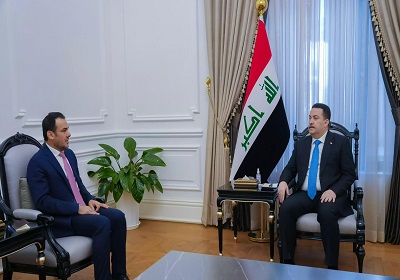
Prime Minister: The path of development will make Iraq a regional political and economic powerhouse
Speech of the Director of the Iraqi Institute for Dialog at the Sixth Baghdad International Dialog Conference
Seventh Baghdad International Dialogue Conference Call for Papers
Comments