


Interview with the editor-in-chief of Thought Dialog magazine, Dr. Abbas Radi Al-Ameri
Fouad Masoum for "Dialogue of Thought" magazine: Political quotas hinder the development of government institutions
In the midst of the political and social transformations that Iraq has witnessed over the past decades, opposition movements have played a pivotal role in shaping the paths of change and confronting Saddam Hussein's regime. Among those leaders who participated in political action and negotiations, Dr. Fuad Masum, head of the Coalition of Kurdistan Blocs, has a deep experience in political action and the struggle for democracy and national rights.
In this interview conducted by Thought Dialogue, we shed light on his vision of the fate of the former regime, the experiences of the opposition and its plans to topple the regime, the challenges faced by the post-regime phase, as well as his assessment of the legislative process and the challenges facing the building of a federal state in Iraq. The interview also addresses his vision of the current political crisis, the conflicts between the components, and the role of political forces in achieving sustainable stability that reflects the aspirations of Iraqis.
Fouad Masum provides an objective and deep insight into Iraqi political experiences, focusing on the challenges of building a modern state in light of the plurality of Iraq's components and the complexity of the political scene.
The following is a transcript of the interview
Dialogue of thought:As an opposition to Saddam Hussein's regime, what was your obsession? What was your plan to topple the regime?
Dr.. Fuad Masum:
Since the days of the opposition's activities and the conferences that were held, the main obsession or goal was to topple the regime, and we may have had some visions of the future after the fall or overthrow of the regime, but they were just general principles and visions without going into details.
At the London conference held in 12/2002, we presented a concept of the system of government, as for the paper on the system of government, I may have drafted it, and the political paper had a number of brothers from Al-Iraqiya, from the Council, Dr. Hamed Al-Bayati, and from National Accord, and about two weeks or ten days before the start of the conference, a committee consisting of Dr. Adel Abdul Mahdi, the late Sami Abdul Rahman, and myself, the three of us reviewed this paper.
After the fall of the regime, we were surprised that the American forces present in Iraq are an occupation force and we entered into many discussions with Bremer and before Bremer was Karner, and Karner was understanding and understanding and we were close to each other and not in his mind that these forces are occupation forces, he was about to form a national government for the various political currents, but in fact, when the Governing Council began and then the practical life, the Shiites were concerned that the former regime through its expertise or its many cadres through the formation of the armed forces, military and police by Bremer without investigating the person. In fact, when the Governing Council began and then practical life began, the Shiites were concerned that the former regime, through its many experiences or cadres, would be able to form the armed forces, military and police by Bremer without investigating the person, just looking at the size of the person and appointing him, the concerns were that the former regime or quasi-former regime could control the government.
The obsession of the other component was that when the Shiites take control of the state, they will take revenge on others, and other obsessions that the Kurds have a key role in the new Iraq and seize any opportunity to separate from Iraq and become independent, and the obsession of the Kurds that tomorrow the Sunnis and Shiites, all belonging to the Arab nationality, may agree among themselves and make us another Anfal and a second Halabja, these obsessions began and the Governing Council had no real partnership in making decisions, they were discussing Bremer with strong discussions. In the recent elections, there was a difference and not in the previous elections, here there is a question (the difference in which direction): The first difference was that the National Coalition represented all these components, but this time there was a split, and the Sunni component, on the other hand, was dispersed and displaced, so they agreed to unite in one front, this is the difference. In the last period or the last moment, of course, they tried to agree with some of the National Alliance and the State of Law, but it was too late, I speak from the intellectual point of view and not from the political point of view, the political opinion is different, they are outwardly united despite all the deep personal and tribal differences between them in their confrontation with the other bloc, for example, when the issue of Iraqiya comes, the National Alliance agrees, but if there were no Iraqiya, the differences would have been many. And now we have four key security positions that have not yet been agreed upon, the Ministry of Defense, the Ministry of Interior, National Security and Intelligence. We are facing serious issues, how do we overcome them? This cannot be overcome by kissing beards, there must be practical steps. These practical steps need courage, decision-making and responsibility from all parties. Second, agreement on basic steps because I said trust between a man and his wife, but there is no trust between the political parties. The political parties must take practical steps, one for one, and trust does not come like that between politicians, and so far whoever takes the first step, this first step is essential, for example, three meetings we did not reach anything every week, but meetings with no result.
We have more than six constitutional articles, all of which are regulated by law, and if they are not regulated by law, it means just a principle recorded in what we call the constitution, but this is not implemented because it is conditional on drafting a law, and as long as it is not regulated by law, this constitutional article remains inoperative, so if we agree to legislate the laws referred to in the constitutional articles, I think then we will have the infrastructure to manage the state Most of the laws in force are mostly laws that existed during and before the Saddam Hussein era and even the US-Iraq agreement that became without parliamentary approval, but Parliament is informed about them, but
Secondly, in other areas, we declared a federal state, but this federal state is just a name only in the Kurdistan Region, for the Kurdistan Region is a federal state, and the rest is a non-federal state, so in a kind of duality on the one hand a federal state and on the other hand a centralized state. The result of the centralized state is forty-six ministers, and after the other positions, it becomes more than forty-six, forty-six in a federal state. As for the economy, unfortunately, we do not have in the government since the first formation of the government until now economic experts capable of economic planning to save the country, so we must work to take advantage of experts in the field of energy, meaning is it reasonable all this material potential in Iraq and the Iraqi people live in poverty and half of it is below the poverty line, is it possible we are the country of oil and oil we need gasoline and import it from abroad what is reasonable this thing so the parties involved in their internal conflicts on their obsessions without thinking about the interest of Iraq and there must be practical steps and we still lack these steps.
Dialogue of thought:What is your opinion of the legislative process in Iraq and do you think it is on the right track in light of the tug-of-war between the head of the legislative authority and the head of the executive authority?
Dr.. Fuad Masum:
This decision issued by the Federal Court that Parliament does not have the right to legislate This word was used and raised a lot of gossip and gossip The task of Parliament is to legislate, but from the media point of view, the news was published in a way that was intended to confuse the Constitution Draft laws come to Parliament either from the President of the Republic or the Council of Ministers Parliament has the right to submit proposals for laws in Parliament I was part of the group that worked to cancel the Ministry of Municipalities and Social Affairs in the Ministry of Labor and our goal when we presented this proposal law was that we take steps towards federalism, meaning Najaf municipality should be responsible for the lands, etc. Basra, Nasiriyah, Amara and so on, the municipality is a purely internal matter related to the provinces. Basra, Nasiriyah, Amara and so on, meaning the municipality is a purely internal matter related to the governorates, and in that social affairs, the social welfare network is supposed to be linked to the governorates, why do we centralize all of these, the government at the expense of abolishing a difficult ministry, and therefore the employees must be distributed, and this becomes confusion They submitted an objection through the Presidency of the Republic to the Federal Court not from a purely legal standpoint and not from the idea of federalism but from the standpoint of those what will be their fate They issued this opinion We certainly have many observations on the Federal Court but at the same time we must abide by its decisions but in our convictions we have observations by Lap ... The point is that it does not have the right to legislate, which means submitting proposals for laws that have to do with the financial aspect, the government is supposed to approve it, and if it becomes the government develops.
Dialogue of thought: After eight years of change, don't you see that there is a lack of planning in the service departments despite the huge funds, and that there is misuse of funds and disbursement, so no change has taken place?
Dr.. Fuad Masum:
For example, hundreds of directors general or perhaps dozens are not qualified to be directors general. The director general is a spiral of movement in all the state, the directors general are the basic cadres on which the state depends in all its executive, legislative and judicial fields, and they are the basis and the director general looks at his minister, if he is from his minister's group, he moves and if he is not from his minister's group, he must submit a daily report to the political party to which he belongs. These documents, which are published daily in newspapers, are published through the employees of the state administration until now what we have first Iraq originally does not have a democratic tradition, there were some traditions in the royal era, so in the royal era you will not find an official after all these years that he exploited his position, Nuri al-Said, when he was traveling to Lebanon or London, he used to borrow money from Dr. Ahmed al-Jalabi's father and when he returned within three or four months the money was returned to him because he had no Abdul Karim Qassim and his group. He had no money and Abdul Salam Aref died poor and had nothing, but in the era of Saddam, control began to control all state facilities, capabilities and employees according to their proximity to Saddam and the party, and until now these remain, the poor man when he goes to departments must have an intermediary, as long as the state is not organized, so there is no control over those bodies to be good, and until now there is no employee accountability, for example, they talk about corruption until now we have not heard a corrupt or corrupt person tried except sometimes, which takes a political nature.
Dialogue of thought: What are entrepreneurs afraid of?
Dr.. Fuad Masum:
For example, when in the opposition, who were clear and active and had a role in the Supreme Islamic Council, the two Kurdish parties and the Dawa Party, and there was an Islamic party, although this party stays away from any activity, which is known today as the Islamic Party, even in the London conference they did not participate, as well as the National Congress headed by Dr. Ayad Allawi, a key participant. And now the same group is still in power, including Ayad Allawi.
Dialogue of thought: Where are your friends Dr. Chalabi, Sharif Ali bin al-Hussein, Hamid Majeed Moussa, and even the same Dr. Ayad Allawi?
Dr.. Fuad Masum:
The Iraqi Communist Party, which was the largest party, used to hold demonstrations and chant, "Long live my leader Abdul Karimi," but the circumstances, liquidations, and the party did not present new proposals, so they remained in their previous position and could only get one seat.
Also, Sharif Ali is a respected figure who deserves to be Iraq's ambassador to Britain, for example. Al-Sharif is a Sunni, but his mentality does not have sectarian tendencies, he is closer to the Shiites, so the Sunnis are not interested in him, so the real project owners who had power were already on the scene and America was calculating them, and Dr. Al-Jalabi could have remained a strong man, but he entered into a dispute with the Americans, and his positions were national and very important in some sessions, especially when the presence of American forces turned from liberator to occupier, in fact three spoke with the Americans, Al-Jalabi / Mam Jalal / Kaka Masoud.
Dialogue of thought: Do you fear the return of the Baath?
Dr.. Fuad Masum:
I don't think the Baath Party will be able to return to power as a Baath now that they are in the opposition and there are many conflicts between them and the issue of the Baathists, even when we were in the opposition days, we called them, namely Hamed al-Jubouri and Salah Omar al-Ali, and told them to come to the opposition and form a new organization, even if this organization is called the Democratic Baath, they said we cannot make any organization without the approval of the national leadership, which was in Baghdad and the nationalist in Syria, as they derive legitimacy from the national leadership. Sectarianism is the danger to Iraq. There are obsessions that the Shiites are ruling Iraq and they believe that Shiite means Iran. So we need to get rid of the conflicts.
Dialogue of thought: There is the duality of centralization, with all its mistakes in the past, and federalism, with all its fears, except for the Kurdistan Region's successful experiment. Why are there fears of a Shiite region?
Dr.. Fuad Masum:
When the project was presented under the title of nine governorates, it was understood by others as a way to secession because now independence can become an internal affair, the internal affairs can be decentralized and federalized, even the internal affairs can be federal, but a region that is independent and cut off from Iraq and belongs to another country is not possible, the personal and geographical conditions in Kurdistan are better than the regions of Iraq, the formation of the region, the constitution regulates it step by step, I think whenever regions are formed then Iraq feels stable for example now the Arab Minister of Industry, no matter how much he tries to work in Basra or Amara complain about his interest in this, like his interest in Anbar Governorate and the Minister of Higher Education, for example Saiq.
Dialogue of thought:We talked about the political level, what about the grassroots level?
Dr.. Fuad Masum:
First, cultural institutions that don't exist, good people we bring to the Ministry of Culture whose job is to develop culture. The development of culture means all the ministers of culture who came, the best of them is Mufid Al-Jazairy, but he is not the ideal man for culture. And Saadoun al-Dulaimi is a good and excellent human being with cultural interests, but you cannot hand him the Ministry of Culture in the sense of developing culture in Iraq, it was supposed to be a minister capable of developing culture and has interests and areas to develop it in some aspect of culture, history, civilization, investigations, music, poetry, meaning he has a specialization in cultural and artistic fields. For example, we in Iraq do not have ballet, but it is necessary.
Dialogue of thought:Are you optimistic about the future?
Dr.. Fuad Masum:
The future of Iraq is a promising future when we talk about the positives, we do not imagine that the reconstitution of a state of Iraq after the passage of these years of tragedies and dictatorship ... And we must start from education because it is the foundation, it is necessary to reconstitute the Iraqi person from kindergarten to the last and most countries that went through similar stages, the same thing, the Prime Minister of the GCC mentioned their suffering when the authority was a dictatorship and dependent on the Soviet Union and after the fall of the government and financial and administrative corruption and other countries that went through a difficult situation Russia, for example, still has many issues regarding financial and administrative corruption and conflicts between nationalities We are in some respects better than other countries, at least thank God we did not reach a state of infighting and we were on the verge of it In some respects, we are better than other countries, but thank God, the wise people of Iraq are sparing Iraq these tragedies and even the obsessions that exist between Shiites and Sunnis and between Kurds and Arabs, not at the popular level, but at the political level between politicians who aspire to rule hundreds of thousands, you find a Shiite whose wife is a Sunni, a Sunni whose wife is a Shiite, or an Arab whose wife is a Kurd, for example in Northern Ireland, the Deputy Prime Minister is Catholic and the Prime Minister is Protestant, so they put Catholics in meetings on the one hand and Protestants on the other hand, and they have a wall between them so they do not speak with one another, this thing we do not have so they are surprised by us.
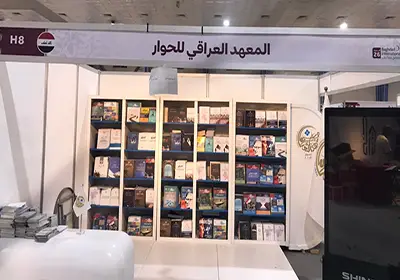
The Iraqi Institute for Dialogue, the logistical sponsor of the Baghdad International Book Fair, opens its own pavilion at the fair
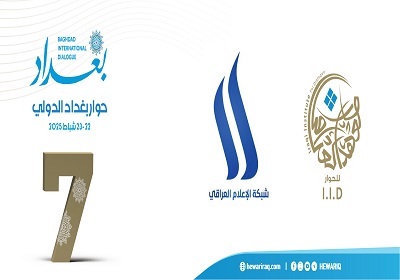
Official agreement between Iraqi Institute for Dialogue and the Iraqi Media Network to sponsor The Seventh Annual International Conference of “Baghdad Dialogue” 2025
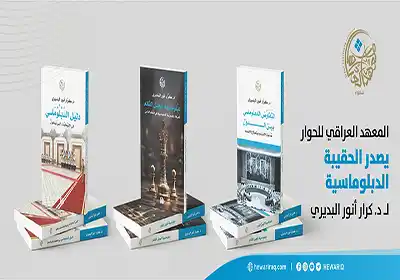
The Iraqi Institute for Dialogue publishes "The Diplomatic Portfolio" by Dr. Karrar Al-Badiri
Invitation to the 79th issue of Dialogue of Thought
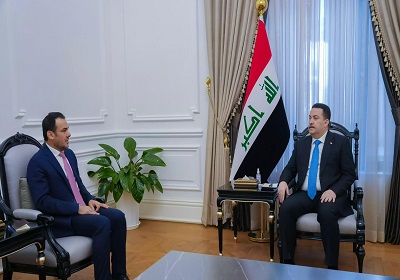
Prime Minister: The path of development will make Iraq a regional political and economic powerhouse
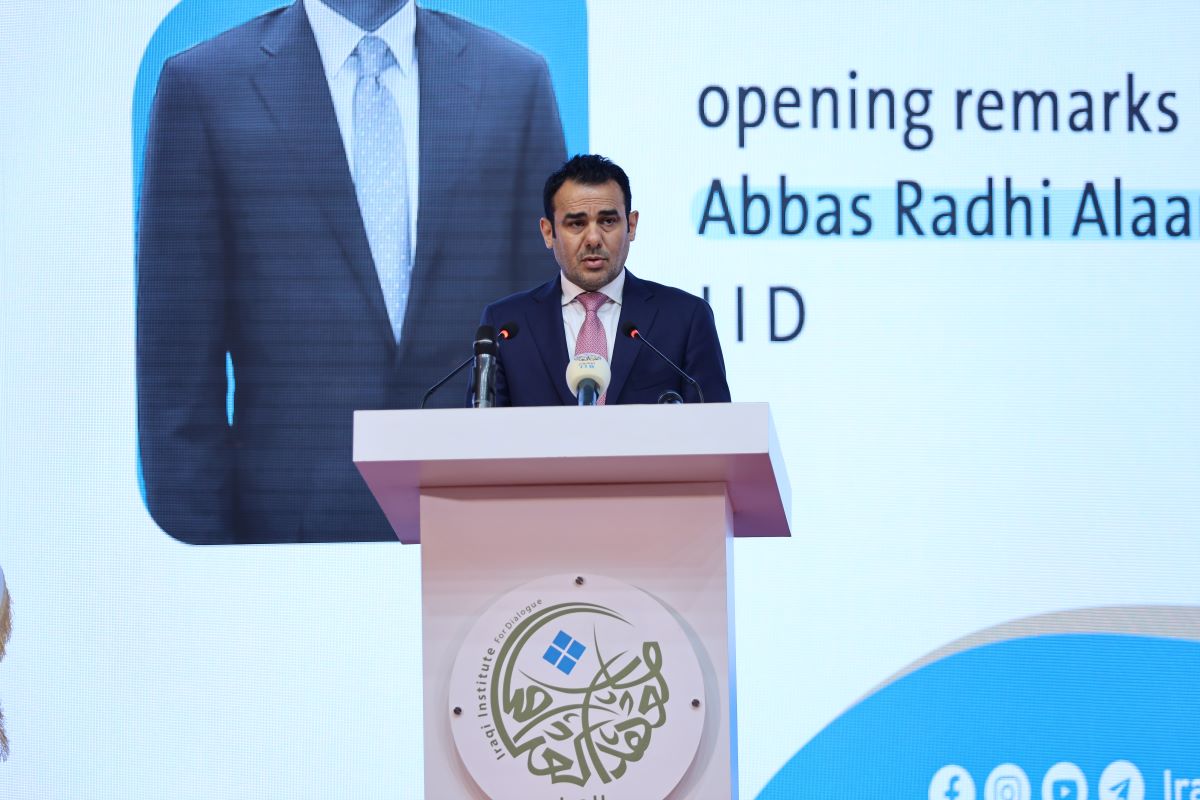
Speech of the Director of the Iraqi Institute for Dialog at the Sixth Baghdad International Dialog Conference
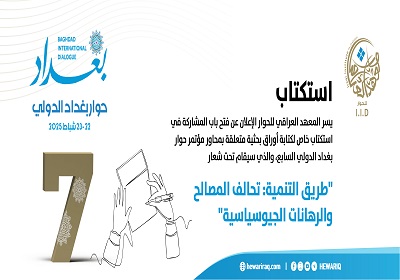
Seventh Baghdad International Dialogue Conference Call for Papers
Comments