


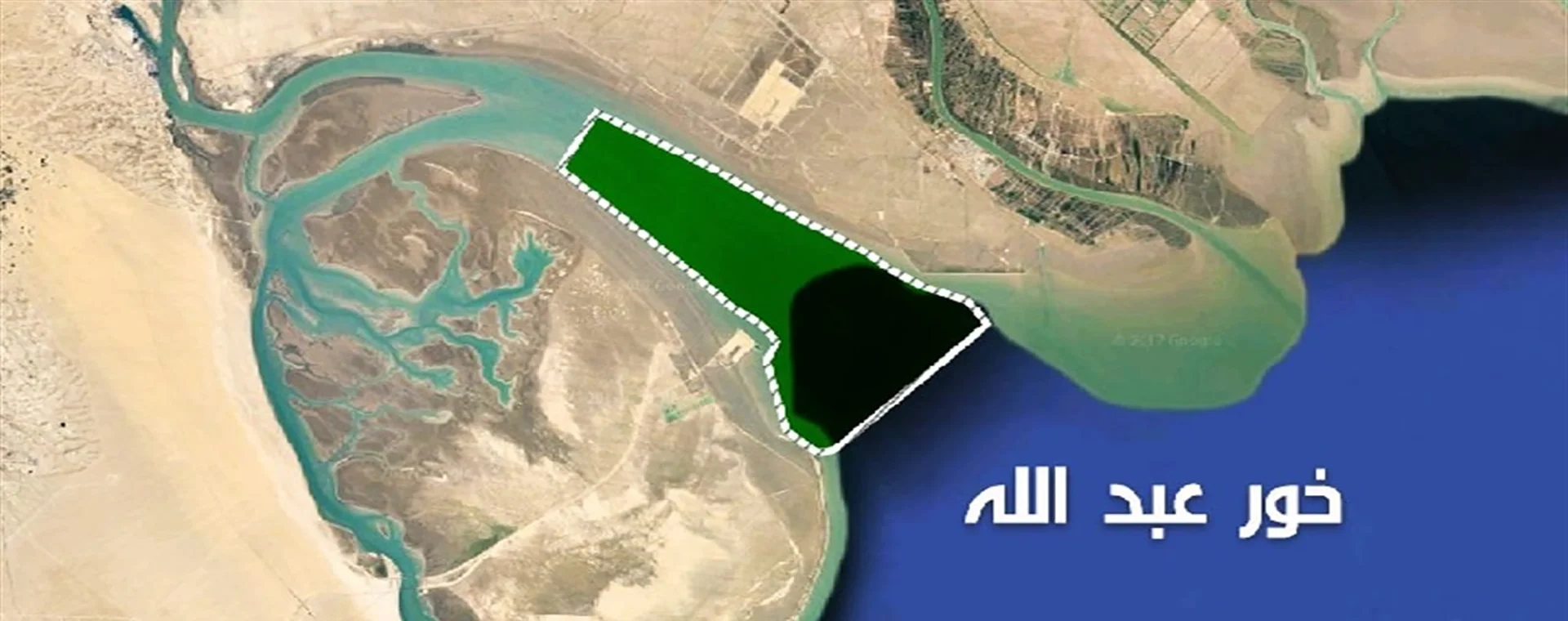
The Khor Abdullah Agreement Between Evidence and Misinformation - An Objective Legal Reading
In the wake of widespread misinformation among the community regarding the issue of the Khor Abdullah Agreement because of some of those who are looking for excitement and electoral propaganda, because of some voices moving the scene from behind the curtain, and because of some patriotic and well-meaning enthusiasts who are not knowledgeable or familiar with the subject and are lost and lost.
After the unjustified silence of the Ministry of Foreign Affairs and its failure to clarify matters in detail to the Iraqi people, it is the duty of the people of knowledge to clarify the truth, so that people do not continue to follow every whisperer without guidance and to throw the argument to them, calculating in this the satisfaction of Allah Almighty first and last, noting that our goal is to clarify the truth to the dear Iraqi people By presenting an abstract legal and objective point of view away from politics and political and electoral conflicts, which we have nothing to do with, and although we are not a party to the subject and have nothing to do with it, but the confusion, clamor and the collective mind that runs after allegations according to the saying "Hashar with the people" was the reason for publishing this study to serve those who seek evidence and not misinformation.
To demonstrate the prevalence of this misinformation, ask yourself the following questions to some of the thousands of people who have spoken on this subject and cheered for it: Have you read the Khor Abdullah Agreement? Have you read the UN Security Council resolution on the subject? Where is the legal article in the agreement that sold the creek to Kuwait or gave it part of Iraq's territory, can you not guide us to it?
The answer will surely be clear to you from now on, and that is enough evidence. Based on this, we invite everyone, whether they agree or disagree, to read this study in its two parts and then judge what they want.
In general, we will gradually and briefly begin to explain the subject of the Agreement on the Regulation of Maritime Navigation in the Khor Abdullah from the legal point of view so that the truth is clear with evidence for the honorable reader, so that the picture is complete:
1. The story began in the 1990s in the aftermath of the former Baathist regime's invasion of Kuwait, which subsequently resulted in the adoption of dozens of resolutions by the United Nations Security Council against Iraq, including resolution 833 (1993) concerning the demarcation of the border between Iraq and Kuwait at the Khor Abdullah. A United Nations commission at the time demarcated this border, which was adopted by resolution 833, and the former Baathist regime was bound by it as an international obligation among dozens of international resolutions issued after that regime's defeat in the Gulf War, which broke the regime's back and exhausted Iraq.
2. In 1993, the United Nations Boundary Commission adopted the median line as the maritime boundary between Iraq and Kuwait within the Khawr Abdullah instead of the thalweg line because of the narrowness and limited depth of the Khawr. The median line was recognized as the final water separation point between the two countries up to point (162) on the UN map near the mouth of the creek. All this was adopted in UN Security Council Resolution (833), while some voices are now loudly claiming that the above statement is the cause of the 2013 Khor Abdullah Agreement and not the Security Council Resolution.
3. After the fall of the former regime in 2003, the Iraqi government concluded an agreement with the Kuwaiti government in 2012 to regulate maritime navigation in the Khor Abdullah. The United Nations Security Council resolution (833), which demarcated the border between the two countries, did not address how to regulate this navigation and the passage of ships through the waterway, which exposed Iraq to losses and its ships to the risk of collision with the Kuwaiti coast guard. The agreement was signed in Baghdad on 29 April 2012, and the Cabinet voted to approve it on 12 November 2012.
4- This agreement was then submitted to the House of Representatives for a vote of approval, which was approved by the House on August 22, 2013.
5- Considering that the law in force at that time regulating international conventions and how to ratify them was Law No. (111) of 1979, the above agreement was submitted to the House of Representatives for approval in accordance with this law, which was voted on by a simple majority, ratified by the President of the Republic, and published in the Official Gazette as Law No. (42) of 2013 on November 25, 2013.
6. After fulfilling all the constitutional and legal requirements to ratify the Convention, it was deposited with the United Nations as an international agreement that is binding on its parties and subject to the provisions of international law from which one of the parties cannot derogate at its own will. This means that Iraq and Kuwait cannot, from the point of view of international law, derogate from the agreement at their unilateral will.
7 The aim of the 2013 agreement was to organize maritime navigation in the Khor Abdullah between Iraq and Kuwait and to define an operational mechanism for navigational access that includes the following: Corridors, ship routes, entry and exit points.
The agreement is of a technical and operational nature, not political or sovereign, and has nothing to do with the division or demarcation of borders between the two countries, contrary to what some claim. This is clear from the name of the agreement, Agreement between the Government of the Republic of Iraq and the Government of the State of Kuwait on the Organization of Maritime Navigation in the Khor Abdullah, as well as from its texts, including Article 1, which stipulates the following: ((The purpose of this agreement is to cooperate in organizing maritime navigation and preserving the marine environment in the Khor Abdullah navigation corridor in the interest of both parties))). Some of them are mentioned in the Convention's rationale: ((In order to regulate maritime navigation in the Khor Abdullah through the formation of a joint committee that works to activate the provisions of this agreement and develop joint plans for maritime safety in the Khor Abdullah and other maritime and environmental issues and for the purpose of strengthening the bilateral relationship between the two countries and respecting the right of navigation traffic established in international charters and conventions, this law was enacted))). To further emphasize that the agreement is not concerned with demarcation, Article 6 states:
((This agreement does not affect the boundary between the two parties in the Khor Abdullah established by Security Council Resolution No. 833 in 1993This confirms once again that the borders in al-Hawr are defined and demarcated by the UN Security Council resolution, and therefore cannot be manipulated in the agreement or deviated from, as everyone knows.
8. Prior to the conclusion of the 2013 Agreement on the Regulation of Maritime Navigation in the Poplar, Iraqi vessels were obliged to implement resolution 833 (2013). Under that resolution, Iraqi vessels wishing to pass through the Poplar towards Kuwaiti territorial waters were required to: Obtain Kuwait's permission to enter, fly a Kuwaiti flag instead of an Iraqi one, and pay passage fees to Kuwait. Although Iraq has not implemented this in practice, it remains an international obligation, and the United Nations demanded its implementation before agreeing to Iraq's exit from the Sabah Chapter. After the agreement, all of this was lifted and Iraqi ships officially flew the Iraqi flag.
9. From the foregoing, it is clear that Iraq has technically and technically achieved a benefit from the 2013 Agreement. If there is damage or injustice to Iraq, it stems from United Nations Security Council resolution 833 (1993) and the foolish policies of the former Baathist regime. Accordingly, whoever wishes to serve the homeland and the people should discuss with the United Nations Security Council the possibility of getting rid of this resolution and dozens of other unjust international resolutions - which cannot be achieved, of course, and not mislead people by claiming that the 2013 Agreement is the reason for the unjust demarcation of Iraq's boundaries, that it cut off parts of it and that it sold Al-Khor to Kuwait, and so on.And so on, claims that do not exist except in the imagination of their owners! How is it that this agreement carved out parts of Iraq's land and waters or that it sold the creek to Kuwait, although the one who gave it legitimacy were the people's representatives in the House of Representatives in 2013, and perhaps some of those who now object to it in parliament were among those who voted for approval at the time!
10- Whoever wishes to verify what we said in paragraph (9) above, let him follow the subject scientifically and accurately and not rely on the statements of Zaid or Amr. It is also possible to seek the help of artificial intelligence by asking it about this part, provided that the question specifies that the answer must be technical, technical, objective and neutral, supported by legal evidence and not related to the opinions of Iraqis and Kuwaitis. !!!
We have reached the following conclusions: UN Security Council Resolution No. 833 of 1993 defined and delineated the border between Iraq and Kuwait in the Khor Abdullah, not the 2013 Agreement on the Organization of Maritime Navigation in the Khor Abdullah. The purpose of the 2013 agreement was to organize maritime navigation in the Khor Abdullah between Iraq and Kuwait and to define an operational mechanism for navigational access. It is of an operational rather than a political or sovereign nature, and has nothing to do with defining or demarcating the border between the two countries.
The damage done to Iraq in the Khor was caused by UN Security Council Resolution 833, like dozens of other international resolutions issued in the wake of the occupation of Kuwait by the former Baathist regime that harmed and oppressed Iraq. The 2013 agreement came to mitigate this damage with regard to the regulation of navigation in the Khor Abdullah.
In continuation of the first part, we continue with the following points:
11. If some people have some objective observations on the agreement, they should present them in an objective manner, away from sensationalism, propaganda and clamor, so that they can be discussed. If they prove to be valid and convincing, they can then be addressed through negotiation and mutual understanding between Iraq and Kuwait and in accordance with the provisions of international law, not through slogans and fanning the flames of war as the former regime did! Our Constitution defines the mechanism for resolving international disputes through the text of Article (8), which stipulates the following (( Iraq upholds the principle of good neighborliness, is committed to non-interference in the internal affairs of other countries, seeks to resolve disputes by peaceful means, bases its relations on common interests and reciprocity, and respects its international obligations)).
As for the position of the 2013 Convention on the Regulation of Maritime Navigation in the Khor Abdullah in this regard, it should be noted that Article 14 of the Convention defines the mechanism for resolving disputes between Iraq and Kuwait, stipulating the following: ((Any dispute arising between the two parties regarding the interpretation or application of this agreement shall be settled amicably between them through consultations, and if they are unable to reach an agreement on this dispute, it shall be referred to the International Tribunal for the Law of the Sea (ITLOS).))). Moreover, it is possible to amend or repeal some of the provisions of the Convention if reasonable and experienced persons are convinced of this, away from the hype, taking into account the provisions of the Convention and international law, because the Convention is, after all, an international obligation and the Convention authorizes any amendment or repeal of it, provided the two countries understand and agree on it. With regard to the possibility of amendment, article 16, paragraph 3, of the Convention stipulates the following: ((This Agreement may be amended by agreement of the Parties and the amendments shall enter into force in accordance with the procedures set forth in the first paragraph of this Article))). With regard to the possibility of revocation, Article 16(2) provides as follows: ((This agreement shall remain in force for an indefinite period, and each party may terminate it with six months' written notice to the other party, provided that the termination is done with the consent of both parties )).
12. Bearing in mind what was stated above in part I, those who believe that the Convention should be abrogated must, from the national, legal and logical standpoints, provide reasons for doing so, provided that they are realistic reasons. On the other hand, they must provide a suitable alternative for Iraq if the Convention is abrogated, in the sense that the issue is not one of sparring and quarrelling, but one that must take account of the national interest. What alternative do they offer if the agreement is not canceled?
From a legal point of view, we must know that any revocation of the agreement will necessarily lead to a return to UN Security Council Resolution (833), which is definitely not in Iraq's interest, because adhering to it to the letter will cause losses to Iraq, as already explained! It is also likely that Kuwait will not give up the rights it obtained from this resolution, so the sooner we come to an understanding with it in the agreement to improve our situation, the better. It is worth mentioning here the need to pay attention and expedite the completion of the large port of Faw, this important strategic project, as one of its important fruits is to reduce the value of the Khor Abdullah to Iraq in the first place, according to some stakeholders.
13. Some politicians and parliamentarians, knowingly or unknowingly, raise the issue of Khor Abdullah's historical belonging to Iraq, so they believe that the agreement violates history and waives Iraq's historical rights! Although the issue was shown to be untrue in the first part, as the reason for Iraq's damage in this regard is the Security Council resolution and not the agreement, but nevertheless, it seems that the logic of this belief - the historicity of the Creek - is not much different from the logic of (the tyrant), who occupied Kuwait for the same reason, based on the fact that historically Kuwait is part of Iraq and not just the Creek, which means that the owners of this logic want to revive those absurd policies of the former regime that brought nothing but wars and destruction to Iraq.
If we follow this logic, the map of the entire world will change and many Arab countries will disappear from the map, Turkey claims Mosul, Iran swallows the Gulf states, India reclaims Pakistan, Afghanistan returns to Pakistan, and Ukraine, Georgia, Latvia, Lithuania, Croatia, Jake, and dozens of other countries disappear. And dozens of other countries! Everyone with a sound mind knows that the rule of law and international law is now international law, not history, and that the current borders of countries are recognized by the United Nations, not the historical past!
14. In order not to be fooled by some, a distinction should be made with regard to the Khawr Abd Allah Agreement between two important matters, between the Agreement as it stands on the one hand and certain practices of the Kuwaiti side on the other. If certain practices of the Kuwaiti side are unacceptable from Iraq's point of view, and they certainly are, such as the building of artificial islands to change the area of the creek in its favour or the construction of the Mubarak al-Kabeer port and the like, the Agreement has nothing to do with these provocative practices and is not the cause of them. Such practices and problems should be resolved through the diplomatic framework if we can, otherwise through resort to international courts and not through mobilization and mobilization.
15. In 2014, the 2013 agreement regulating navigation in the Khor Abdullah was constitutionally challenged on the grounds that it violated the constitution (Article 61 IV). The Federal Supreme Court ruled at the time to dismiss the challenge by Decision No. 21/Federal 2014 on December 18, 2014, which means that the agreement is constitutionally immunized.
16. In 2023, for the same reason, the agreement was challenged on the grounds that it violated the constitution (Article 61/IV). The challenge again claimed that this provision required the House of Representatives to approve the international agreement by voting on it by a two-thirds majority of its members, whereas the vote was approved by a simple majority.
17. In 2023, the Federal Supreme Court issued its decision on the subject - Federal No. 105 / 2023 on 4/9/2023 - stating, first, that it reversed its previous decision on the same subject - Decision No. 21 / 2014 on 18/12/2014 - and, second, ruling that the law enacted by the House of Representatives on approving the agreement to regulate maritime navigation in the Poplar, Law No. 42 of 2013, is unconstitutional. It violated Article 61(IV), which requires a two-thirds majority to approve the agreement, and since it was approved by a simple majority, it violated the constitution, although the court's previous final and binding decision on the same subject was to rule on the constitutionality of the agreement.
18. In its recent decision, the Court did not enter substantively into the content of the agreement, nor did it indicate that it represents an infringement of the country's sovereignty or a cession of part of its territories and waters, as some are wrongly and delusively trying to suggest. Rather, the Court limited its decision to a formal consideration, that is, a violation of the form required by the Constitution to approve international agreements, namely a two-thirds majority rather than a simple majority.
19. We recognize at the outset that the Court's decisions are final and binding, must be implemented, and are appreciated and respected, but this does not prevent us from stating professionally that the Court's decision in this regard was neither successful nor consistent with the Constitution, for a number of reasons that are not relevant here.
20 - After the first part of this study was published and the reason for the damage caused to Iraq in the Khor Abdullah lies in UN Security Council Resolution (833) and not the 2013 Agreement, some suggested that the Council of Representatives should revoke Iraq's acceptance and recognition at that time of this resolution to get rid of its consequences? One finds himself bewildered and surprised by the possibility of making a proposal with such a level of naivety, which is shameful to answer! These are resolutions issued by the highest institution in the world (the United Nations) and its highest organ, the UN Security Council, and the resolutions against Iraq at that time were issued in accordance with the provisions of Chapter VII, which authorizes the use of force against it, and then simply cancel the law that recognizes these resolutions, nullify their effects, and demand the UN Security Council to submit to what the House of Representatives decides with such naivety! It is the same misinformation and ignorance that we talked about earlier!
21. The mentality of some members of society in 2025 is supposed to be radically different from their mentality in 2003 in terms of investigating the truth and not believing any claim unless after careful consideration and verification - especially if this coincides with the election season and the many advertisements aimed at polarizing the public, but the Khor Abdullah Agreement issue has unfortunately blown this hypothesis and put us back to square one!

The Iraqi Institute for Dialogue, the logistical sponsor of the Baghdad International Book Fair, opens its own pavilion at the fair
The Iraqi Institute for Dialogue publishes "The Diplomatic Portfolio" by Dr. Karrar Al-Badiri
Official agreement between Iraqi Institute for Dialogue and the Iraqi Media Network to sponsor The Seventh Annual International Conference of “Baghdad Dialogue” 2025

Invitation to the 79th issue of Dialogue of Thought
Prime Minister: The path of development will make Iraq a regional political and economic powerhouse
Seventh Baghdad International Dialogue Conference Call for Papers
Praise for the Baghdad International Dialogue: Strengthening Iraq's pivotal role and a meeting point for visions
Comments