


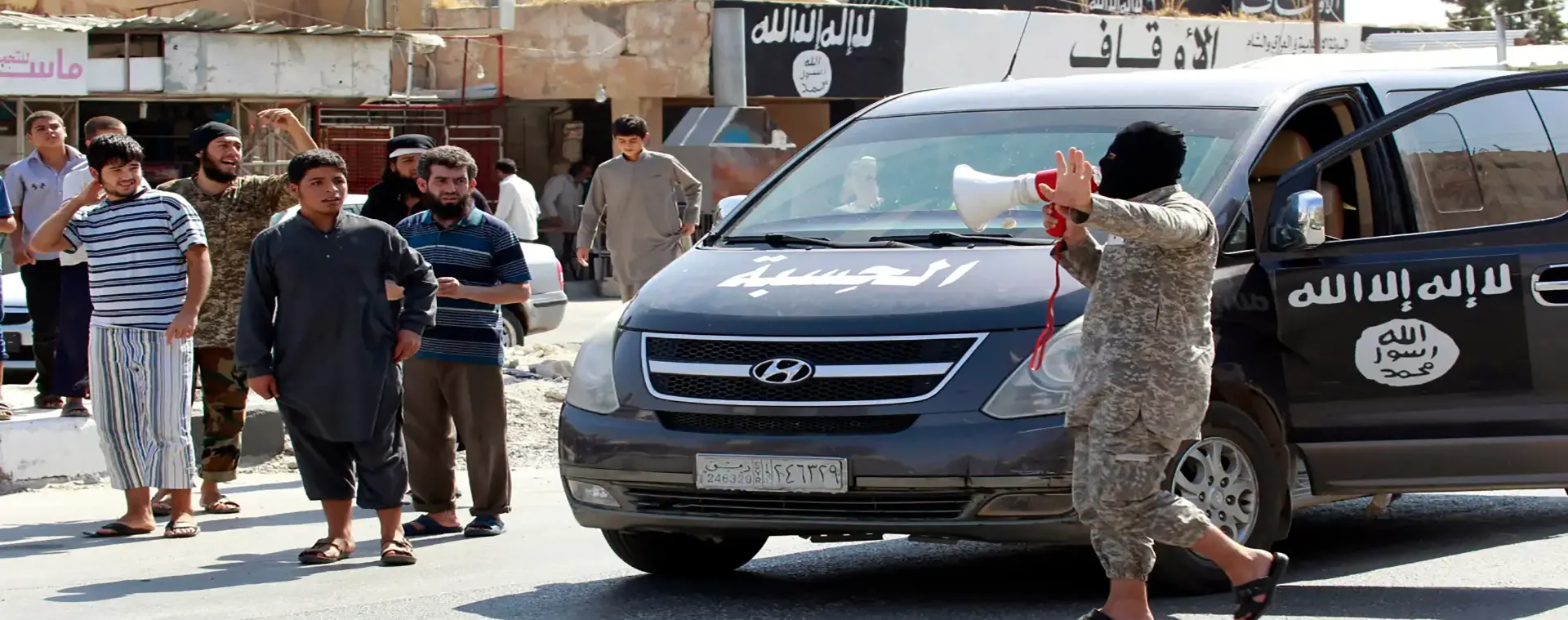
By Researcher and Analyst: Amir Sabah
D.A.. Nest. Genesis and roots
The Daesh terrorist organization emerged from the Iraqi branch of al-Qaeda, expanding in Iraq beginning in 2006, and then in Syria due to the political situation of the Syrian regime and its confusion in 2011. The organization then sought to expand to Libya, Egypt, Afghanistan and Southeast Asia.
Since its inception, ISIS has capitalized on its ability to propagate a policy of absolute terrorism, aided by the emergence of several media channels and promoted by a number of Arab channels
The term ISIS refers to the Islamic State of Iraq and the Levant, where the extremist organization describes itself as the Islamic State or Emirate, as stated in Abu Muhammad al-Adnani's May 12, 2014, recording.
The roots of Daesh, the first nucleus of the Islamic State of Iraq, which emerged on October 15, 2006, under the leadership of Abu Omar al-Baghdadi and his deputy Abu Hamza al-Muhajir, then collapsed in 2007 after the disintegration of the organization's bases and safe havens in Anbar, Diyala and Baghdad The organization suffered in early 2008 from a clear confusion that led to its collapse As a result of the decline of its influence in the mentioned areas as a result of the joint security coordination between the Iraqi and American forces alike, and the number of foreign fighters coming to the organization decreased in that period, and on April 18, 2010, both Abu Omar al-Baghdadi and Abu Hamza al-Muhajir were killed in an air strike near the city of Tikrit.
On May 16, 2010, Abu Bakr al-Baghdadi was appointed as the leader of the organization. Al-Baghdadi supported the organization by appointing former intelligence and military officers from the former regime who were all detained in the Bucca camp, where the nucleus of the organization included Abu Abdul Rahman al-Bilawi, Abu Ayman al-Iraqi, Abu Muslim al-Turkmani and Colonel Samir al-Khalifawi, known as Haji Bakr, who became the general military commander responsible for overseeing the organization's operations, as he had a direct role that later paved the way for the emergence of the organization
The organization made a strong comeback in 2013 and 2014. As for its mandate in Syria, its establishment was announced on April 10, 2012, one day after al-Qaeda's branch in Iraq, led by its emir Abu Bakr al-Baghdadi, affiliated with the Nusra Front, led by Abu Muhammad al-Julani, but the latter did not accept it, and a split occurred, with the majority of the Syrian fighters joining Nusra, and 70% of its fighters defecting, founding ISIS under the direct leadership of Abu Bakr al-Baghdadi, who took over the organization in April 2010, and the defectors who founded ISIS are estimated at approximately 12,000 fighters in Syria.
Part I: The Islamic State of Iraq First appearance October 2005-2006
Initially, Baghdad, Anbar, Diyala, Salah al-Din, Nineveh and Kirkuk were under the influence of the Islamic State of Iraq, as these areas were directly targeted by the terrorist organization. It also included other areas such as Babylon and the Middle Euphrates, and took Anbar as its capital, announcing this in 2006.
It was announced at the time by Abu Abdullah al-Jubouri, spokesman for the Islamic State of Iraq
This organization became the direct extension of ISIS after it merged with other Salafi-jihadi groups, such as Jaish al-Fatihin, Jund al-Sahaba, Ansar al-Tawhid and Sunnah Brigades, all of which were under the leadership of Abu Omar al-Baghdadi, where he presented himself as the emir of the caliphate of the Islamic State in Iraq, and shortly thereafter other Salafi-jihadi groups joined, namely Saraya Fursan al-Tawhid and Saraya Millet of Ibrahim.
Part II: The fall of the organization and the emergence of the Awakenings
The formation of the tribal Awakening Councils had a major impact in confronting al-Qaeda, led by Sheikh Abdul Sattar Abu Risha, the Sheikh of al-Dulaim in Anbar, who was assassinated by al-Qaeda in 2007 under the direction of what was known as the Ministry of Security in the al-Qaeda organization, but the continuation of the Awakenings and their success in confronting al-Qaeda and the Islamic State of Iraq and expelling them in many areas in Anbar, Fallujah and some areas of northern Iraq represented a major challenge and an effective and clear retreat.
The Islamic State of Iraq recognized the fall of its state
However, it emphasized the possibility of a return, taking advantage of the confusion and change in the security agenda, which helped al-Qaeda return and carry out a number of major terrorist operations from September 2009 to April 2010, despite the targeting and killing of its emir and deputy emir, Abu Hamza al-Muhajir, and its emir, Abu Omar al-Baghdadi, in 2010.
Part III: Al-Qaeda activity in Syria
Despite the late presence of al-Qaeda and Salafi jihadists in Syria, there were active calls by some al-Qaeda jihadists, authorizing those seeking jihad to enter Syria. The late intervention was after the spread of protests in various Syrian regions, and the regime lost control over some areas within it, and this intervention began individually coming from neighboring countries in Lebanon and Iraq, where the Abdullah Azzam Brigades, al-Qaeda in Iraq, and some other countries that had previously entered Iraq after the 2003 war by allowing and encouraging the Syrian regime itself to intervene, and names such as Abu Musab al-Zarqawi, Abu Anas al-Shami, Abu Mohammed al-Jolani, and al-Qaeda in Iraq emerged on the Iraqi scene.
In an audio recording that first appeared in April, Abu Bakr al-Baghdadi, the emir of al-Qaeda in Iraq, announced that Jabhat al-Nusra was an extension and part of al-Qaeda in Iraq, that its leader, Abu Muhammad al-Joulani, was one of the leaders of al-Qaeda in Iraq, and that the names of the Islamic State of Iraq and al-Nusra Front had been abolished and the declaration of the Islamic State in Iraq and the Levant was announced. A day later, however, Abu Muhammad al-Joulani, general in charge of the Nusra Front, denied in an audio recording what Abu Bakr Baghdadi had announced, saying he did not respond to Baghdadi's call, declaring his allegiance to Zawahiri and the central leadership of the organization, saying: "This is a pledge of allegiance from us, the sons of Jabhat al-Nusra and their general leader, to Sheikh Ayman al-Zawahiri, the Sheikh of Jihad.
Part IV: The security fiasco and ISIS's restoration of its state
In Iraq, the return of ISIS since 2013 after the emergence of the sit-ins in Anbar at the same time was the first appearance of Abu Muhammad al-Adnani, who was then the spokesman for al-Qaeda in Iraq, before he was known as the media spokesman for the Islamic State (ISIS), mobilizing the people of Anbar for jihad and revenge ISIS was active in the field and media in those areas, taking advantage of the troubled security situation in that period. He worked to woo some of the tribes that sympathized with him.
On June 11, 2014, Mosul, Iraq's second largest city, and the rest of Nineveh province, and before that, large areas of Anbar province and Salah al-Din province, fell completely into the hands of ISIS. All of this happened in a record time frame, during which ISIS achieved violent attacks that enabled it to control vast territories.
At the time, the number of terrorists was estimated at 3,000 terrorists who were able to control the city and released more than 2,500 detained terrorists from Badoush prison, which is a dangerous number if they are an additional asset to ISIS suicide bombers and operatives, especially since ISIS moved south to Baiji and Sinaiya in Salah al-Din governorate.
After being confined to Anbar at its inception in 2007, the Islamic State (IS) has managed to control large areas in Iraq and Syria, expanding into both Syria and Iraq.

The Iraqi Institute for Dialogue, the logistical sponsor of the Baghdad International Book Fair, opens its own pavilion at the fair

The Iraqi Institute for Dialogue publishes "The Diplomatic Portfolio" by Dr. Karrar Al-Badiri
Official agreement between Iraqi Institute for Dialogue and the Iraqi Media Network to sponsor The Seventh Annual International Conference of “Baghdad Dialogue” 2025

Invitation to the 79th issue of Dialogue of Thought
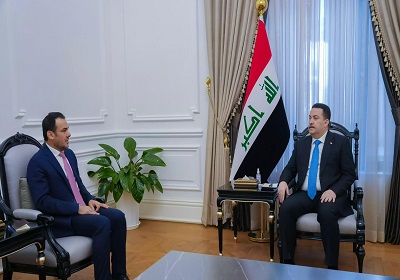
Prime Minister: The path of development will make Iraq a regional political and economic powerhouse
Seventh Baghdad International Dialogue Conference Call for Papers
Praise for the Baghdad International Dialogue: Strengthening Iraq's pivotal role and a meeting point for visions
Comments