


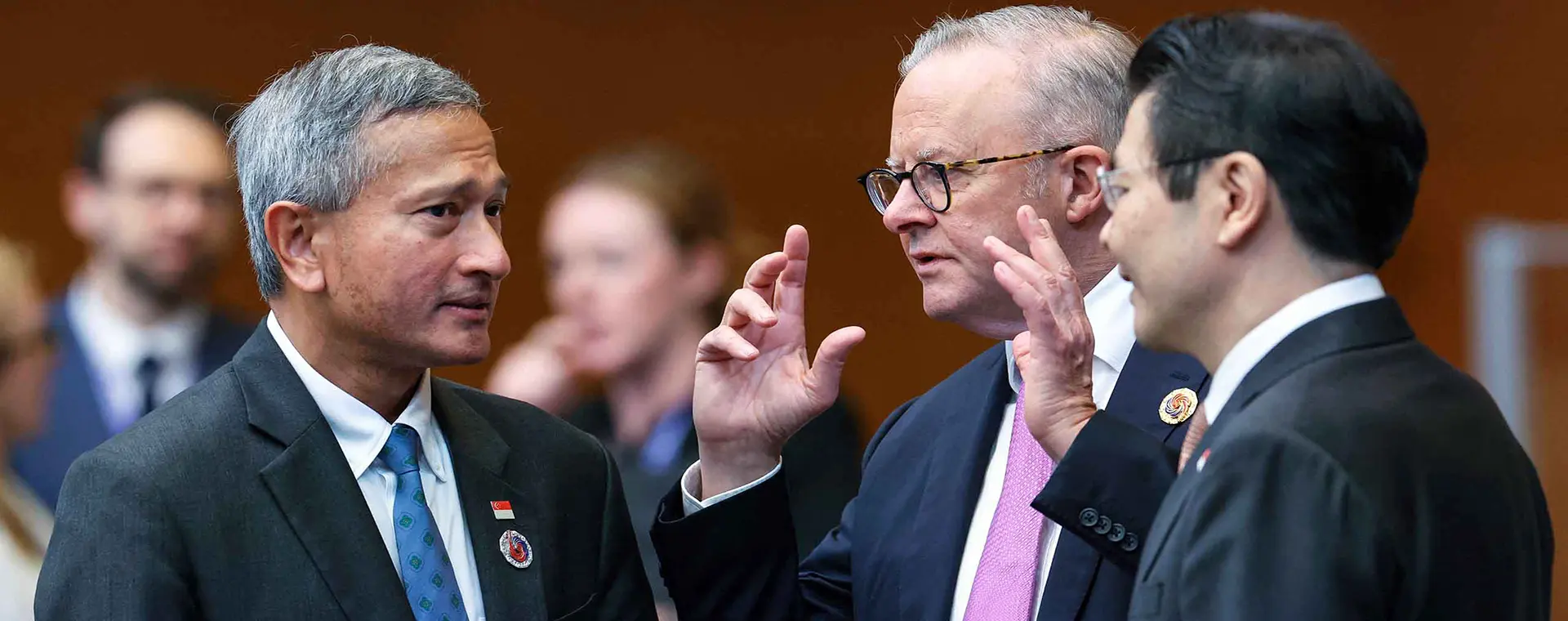
Translation: Iraqi Institute for Dialog - Graeme Doble - Journalist in international affairs
Southeast Asia at the center of the geopolitical game
Indo-Pacific leaders met this week in Malaysia and South Korea to assess the regional power game. Despite official appearances, caution and, at times, even fear were in evidence.
Estimates of power balances are relative judgments about which countries are rising and falling, and what might happen next. Summits are where leaders put their faces to these balances, but the trouble with the current era is that Asia's summits have become less of an "orchestra of power" and more of an "orchestra of uncertainty."
In Kuala Lumpur, the ASEAN Leaders' Meetings and the East Asia Summit epitomized the achievement of the Greater Association of Southeast Asian Nations: A region that expanded from ten to eleven countries after East Timor joined after a 14-year journey to become a full-fledged member, equal to the former state of Indonesia. This achievement represents the region's ability to transcend history in favor of geography.
ASEAN has made war between its members seem unlikely, but the stability of this common guarantee was shaken in July when Cambodia and Thailand engaged in a five-day border battle that killed at least 48 people and displaced 300,000. With significant help from the United States, ASEAN pushed for a ceasefire and a framework of understanding, with the two countries signing a declaration of military truce and withdrawal of heavy weapons from the border, with monitoring by ASEAN observers.
But the paradigm of uncertainty continues to threaten ASEAN, as the association has not been able to utilize the Southeast Asian model to shape the future of the Indo-Pacific.
This week, Malaysia celebrated the 20th anniversary of the first East Asia Summit in Kuala Lumpur in 2005, which was full of optimism and possibilities for linking economic dynamism with new peace structures. Australia formally joined the summit by signing the ASEAN Treaty of Amity and Cooperation, confirming its geopolitical position alongside its geo-economic position in APEC.
Current shifts in diplomatic summits reflect the new reality: Geopolitical competition in the Indo-Pacific has replaced the geo-economic optimism of the Asia-Pacific. The "C" in APEC's name-cooperation-has become more difficult, perhaps better translated as "competition," as regional economic ambitions come under pressure from tariffs, risk reassessment, and trade separation.
The Far East is not what it used to be
Historically, the East Asia Summit has been more a matter of power than geography. Had geography ruled, China would have completely dominated the summit, but the participation of Australia, New Zealand, and India contributed to a greater balance at the table, and later opened the door for the United States and Russia to join.
The current reality means that US President Donald Trump's presence at the ASEAN summit in Malaysia was a symbol of the importance of the US role in the region, especially after he had attended only one of the previous summits and left before the official photo was taken, reflecting ASEAN's fears of US policy instability.
Changing power changes geographic understanding, and regions are renamed. As senior ASEAN scholar Amitav Acharya explains, terms such as "Far East," "Asia," "Asia," "Asia-Pacific" and "Indo-Pacific" were constructed according to the interests of different powers, but the new concept of the Indo-Pacific does not place ASEAN at the center, which could put pressure on the organization's regional culture and identity.
China and the United States: Conflict of strategies
China rejects the "Indo-Pacific" concept as a dangerous American creation and seeks to avoid challenges to its hegemony through a two-ocean strategy. ASEAN has cautiously embraced the concept, while Australia, India, Japan, and the United States have actively promoted it.
According to Acharya, the current period of US-China conflict is similar to the previous Cold War, but more complex: The US and China have shifted from reluctant partners to outright rivals, and Southeast Asia faces significant challenges in maintaining its central position.
China's economic and military rise is different from post-World War II Japan; China still carries some historical grievances and faces significant maritime and geographic challenges, such as disputes in the South China Sea, where the United States, India, Japan, and allies such as Singapore and Australia intervene to deter any threat.
ASEAN's Options for Survival or Dissolution
Acharya points to two possible futures: First, ASEAN being swallowed up by China, India and the escalating US-China rivalry, and second, ASEAN continuing as a living and functioning entity if it adheres to three principles:
Building a clear regional identity
Embracing Freedom and Democracy
Focus on neutrality, balance and caution
He calls for ASEAN to recognize its regional roots and embrace external influence that enhances its independence, while rejecting hegemony from any external power, asserting that its own regional model is a capacity to engage with major powers without being subservient to them.
The ongoing diplomatic dance
In the face of the power struggle between the United States and China, Southeast Asia must continue its "neutral, balancing, and ASEAN-centric" approach, one that sends senior leaders a clear message: "Don't force us to choose!"
This message remains at the heart of the ASEAN model, where major powers must persuade the region, but accept vague and flexible answers, as the collapse of this model occurs if major powers try to impose their will.
Ultimately, ASEAN now faces a new era of power politics, with Southeast Asia at the center of the geopolitical competition between China and the United States, and its fate determined by its ability to maintain its centrality and identity in a changing world.

The Iraqi Institute for Dialogue, the logistical sponsor of the Baghdad International Book Fair, opens its own pavilion at the fair

The Iraqi Institute for Dialogue publishes "The Diplomatic Portfolio" by Dr. Karrar Al-Badiri
Official agreement between Iraqi Institute for Dialogue and the Iraqi Media Network to sponsor The Seventh Annual International Conference of “Baghdad Dialogue” 2025
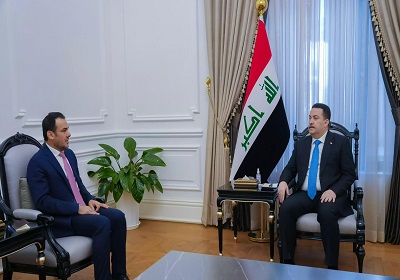
Prime Minister: The path of development will make Iraq a regional political and economic powerhouse

Invitation to the 79th issue of Dialogue of Thought
Seventh Baghdad International Dialogue Conference Call for Papers
Praise for the Baghdad International Dialogue: Strengthening Iraq's pivotal role and a meeting point for visions
Comments