



By Mariana Sharontaki, International Policy Expert at Lincoln University
From research to theory: Toward a Comprehensive Framework in International Relations
At a critical juncture for both global and regional politics, it has become increasingly clear that facts on the ground - that is, concrete political developments - have outpaced traditional scholarly arguments and conceptual positions put forward over the past decade, gradually rendering many of them irrelevant. The rapid emergence of domestic developments into regional events with far-reaching implications for the international system reduces the space for ambiguity.
This is because the reality of these events, driven by real-world dynamics and transcending conventional logic, has imposed itself on theory. To a large extent, these phenomena are no longer just sub-regional studies, but have become essential components of science as a whole. However, this does not mean that theory must cease to be general or generalizable. Any comprehensive understanding of a particular phenomenon requires an integrated analytical framework, since "theory constitutes a set of guiding principles on which any independent analysis must be based."
In the context of international relations, this shift was originally initiated by states themselves, which elevated non-international actors, recognizing them, in a sense, as equally important as international actors, to the point where these non-international actors were able to force their recognition on the international stage as legitimate actors.
Notable examples of non-state actors
There are two extreme but illustrative, unconventional and historically significant examples: First, the rise to power of a religious extremist group that received partial internal acceptance with significant regional and international support. HTS, led by Abu Mohammad al-Joulani, is an example of a non-state actor that has become a pivotal player in the Syrian political landscape, challenging traditional state-based models.
Second, the century-old Palestinian case, and its ongoing efforts to achieve statehood, also highlights the dynamic complexities of non-state actors in international relations. Both examples illustrate the growing influence of non-state actors in reshaping regional and global political orders.
Categorizing non-state actors
The emergence of a new typology, which predates recent developments in Syria and flows naturally from the recognition that regional dynamics and international relations constitute a unified field, highlights the need to distinguish between different types of non-state actors. It has become clear that there is a dividing line between extremist groups - regardless of their ethnic or religious orientation - and "states-to-be," which often represent more established versions of ethnic groups.
Extremist groups are primarily characterized by radical extremism in discourse and practice, a strategic choice that recent studies suggest provides some benefits to these groups. On the other hand, "prospective states" do not necessarily seek full independence, but rather recognition and coexistence as equals within the international system, making them, after actor states, the most important category of non-state actors in international relations.
The case of Palestine as an example of prospective states
The nature of these prospective states shows, as in the case of Palestine, "entities with state attributes and the ability to modify the status quo, i.e. to lead or shape the development process in order to maintain its power base and autonomy." Despite not having full international recognition, Palestine serves as a special case of a non-state actor actively engaged in foreign policy, including diplomatic initiatives towards the United Nations and other global institutions, as well as Palestinian academic institutions that contribute to research and foreign policy formulation.
The continued involvement of non-state entities in self-determination processes has led to a shift in their role, making them central to the science of international relations itself. This gradual institutionalization of foreign policy behavior by non-state actors signals a shift in their status: They now seek to play distinct roles within the international system, which can be interpreted as a "victory" for the non-state actor within the IR system. This has led to the widespread recognition of non-state actors as policymakers, not only because of their active participation at the regional and global levels, but also because of their necessary contribution to the continuity of regional politics, and as a condition for their survival and development. The Palestinian case is a prime example.
The importance of understanding the nature of non-state actors
The nature of non-state actors is important when compared to their modes of operation, which may differ or be similar across categories. Although modes of operation provide a clear means of understanding the ways in which non-state actors operate, they cannot be a definitive criterion for distinguishing between them. Focusing on their intrinsic nature is key to understanding the distinctive features of their political behavior. It is necessary to recognize their specific nature and trace their trajectories to understand their fundamental differences, as a focus on their intrinsic nature is essential to understanding the distinctive features of their political behavior.
Theoretical conclusion
The fundamental question in international relations is no longer what to observe, but how theory can take these phenomena and integrate them into a comprehensive analytical framework capable of accommodating the theoretical trajectories emerging from contexts such as the Middle East, which has been in a constant state of transition and reconfiguration since 1916 - an organic and political process that is as organized as it is geographical.

The Iraqi Institute for Dialogue, the logistical sponsor of the Baghdad International Book Fair, opens its own pavilion at the fair
Official agreement between Iraqi Institute for Dialogue and the Iraqi Media Network to sponsor The Seventh Annual International Conference of “Baghdad Dialogue” 2025
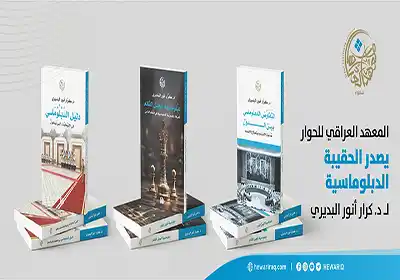
The Iraqi Institute for Dialogue publishes "The Diplomatic Portfolio" by Dr. Karrar Al-Badiri

Invitation to the 79th issue of Dialogue of Thought
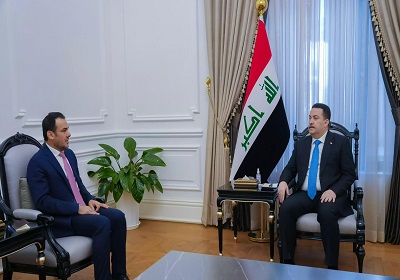
Prime Minister: The path of development will make Iraq a regional political and economic powerhouse
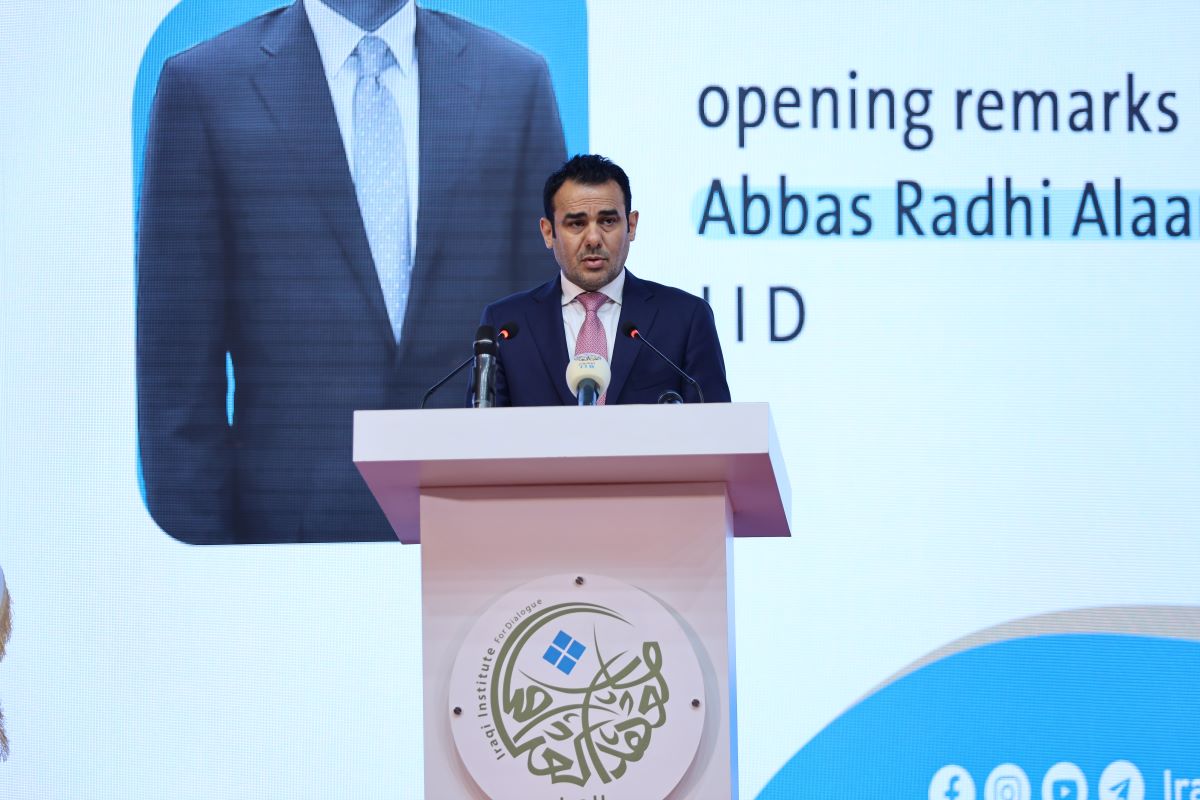
Speech of the Director of the Iraqi Institute for Dialog at the Sixth Baghdad International Dialog Conference
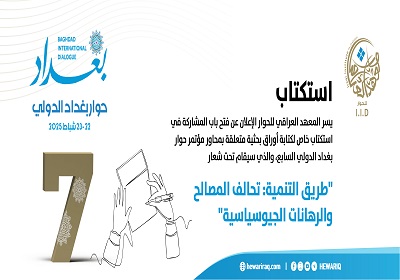
Seventh Baghdad International Dialogue Conference Call for Papers
Comments