


Translation: Iraqi Institute for Dialog
The Great European Delusion and the Dawn of Realistic Foreign Policy
The European Union's liberal foreign policy, especially the European Neighborhood Policy (ENP), has failed miserably. A bloody war of a scale not seen since World War II is raging in our immediate neighborhood. The Eastern Partnership is paralyzed, and twelve years have passed without any new EU enlargement - the longest period of stagnation in European integration since its inception. Relations with Belarus, Turkey, Georgia, and Azerbaijan have deteriorated to crisis level, while the Union has also come into conflict with the two superpowers of our time: The United States and China.
All these crises go back to one common phenomenon: The universality of the liberal doctrine in European foreign policy and its detachment from reality. Since the end of the American liberal-democratic hegemony over the world order, liberalism has lost its ability to maintain international order. If the EU wants to regain its rightful place at the table of the major powers, it must adopt a realistic, pragmatic and intelligent foreign policy.
The Decline of Liberalism and the Beginning of a New Era of International Multilateralism
The era of unipolarity - the world order shaped by the temporary hegemony of the United States - has come to an end, to be replaced by a multipolar or interlocking international order. This transformation did not happen overnight, but 2008 was the symbolic turning point.
The global financial crisis shook confidence in the American model of liberal capitalism, and the global economic center of gravity shifted eastward to China, which represents the model of organized, state-led capitalism. Since then, the global distribution of capital and power has undergone a radical shift - a new repolarization: China's GDP (as measured by purchasing power parity) has surpassed that of the U.S., and the BRICS countries account for about a third of global merchandise trade, rapidly approaching the size of the G7.
When the global free trade system based on economic liberalism failed to maintain American supremacy - and instead empowered competitors - Washington embarked on a radical reshaping of its international trade relations. After a century of leading the global liberal economy, the U.S. re-adopted protectionism as a strategic tool. Although the decisive shift came during Donald Trump's presidency (2016 onwards), both Republican and Democratic administrations continued this grand approach, agreeing to block the appointment of judges to the World Trade Organization (WTO) Appellate Body, bringing the global trading system to a standstill.
A shift in international relations
Along with this shift in the balance of economic power, there has been a parallel shift in the structure of international relations. In addition to the legal and institutional internationalism with Euro-American roots, new normative forces have emerged in the form of regional or "mini" cooperation frameworks such as: BRICS, the Shanghai Cooperation Organization (SCO), the Gulf Cooperation Council (GCC), the Association of Southeast Asian Nations (ASEAN), and the Organization of Turkic States (OTS).
The "re-globalization" of international relations accelerated dramatically during the COVID-19 pandemic. The experience of the World Health Organization revealed the unequal distribution of resources of international institutions, reinforcing calls around the world for restoring sovereignty, embracing protectionism, and seeking a more just world order. The failure of the Paris Climate Agreement has also left a profound impact on younger generations, who have realized that traditional multilateral frameworks are no longer capable of solving major global issues.
The International Law of War Crisis
A key part of the traditional international order has also collapsed: The international law of war. Azerbaijan regained its territory by force and then terminated the Organization for Security and Cooperation in Europe's Minsk Group. In 2022, Russia launched a bloody war on Ukraine and then withdrew from the Open Skies and New START treaties. Amid this escalation, five EU member states - Poland, the three Baltic states, and Finland - withdrew from the Ottawa Treaty banning anti-personnel mines.
The "American peace" in Europe is over, and international conflict resolution institutions have failed to fulfill their role. We have entered a period of heightened uncertainty, where the rules of engagement are constantly being rewritten. Recognizing this reality and dealing with it realistically is painful, but for Europe to remain a player in the new world order, it is existential.
The Great European Delusion
In 2018, John Mearsheimer published his famous book The Grand Illusion, one of the most quoted critiques of liberal foreign policy.
Mearsheimer argues that the end of the Cold War and the fall of the Soviet Union gave the United States global economic and military supremacy, creating a unipolar system dominated by liberalism in international relations.
The goal of US liberal foreign policy was to transform as many countries as possible into liberal democracies, thereby opening up their economies and political systems to US capital and political influence. America's European partners, especially Britain and the European Union, have been involved in this project.
With this approach, the Euro-Atlantic space expanded rapidly through a policy of "exporting democracy." In the fifteen years after the unification of Germany in 1990, NATO expanded by ten new countries; after the 1999 expansion in Central Europe, three former Soviet republics joined in 2004; and just one month later, ten countries from the former Eastern Bloc joined the European Union.
American military and liberal economic superiority has enabled both NATO and the European Union to expand eastward, reinforcing the European belief in the supremacy of the liberal model globally. But Mearsheimer argues that this liberal doctrine was built on an illusion doomed to failure.
The failure of liberal doctrine in the face of the logic of power
While spreading democracy and human rights are morally noble goals, this idealistic approach ignores the logic of the balance of power. When a liberal state tries to impose its model in a region where there are other powers with different systems, the project becomes unsustainable.
In such cases, liberal forces resort to realist practices and use hard power under the cover of liberal rhetoric, but if realism is absent, only soft tools remain: Rhetorical isolation, economic sanctions, and promises of democratic institutions and natural rights.
Mearsheimer argues that this policy became globally unsustainable after the end of unipolarity, especially in the European case. The project of a "free and united Europe" - based on the assumption that the continent would voluntarily democratize and fully integrate into the Euro-Atlantic space - was from a geopolitical perspective unrealistic, because the presence of other superpowers and rival regimes in the European space makes clashes inevitable and leads to the failure of liberal politics.
From the Bucharest Summit to the Georgian War
In 2008, the year that marked the beginning of the end of unipolarity, NATO announced at the Bucharest summit that Ukraine and Georgia were candidates for membership. At the time, many European officials, especially the Germans and French, warned that Russia, emerging from the ruins of the Soviet Union, still considered these two countries to be within its immediate sphere of influence and would respond strongly to any U.S. military or arms presence in those regions.
Vladimir Putin made his position clear when he said in April 2008 that this was a "direct threat." A few months later, in August of the same year, the Russian army entered Georgia, and Moscow recognized the independence of Abkhazia and South Ossetia, freezing the conflict indefinitely and halting Georgia's integration into the Euro-Atlantic system.
The Eastern Partnership: A European attempt to export democracy
In the same year (2008), the European Union launched the Eastern Partnership Initiative as a European version of the democracy export project. Lacking hard power tools, it relied on soft means: Improving legal and institutional systems, promoting good governance, and supporting "economic integration and convergence with EU policies," i.e. preparing these former Soviet republics - Belarus, Ukraine, Moldova, Moldova, Georgia, Armenia and Azerbaijan - for future membership. The program was later expanded to include support for democracy, human rights, rule of law, sustainability, anti-corruption, and support for civil society.
But the results have been underwhelming. By 2021, Belarus suspended its participation in the initiative, and Azerbaijan canceled its political coordination with the Union over its positions on the Nagorno-Karabakh war in 2020. Georgia, which was considered a model of success in the ENP until 2022, had its accession process frozen in 2024 by the European Council itself.
In Ukraine, the popular commitment to democracy and joining Europe has turned into open warfare. Europe has not coupled its promises with geopolitical realism or security guarantees - EU accession often precedes NATO membership - making the European liberal agenda a victim of Russian power politics.
The outcome of the Ukrainian war remains unresolved, hanging like a sword over the head of Moldova, which aspires to join the Europeans. As for Armenia, it remains trapped between geographical, economic and security challenges that make its European prospects more uncertain than ever.
The Failure of Liberal Foreign Policy
Over the past three decades, the United States has sought to impose a liberal world order under its leadership, based on the assumption that democracy and a free market economy would lead to a more stable and peaceful world. Washington's wars fought in the name of spreading democracy have destabilized entire regions, such as in Iraq, Afghanistan, and Libya. Over time, trust in America's intentions declined, and rising powers such as China and Russia began to challenge its hegemony, seeing the liberal global order as a cover for continued Western supremacy.
At home, costly wars and economic crises have contributed to rising populist tendencies and shaken faith in the United States' ability to lead the world. What was supposed to be a liberal international order based on cooperation and international law has been transformed into one dominated by unilateral interests and double standards, ultimately weakening America's own standing in the world.

The Iraqi Institute for Dialogue, the logistical sponsor of the Baghdad International Book Fair, opens its own pavilion at the fair
Official agreement between Iraqi Institute for Dialogue and the Iraqi Media Network to sponsor The Seventh Annual International Conference of “Baghdad Dialogue” 2025
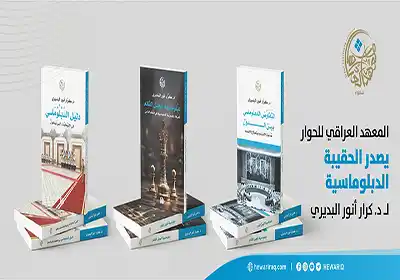
The Iraqi Institute for Dialogue publishes "The Diplomatic Portfolio" by Dr. Karrar Al-Badiri

Invitation to the 79th issue of Dialogue of Thought
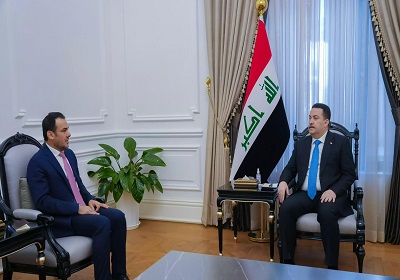
Prime Minister: The path of development will make Iraq a regional political and economic powerhouse
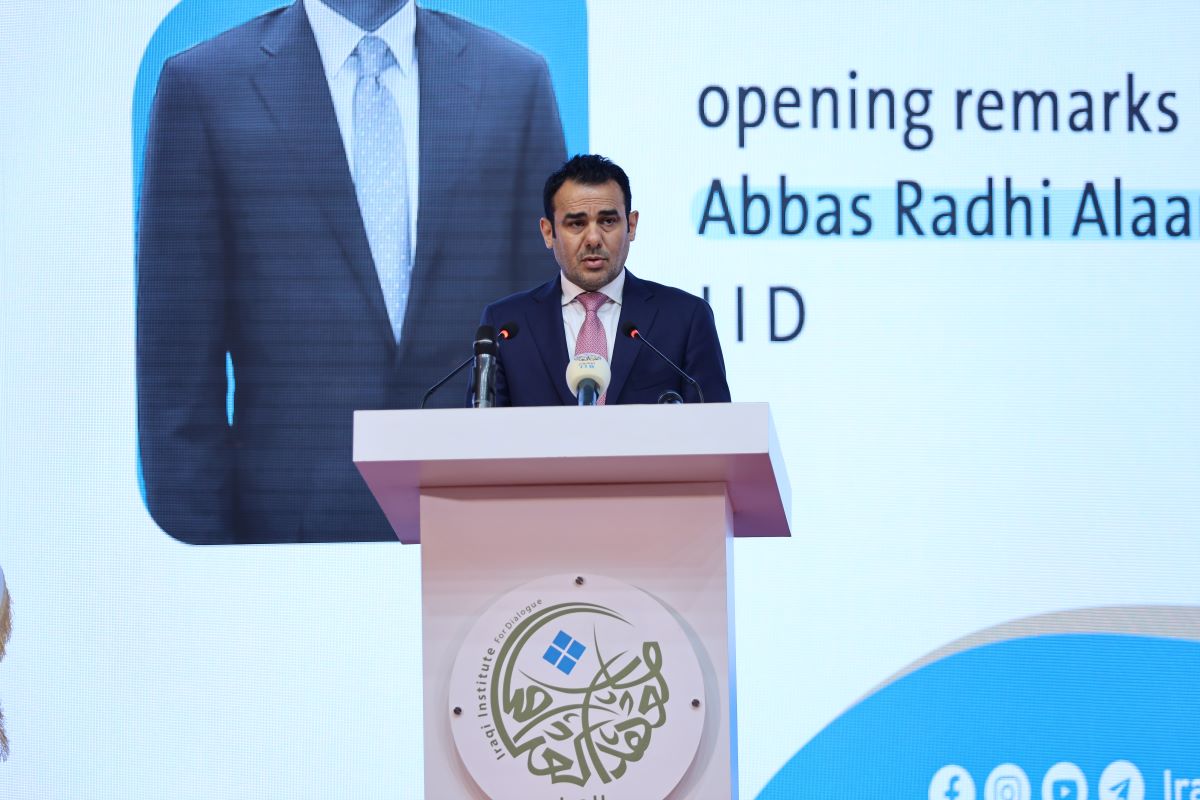
Speech of the Director of the Iraqi Institute for Dialog at the Sixth Baghdad International Dialog Conference
Seventh Baghdad International Dialogue Conference Call for Papers
Comments