


Hafez Al Bishara, a writer and media personality, is interviewed by Dialogue of Thought
Hafez Al-Bishara was interviewed by Hewar Al-Fikr magazine in issue (13) published in June 2010.
Dialog text
Dialogue of thought: Political affiliations have multiple levels. How to make political affiliation with the state and the country the first affiliation?
Hafez Al Bishara:The existence of parties is one of the most important components of the modern state, and in the normal situation, no contradiction or competition can arise between loyalty to parties and loyalty to the homeland, because the association with the party is not loyalty in the ideological sense, as the party is a means of serving the homeland and the people, and every support or association with the party is a means to achieve certain demands. However, parties in primitive societies or those that have not lived the experience of the circulation of power are different from parties in modern democratic countries, as it is known that the less developed countries where parties are still experiencing conflicts of a radical nature, and these conflicts have not been resolved in favor of a certain vision and because of the radical or ideological character of the parties.
The more the state succeeds in depoliticizing its administrations and establishing a system of institutions, the less active the parties will be, the more society will be immersed in the state, and the more civil society organizations will emerge that can gradually replace the parties.
Dialogue of thought: The political decision-making process in Iraq is approaching the "leader-elite" or "leader-dominant" model, and this confirms the lack of democratization of the political decision. What are the mechanisms and means to achieve the democratization of the decision?
Hafez Al Bishara:It is assumed that Iraq has become a country that applies participation, election, pluralism and the constitution in its political life, separates powers, believes in freedoms, and seeks to build a state of institutions, and these features are directly reflected in its political and administrative performance, as there is no longer a singularity in the decision, and to be precise, the decision and what is meant by it cannot be defined in the system that separates powers as there are mechanisms in legislation and the only legislative and oversight institution is the Council of Representatives, and the only executive institution is the cabinet or the government, and there is the judicial authority and the judicial work does not dispute it only, and the constitution clarifies the formation and functions of each authority and its dependencies, if expansion occurs So I do not think that decision-making in Iraq is going in the direction of the elite method or the method of the individual ruler, but there is a third model, which is the separation of powers and the state of institutions.
Dialogue of thought:Do you see it as complicated or easy to manage the dialogues to form a government given the prevailing climate?
Hafez Al Bishara:There are several factors that will influence the talks aimed at forming a government:
a) The legal ratification of the final election results was delayed, and the issue was further complicated by the Commission's acceptance of a recount of the capital's votes at the request of the State of Law List, while other blocs intend to submit similar requests for a recount, and in another development, the Court of Cassation announced the exclusion of more than fifty candidates for accountability and justice, most of them from the Iraqi List, which will change the outcome of the elections. Each of these developments requires a judicial decision and raises serious political unrest.
b) The largest list, al-Iraqiya, is infuriating the Iraqi street because it includes Baathists, remnants of the former regime and those subject to de-termination, and the other lists are embarrassed to enter into a discussion with it about forming a government.
c) The State of Law List feels that its president, Nouri al-Maliki, who is the largest holder of votes in Iraq and its second ranking, has the right to impose its conditions in negotiations to form a government, while the National Coalition and others refuse to nominate al-Maliki for a second presidency.
w) State of Law approaches Iraqiya despite deep animosity to force the National Coalition to relent and return to deadlocked merger talks.
c) The Kurdistan Alliance is closer to the National Coalition, and the two are hinting at the possibility of an alliance to form a strong parliamentary front that may attract others, and Kurdistan disagrees with the State of Law and Iraqiya over the centralized management of the state and the weakening of the regions, but Kurdistan can change its alliances if it gets something.
These obstacles were originally caused by the lists obtaining close results and the lack of a supermajority, and could have changed the course of the electoral event if the State of Law and Nationalist coalitions had merged and fought the elections as one list.
Dialogue of thought:The Iraqi foreign policy agenda in general and the Middle East in particular is subject to frequent debate about the extent to which this policy is in line with Iraq's core interests. How do you comment?
Hafez Al Bishara:Iraq is capable of reformulating its international relations and its relations in the Middle East and the Arab world in a new way that is consistent with the nature of its political system, there are two ways of managing international relations, the idealistic way and the realistic way, and the democratic system in its relations favors the realistic method based on the formation of a system of common interests with the countries of the region, but there are many factors that stand in the way of reforming Iraq's international relations, the most important of which are:
1- Iraq is still under Chapter VII of the United Nations, which violates its independence and reduces the enthusiasm of countries to establish close relations with it.
2- There is a difference with the countries of the region in the nature of the ruling political system, and international relations develop in light of the political homogeneity between the ruling regimes, and the relationship between a dictatorial regime and a democratic regime is rarely fruitful.
3- Some countries in the region view the new regime in Iraq with fear and hostility and consider its presence as a prelude to change in their own regimes, which leads to a loss of confidence.
4- Because Iraq's foreign minister is a Kurd, some Arab countries claim that this goes against Arabism, so their desire to develop relations with Iraq is diminished.
5- The Ministry of Foreign Affairs and Iraqi embassies are still mined with Baathist elements and old intelligence agents under the pretext of professionalism, and they play a dangerous role in undermining Iraq's relations with the Arabs and the world.
6- The relations that Iraq wants to establish with regional countries are of limited use in the field of reconstruction and development because they are relatively underdeveloped countries that cannot provide Iraq with high-end services in these fields, so it prefers more developed countries.
Dialogue of thought:The external factor has become a clear presence in the circumstances of the political crisis in Iraq, especially from the perspective of the openness of the external role and the exposure of its presence... What is the truth of this.
Hafez Al Bishara:The Saudi influence is based on the ambition to fill the vacuum left by old Egypt in the Arab world based on the group of Gulf Cooperation Council countries, the prosperity of its oil site and the expansion of its Wahhabi religious institution in the Islamic world, as for Iran, it wants to practice its life as an independent state with oil, nuclear and cultural rights, but the Iranian religious approach and refusal to submit to the West and the Israeli obsession with Tehran of Talmudic origin complicated the dispute with it, and did not stop all the way. Saddam had launched his war on Iran with Arab support and was the guardian of the eastern gate, which is the gateway to Israel, which became the centerpiece of the management of the Greater Middle East extending from the Himalayas in Central Asia to the Atlantic coast, and when the change occurred in Iraq, some Arab countries decided to support the takfiri Baathist coalition to return the Baathists to power in Iraq or burn and destroy the country, because they feared the establishment of a democratic system of government It is considered a breach in the citadel of Arab dictatorship, and their fear of an expected cooperation between Baghdad and Tehran, which makes Iran advance a step on the ground towards Israel and violate the existing sectarian balance in the region based on keeping Iraq under the hegemony of the sectarian minority government, and thus the countries of the region have a trusteeship over some Iraqi parties that work on behalf and use sectarian justifications to implement a regional agenda.
Dialogue of thought:One of the phenomena that emerged from the conflicting interactions between the parties to the political process in the previous phase is the imbalance of internal power, so what is your opinion on the type of balance that leads to the creation of cooperative interactions between these parties.
Hafez Al Bishara: The Baathist-Takfiri alliance succeeded after the fall of the defunct regime in creating a false impression in the Iraqi and Arab public opinion that Iraq is witnessing a sectarian war between Sunnis and Shiites, and the truth is that the Baathist-Takfiri alliance waged a war that targeted all components of the Iraqi people without discrimination, as it is a war of takfir against the entire Iraqi people, and some suspicious forces tried to benefit from this battle but failed in the end. The Iraqi national forces can achieve more cooperation and understanding between them if they adhere to the following conditions:
- Feeling a sense of belonging to the homeland and placing it above secondary sectarian and national affiliations.
- Depoliticize secondary affiliation and keep it within its natural size as a cultural right.
- Prioritizing dialogue and understanding and not resorting to violence in resolving disputes.
- Satisfaction with the constitution, belief in the democratic electoral system, and cooperation with all national institutions.
- Not responding to any foreign country that wants to recruit Iraqi individuals or parties to serve its interests.
- Everyone has always endeavored to form a broad-based national participation government based on the rule of consensus and compromise in a way that does not confiscate the electoral right.
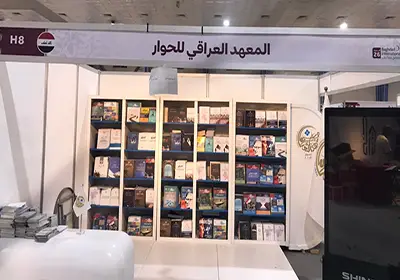
The Iraqi Institute for Dialogue, the logistical sponsor of the Baghdad International Book Fair, opens its own pavilion at the fair
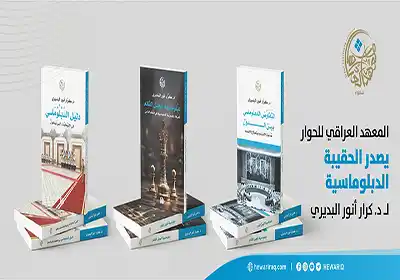
The Iraqi Institute for Dialogue publishes "The Diplomatic Portfolio" by Dr. Karrar Al-Badiri
Official agreement between Iraqi Institute for Dialogue and the Iraqi Media Network to sponsor The Seventh Annual International Conference of “Baghdad Dialogue” 2025
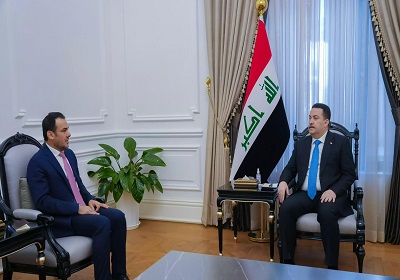
Prime Minister: The path of development will make Iraq a regional political and economic powerhouse
Invitation to the 79th issue of Dialogue of Thought
Seventh Baghdad International Dialogue Conference Call for Papers
Praise for the Baghdad International Dialogue: Strengthening Iraq's pivotal role and a meeting point for visions
Comments