

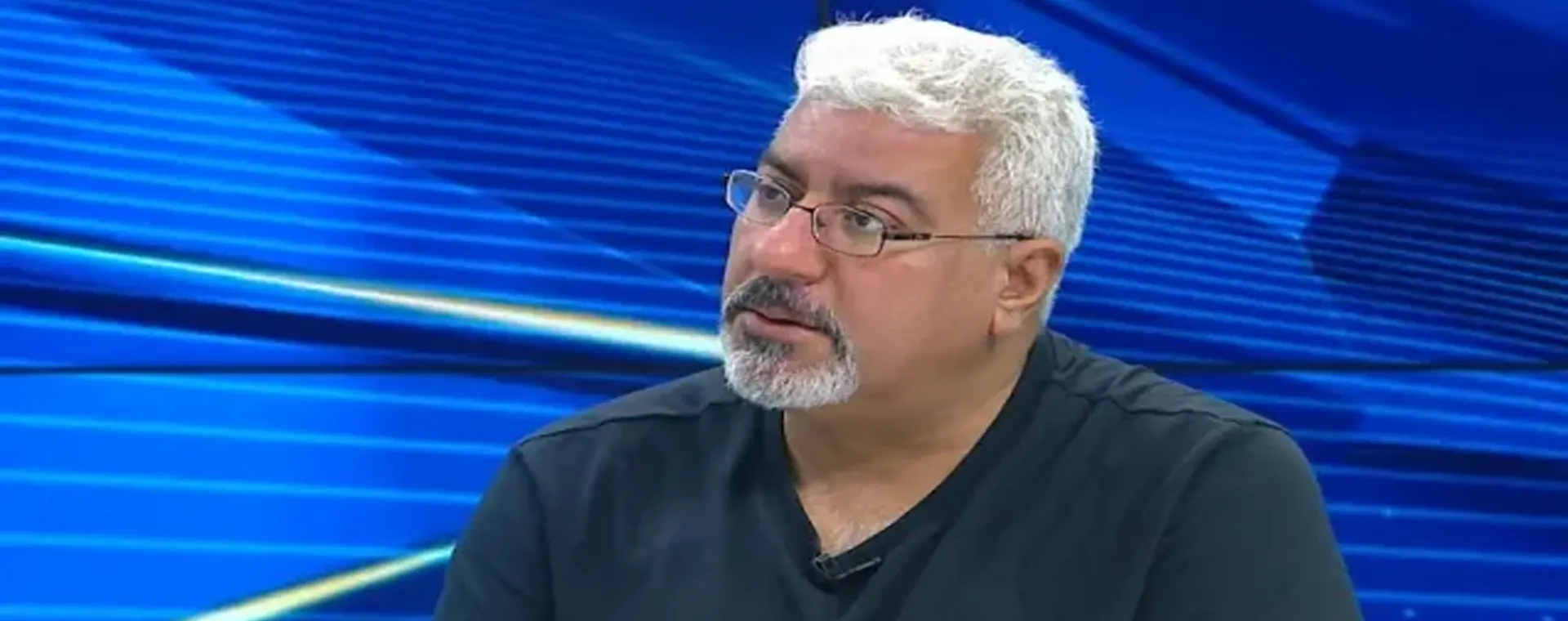
Dialogue of Thought magazine tries Sarmad al-Taie, editor-in-chief of Al-Alam newspaper
In its fifteenth issue, published on December 15, 2010, Dialogue of Thought conducted an interview with Sarmad al-Taie, editor-in-chief of Al-Alam newspaper.
The following is a transcript of the interview
Dialogue of thought: In the recent elections, we wondered: Can observers understand the cultural references of established parties through their electoral slogans written in color in millions of posters from Mosul to Basra?
Sarmad al-Taie: From freedom to pluralism and talking about a prosperous economy and services, we discovered that almost all of them avoided expressing any of the historical narratives for which they were traditionally known. The year 2003 was a critical challenge for Iraqi parties almost without exception. With the exception of the Baath Party, which was left with an organizational name that dominated power only to gradually lose it in a moment that the world paused for a long time, the other parties and the intellectual currents that emerged from them over the decades.
Iraq's parties, like their counterparts in the region, emerged from a historical left, a turn-of-the-century religious fundamentalism, or their nationalist counterparts, all of which did not keep pace with the big questions posed by the global left, religious thought, or nationalism in the post-Cold War era. All of these currents have not kept pace with the big questions posed by the global left, religious thought, or nationalism in the post-Cold War era. The last quarter century was the era of major political revisions that transformed the Eastern Bloc, in which religious reformism emerged in Iran, Turkey and Malaysia, and nationalism, even in Egypt and North Africa, expressed itself with unhesitating political liberalism. But the Iraqi parties were living in a moment of waiting that did not allow for any review, but rather required fighting a battle for survival in which there was not enough "luxury" to ask a question or engage in a deep debate. During the last quarter of a century, the world has been revising its paradigms within various currents.
While our exiled parties were struggling to survive, hoping for a moment of political change that would bring them back to the forefront in Iraq. When that moment came, none of our parties knew exactly what to say. There is still a consciousness that we often glimpse.
It encourages us to make a harsh judgment against the political class we know, an elite that does not have the courage to defend its outdated cultural perspective, nor has it made an effort to debate and debate, qualifying it to keep pace with the shifts in political and social interests later on. The exceptions always exist, but they are special and isolated individual cases whose owners have remained almost silent over the past years, or speak in a muted voice.
Dialogue of thought: The literature of the Iraqi opposition parties in the 1990s was confronted with one question: Will the international inspection teams succeed in dismantling Saddam's regime or not?
Sarmad al-Taie:I was more preoccupied with Ralph Ekeus and the Iraq Liberation Act than I was with questions related to the formulation of a transformed political culture that would be suitable for the adoption of language, attitudes and interpretations that would qualify for a thoughtful transitional phase. Our parties were talking about the challenges of the transition without being able to imagine what it would be like in a country where the US military has removed the cover of the 1960s totalitarian state and mercilessly tossed it into an international system that globalizes violence, economy and information, in the manner of a culture shock from which we have not yet emerged. It can be said that the long-established parties, which until the 1970s were preoccupied with discussing complex arguments and theoretical visions for managing the state, organizing society, and building ideas, took a long cultural vacation throughout the 1980s and 1990s, and were preoccupied with satisfying the instinct to "survive at all costs" in harsh exile. They stopped asking any serious questions and came back to Iraq without answers, and even lost, due to lack of funding, deep personal disputes, and an atmosphere of despair outside the country, a number of important theoretical minds and experiences that no party we know of has been able to preserve to be used in times of need.
The current leaders were talking to them when Saddam Hussein collapsed, asking them what intellectual and cultural foundation they would offer the public as an alternative to the bleak model of the Iraq of the 1990s, but they were repeating to us the faded language of the 1960s that no one remembers anymore. They were confronted with different questions and answered them in a traditional way that has not budged. Communists, Islamists, and nationalists were historical opponents of international intervention and dealing with Washington. Suddenly, they found that the modern world meant America and that it was inevitable to deal with it. The three did not believe in an open economy or political pluralism that accepts the other in a practical way that does not imply exclusion. But they found themselves in front of a pluralistic reality in which there was no winner, because what toppled the previous political system was a military and economic power that emerged from the heart of the liberal West and imposed its conditions. At the moment of Saddam Hussein's fall, the Iraqi parties had an unusable cultural and political system. They also did not have enough time to make deep and logical adjustments through which they could convince the public and elites of the existence of a sound review that explains the shift in balances and the party's transition from dealing with a distorted and temporary interest in exile to dealing with different measures of interest within the project of a complex and rich country that has become the center of an international and regional conflict such as Iraq.
Subsequent developments and the vertigo of armed violence that afflicted everyone until this moment left no opportunity to discuss what should or should not be added or deleted to adapt the cultural and political arguments of these parties. We are confronted with Islamists who are confused about the theocratic state that they have clung to for decades, in the midst of UN-sponsored elections.
Will they offer their audience the promise of a religious state, or what? Will they accept music and the existing secular social order, or will they cancel these manifestations in order to face the charge of extremism on an international level? There were also leftists and nationalists who did not know how to confront a religious tide that the public does not hide, so positions and slogans were confused and the transitions became like a superficial debate that changes by hours and minutes according to media statements made by one team against another and field facts resulting from the violence of one sect against another. The left and right entered the election battle according to the recipe of the developed West, without going through the necessary moment of sparring that paves the way for a healthy and smooth transition.
Some said he was in a "truce" with the foreign ideas he was forced to deal with. Others tried to interpret their historical arguments against the concept of the modern state, hastily accepting a liberal form and trying to fit it into a traditional structure. Some reconciled with tribal values, and others found themselves preoccupied with spoils of a different kind, allowing taboo after taboo to be crossed, with no time to answer any serious questions. Of course, there is a shift in the political convictions of most parties, but it is fragile and not theoretically grounded enough to be defended and openly discussed. A shift made by the requirements of harsh practical realities and the conditions of coexistence and rivalry, not quiet and deep questions. We do not see a question that a party is asking itself, but rather a willingness to adopt any idea that can achieve political gain at the moment, in the manner of "one-time ideas" or a million times, depending on the need. For example, we can hear from Iran's reformists a thousand interpretations of their perceptions of the state. They borrowed the discourse of reformism that emerged twenty years ago in Eastern Europe and spent a great deal of time adapting it, establishing a common, even popular, line of thought that justifies their transformation from radical Islamists to evangelists of a modern, marketable model. They forced the conservative movement loyal to the traditional powers in Iran to engage in a theoretical debate that left Iran with big questions and many answers. What happened with our Islamists, for example, is different. Most of the elite in power today do not have clear answers about the future of freedoms, the economy and political pluralism in the country. There are very confused rules that are still in a moment of great confusion, governed by unstable political factors. Therefore, these elites have not succeeded in crystallizing the terms of political coexistence in a multi-national and multi-religious country, nor have they succeeded in having a moment of openness and clarity with their constituents and opponents to talk about destiny.
Sometimes you think that the country's political elites are stuck in the chapter of international tutelage, just like Iraq and its postponed files. Their debates have not renewed their terminological system and have not tried to clearly quote an experience from here, or a perspective from there, to develop and evangelize it as a specific political program. Similar slogans and the struggle for financial spoils and large privileges have become the main preoccupation of Iraqi politicians. There is no time to modify the previous political culture. Nor has there been enough time to crystallize an alternative political culture. We are not facing an Islamist or nationalist model that has been modified, nor a liberal model that has been adopted. All things are left to time and in limbo, and nothing unifies the terminology of politicians even when they negotiate. The difficult dialog between the political parties, and their ability to quickly switch positions on issues related to the fate of wealth, power, and sovereignty, reveals a historical confusion in their cultural narratives as parties, some of which have been operating for sixty years. The questions that Cold War political elites were asking, our Iraqi parties have not adequately addressed. The answers to which the contemporary world is moving have not been the subject of organized debate among our political elites. As a result, the public finds it difficult to understand the leaders, and the leaders often fail to dialog with themselves and their partners. In fact, this elite has failed to define itself to the world until this moment, because it does not have a thoughtful definition of its arguments or a carefully designed explanation of its rapid political transformations. The fear of asking big questions, however justified, means that the political future of a country like Iraq will not be resolved until further notice. The world, which wants to come to such a country to end its isolation, is hesitant because of this state of doubt, uncertainty and ambiguity. The public is also undecided, and even confused in imagining the paths of the political compass. Everything seems postponed. In the moments of postponement, everyone looks the same, because they share one fact, which is stuck and waiting. And these same people disagree about everything, at the same time, because they have not made up their minds about anything. The plight of our parties is that they are not sufficiently engaged in contemporary political debate. Therefore, they do not have a language of dialog with the ego, nor a logic of negotiation with the other. Like Iraq, they are deferred political projects open to scenarios of splintering and fragmentation, rather than being close to fateful moments that would be suitable for making major stabilization deals.
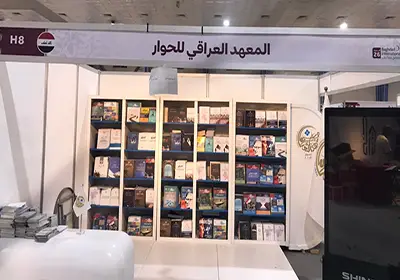
The Iraqi Institute for Dialogue, the logistical sponsor of the Baghdad International Book Fair, opens its own pavilion at the fair
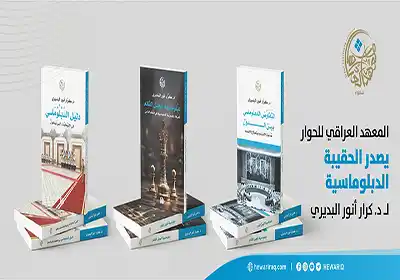
The Iraqi Institute for Dialogue publishes "The Diplomatic Portfolio" by Dr. Karrar Al-Badiri
Official agreement between Iraqi Institute for Dialogue and the Iraqi Media Network to sponsor The Seventh Annual International Conference of “Baghdad Dialogue” 2025
Invitation to the 79th issue of Dialogue of Thought
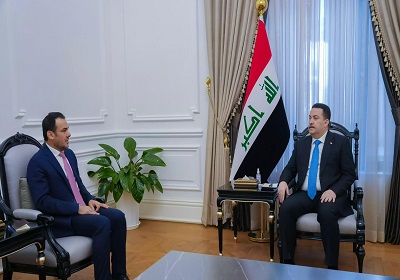
Prime Minister: The path of development will make Iraq a regional political and economic powerhouse
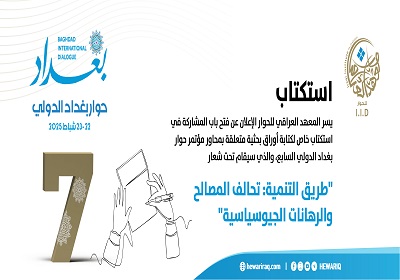
Seventh Baghdad International Dialogue Conference Call for Papers
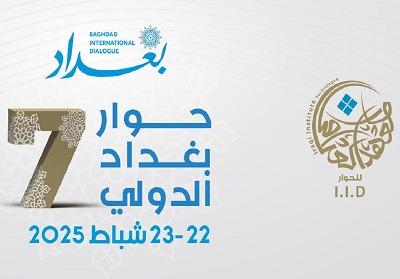
Praise for the Baghdad International Dialogue: Strengthening Iraq's pivotal role and a meeting point for visions
Comments