

Translation: Iraqi Institute for Dialog
French report: Royalty will not return to Iran
The French newspaper Le Monde recently published an article dismissing claims about the social status of Reza Pahlavi, the grandson of deposed King Mohammad Reza Pahlavi. "His surroundings cite the number of views and likes on social networks to prove his popularity, but in the age of deepfakes and bots, these criteria are unreliable," the newspaper wrote: "Some European diplomats, especially in France, see Reza Pahlavi as a card in the deck. Some European diplomats, especially in France, believe that Reza Pahlavi is just a card in an Israeli intelligence game aimed at destabilizing Tehran."
In recent years, Reza Pahlavi's name has appeared more than ever before in political and media circles inside and outside Iran; sometimes as a symbol of pre-revolutionary nostalgia, and other times as an option that some opponents of the Islamic Republic are betting on as a "possible alternative." However, the Iranian political reality and the international environment tell a very different story. But the Iranian political reality and the international environment tell a very different story: The likelihood of the monarchy returning to Iran or Reza Pahlavi coming to power is almost nil.
Analyzing this reality is not done from the angle of desires or inclinations, but rather from the angle of the "balance of power" locally and internationally.
Political systems - especially in countries that have undergone deep revolutions and transformations - rely on two main pillars for survival: Internal power structures and external balances of power.
Reza Pahlavi has no real base in either field.
First: Influential forces within Iran
1. Military and Security Institutions
The armed forces-the army and the Revolutionary Guards-are the backbone of power in Iran today. The experience of countries that have gone through political crises and collapses clearly shows that without the support of these institutions, no alternative regime can take shape.
Reza Pahlavi has no base or influence within these institutions, neither in the military leadership nor in the security services.
2. Administrative bureaucracy
A large class of officials, managers, and employees in state institutions-from governors to mayors-depend on the continuation of the existing system for their existence and function. This class, regardless of their personal views, does not look favorably on the idea of repossession.
3. Iranian society today
Contemporary Iranian society is radically different from that of half a century ago. Young people, women, and the new middle class have a more modern and individualistic political identity and do not look favorably on hereditary regimes.
If in the 1960s the concept of "king" symbolized order and stability, today it is associated in the minds of the new generation with the past and the absence of the right to choose.
4. Local political forces
Secular republicans, nationalists, leftists, reformists-all of these currents, while opposing the Islamic Republic, do not support the return of the monarchy.
Thus, even if the current regime falls, there is no broad domestic coalition that could transfer power to Reza Pahlavi.
II: International situation
1. United States
After the experiences of Iraq and Afghanistan, Washington has abandoned "regime change" projects. Its goal today is crisis management and staged negotiation-not restoration. For the Americans, Reza Pahlavi is a media personality, but not a credible political option.
2. Europe
The Europeans' priorities are regional stability, preventing migration, and controlling the nuclear issue. In their view, a sudden change of regime in Iran is not stabilizing but a security risk.
3. Gulf countries
Despite their differences with Tehran, these countries fear the return of "Pahlavi nationalism" and "Greater Iran" slogans. This concern is present in Riyadh and Abu Dhabi.
4. Russia and China
Moscow and Beijing prefer a predictable and utilizable partner, which is what the Islamic Republic represents, rather than a Westernized monarchist project like Reza Pahlavi.
5. Israel
Even Tel Aviv, as hostile as it is to Tehran, views Reza Pahlavi as a leverage tool rather than an actual option for Iran's future leadership.
Regime Fall Hypothesis
Even if the Islamic Republic falls as a result of an internal crisis or external intervention, it is not clear that the way will be open for Reza Pahlavi.
In such circumstances, armed, local, and political forces, not symbolic figures, vie to fill the power vacuum. Armies or armed factions often manage the transition, not former royal families.
Reza Pahlavi needed three elements to come to power: Support from internal forces, broad social acceptance, and coordinated external support. None of these conditions are available to him today.
Monarchy as a Nostalgia ... not as a political choice
Reza Pahlavi is present in public discourse more as a historical figure than as a genuine candidate to lead Iran's future. Much of his presence in the media-especially in social networks-is a reflection of some groups' nostalgia for the past, rather than the result of organized political power.
Real political action requires organization, coalitions, and legitimacy, which the current royalist movement lacks: Organization, coalitions, legitimacy, which the current monarchist movement lacks.
Even if the regime does change, the likely direction for Iran will be toward a secular republican regime or a transitional council, in line with the aspirations of society and the interests of international powers.
Conclusion
Reza Pahlavi may hold a symbolic place for a segment of Iranians, but politics is not run by symbols and memories.
Organizational strength, broad social support, and international cover are the critical elements-none of which are currently on his side.
Even the claims of "popular support" touted by his supporters do not translate into reality, as evidenced by the fact that his repeated calls for demonstrations in recent years have met with little response.
In any case, even if the current regime collapses, the return of the monarchy would be a return to an authoritarian, patriarchal past that is incompatible with modern Iranian society made up of independent and conscious individuals, making the idea of "reviving the monarchy" closer to a childish political fantasy than a realistic scenario.
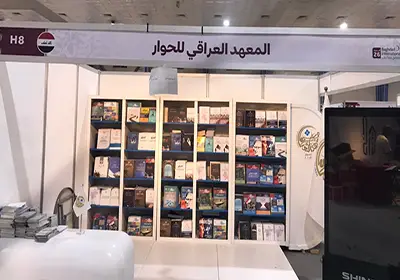
The Iraqi Institute for Dialogue, the logistical sponsor of the Baghdad International Book Fair, opens its own pavilion at the fair
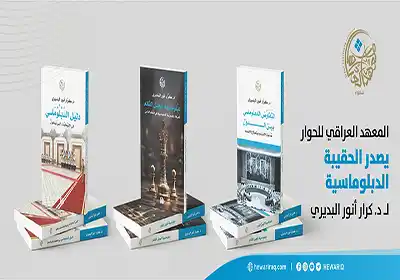
The Iraqi Institute for Dialogue publishes "The Diplomatic Portfolio" by Dr. Karrar Al-Badiri
Official agreement between Iraqi Institute for Dialogue and the Iraqi Media Network to sponsor The Seventh Annual International Conference of “Baghdad Dialogue” 2025
Invitation to the 79th issue of Dialogue of Thought
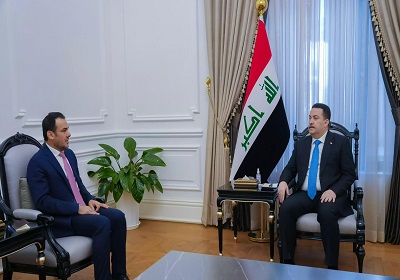
Prime Minister: The path of development will make Iraq a regional political and economic powerhouse
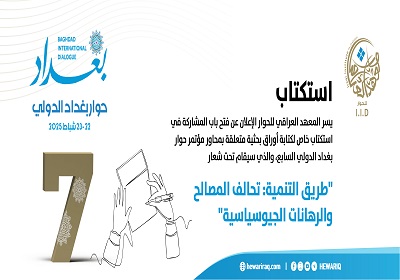
Seventh Baghdad International Dialogue Conference Call for Papers
Praise for the Baghdad International Dialogue: Strengthening Iraq's pivotal role and a meeting point for visions
Comments