


Translation by the Iraqi Institute for Dialog - David Cutler
What does the new U.S. national strategy actually mean for Europe?
The new U.S. national strategy represents a decisive shift in Washington's approach to Europe. While reaffirming the importance of transatlantic ties, it is reshaping its perception of Russia, raising its expectations about Europe's ability to be self-reliant, and placing Ukraine's future in a tighter US-led diplomatic sequence.
"For frontline states, the message is clear: Europe is entering a more demanding phase in the relationship with the United States, one in which its ability to deter, invest, and shape regional stability depends on its own potential, not on the breadth of the U.S. presence." In this commentary, David Cutler reviews the actual implications of this strategy for Europe — and why the coming years will test the cohesion of the transatlantic relationship and Europe's capacity for strategic discipline.
National strategy is not just a periodic update of U.S. policies, but reflects — especially for Europe and its frontline states — the emergence of a new U.S. strategic doctrine that rearranges global priorities, redefines the roles of allies, and seeks to stabilize Europe so that Washington can shift its focus toward the Indo-Pacific and the Americas. If the document is being read in Washington as a pragmatic option, its location in Europe is more like a strategic turning point.
Clearer division of responsibilities
A new division of labor emerges in the strategy: Washington expects Europe to assume far greater responsibility for its own defense, within a well-defined diplomatic framework within the U.S. global chain. "The document calls for unity, urgency, and accelerated weaponization, but leaves Europe with little room to formulate the political conditions for its regional security." The assumptions embedded in the strategy will set the course for U.S. policy for years, and Europe should read them clearly.
Three key questions determine the direction of Europe's response:
How does the strategy redefine the Russian threat? What do you mean by Washington’s support for Ukraine? And how do you recast the coherence of the transatlantic relationship in a more fragmented international order?
The answers reveal a widening gap in the perception of the threat between the two sides — perhaps the largest since the end of the Cold War. Europe is entering a more demanding relationship: its responsibilities are growing, and its influence is shrinking.
Russia's Strategy: Stability Instead of Deterrence
The most worrying message for the frontline states is how to redefine Russia. Rather than portraying Moscow as a key strategic adversary whose intentions determine the future of European security, the strategy presents Russia as a challenge whose risks can be mitigated -- through diplomatic engagement and renewed "strategic stability" endeavors.
This represents a significant departure from previous U.S. strategies. "Rather than making deterrence a cornerstone, the document focuses on de-escalation, reducing tensions, and reopening channels of dialog." The point is clear: Washington seeks to stabilize the security environment—formally or practically—in order to redirect its resources and priorities to other regions. It is an approach that seeks to freeze, not confront, risks, and runs counter to the vision of the Baltic and Northern states that see stability as the fruit of sustained military and political pressure.
The strategy relies on two assumptions that the frontline states do not agree with:
Russia's ambitions are negotiable,
and that the Ukraine war is a perversion rather than an extension of long-term Russian behavior based on coercion.
"The front-line states see Russia as a mobilizing force for a long-term confrontation, while U.S. strategy sees Moscow's behavior as normalized."
The document also elevates internal threats in Europe — such as demographic aging, weak social cohesion and economic slowdown — as more serious in the long run than Russian aggression itself. Despite the reality of these challenges, this proposition is at odds with the Baltic security architecture based on the integration of internal strength and external deterrence.
The strategy puts the United States in the lead for any future diplomatic track with Moscow, which means asking Europe to identify with a diplomatic and political sequence led by Washington, at a time when the conflict in Ukraine requires expanding the European role, not narrowing it.
The result is a structural gap between Washington's assessment and that of the frontline states: the United States sees Russia as a challenge that must be fixed in order to focus on other priorities, while the frontline states see an adversary rebuilding its military power and industrial base, and preparing for an extended confrontation. And in this context, the window for rearming Europe is closing -- and Russia will be more dangerous in 2030 than it was in 2022.
Accelerating settlement, not building long-term security
The strategy deepens this disparity through its approach to Ukraine. It clearly declares that it is in the interest of the United States to achieve a "rapid cessation of hostilities… to restore strategic stability with Russia." This is a major shift: the strategy calls for a quick end to the war rather than a decisive strategic outcome.
"The document focuses on reconstruction, but does not provide a vision of long-term deterrence."
"For Europe, and especially the frontline states, this approach means that for Washington Ukraine is a file to close, not a security structure to build." The strategy leaves Europe with a greater responsibility to determine Ukraine's strategic future, while the United States retains control over the timing of the settlement.
"The risk, from Europe's forward view, is a ceasefire that does not address Russia's structural motives for continuing the conflict, reproducing the crisis later."
Diplomacy is needed — but diplomacy without effective deterrence means a delayed peace, not a lasting peace.
Stronger expectations for burden-sharing
The strategy solidifies what has been going on for years: the “firm punishment” model of the transatlantic relationship. Europe is required to defend itself to a greater degree, at a time when Washington is shifting its focus to other theaters.
This requires Europe to do more than just increase its defense budgets.
real combat power
air and missile defense
long-range fire capabilities
logistic depth
coherent defense industrial base
National and Community Resilience
And its defense industry needs to move from national competitions to a common strategic system. NATO must also develop a political formula that ensures capabilities are provided to countries most under Russian threat.
Cohesion in a more egalitarian coalition
The strategy reflects a more interest-based phase in transatlantic relations. Cohesion is no longer an end in itself, but a means to ensure the stability of Europe, allowing Washington to focus on other issues.
Three trends emerge:
Conditional coherence of the American sequence
That is, Europe, led by American diplomacy, accepts the Russian file, accelerates its rearmament, and addresses its internal crises so as not to confuse strategic planning.
A fundamental difference in the perception of threat
The United States sees a conflict that must be brought to an end quickly; Europe sees an opponent preparing for a longer tour.
Greater responsibilities for less influence
The strategy places a greater defense burden on Europe without giving it a parallel capacity to shape the political framework for regional security.
These are not reasons for pessimism, but a call for clarity and realism.
A moment for strategic clarity
The strategy combines three major shifts:
Mitigating the Russian Threat
Preference for a quick end to the war in Ukraine
Unprecedented expectations for Europe's self-reliance
Europe faces a new era that requires it to redefine its role.
Stability will not be achieved by old assumptions, but by aligning rhetoric with capabilities, adapting diplomacy to security needs, and ensuring that peace is based on effective deterrence rather than postponement of danger.
What should Europe do now?
Europe has a wide margin of action, and the frontline states have a more important role to play in shaping the future:
Accelerating large-scale defense production
through long-term supply lines, common standards, and coordinated investments.
The shift to deterrence by prevention, not revenge
by building capacity and infrastructure and fully implementing regional defense plans.
Positioning Ukraine within the European Security Architecture
before imposing on it a position that is less than it deserves or serves external interests.
Strengthening community resilience
by protecting information, developing cyber defense, and securing energy and infrastructure.
Treating Russia as a Long-Term Adversary
Even if the American characterization is different.

The Iraqi Institute for Dialogue, the logistical sponsor of the Baghdad International Book Fair, opens its own pavilion at the fair
Official agreement between Iraqi Institute for Dialogue and the Iraqi Media Network to sponsor The Seventh Annual International Conference of “Baghdad Dialogue” 2025

The Iraqi Institute for Dialogue publishes "The Diplomatic Portfolio" by Dr. Karrar Al-Badiri

Invitation to the 79th issue of Dialogue of Thought
Prime Minister: The path of development will make Iraq a regional political and economic powerhouse
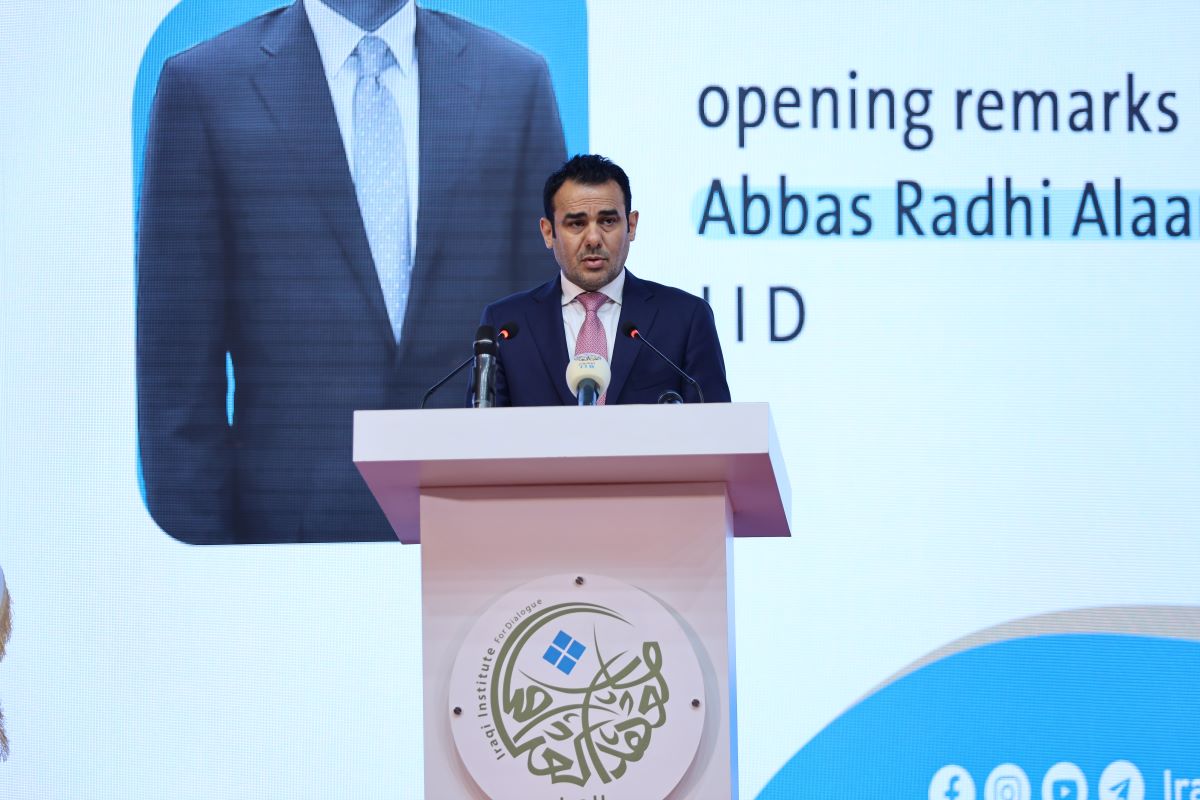
Speech of the Director of the Iraqi Institute for Dialog at the Sixth Baghdad International Dialog Conference
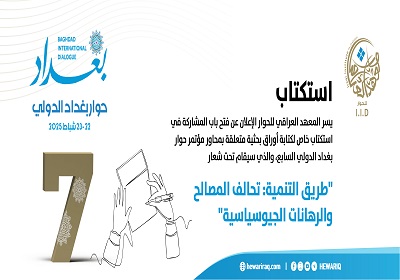
Seventh Baghdad International Dialogue Conference Call for Papers

Comments