


Saud bin Mushtaq - Researcher in Global Policy, International Relations and Risk Assessment
The Rise of Chinese Military Power: Shaping the Future of Global Security
The Indo-Pacific has emerged as one of the world’s most strategic regions, not just because of its economic weight, but for its pivotal role in shaping global security dynamics.
The choice was made on this topic because China's rapid military expansion and Beijing's assertive regional policies are redrawing the balance of power in the region and reshaping the international order.
And as tensions over Taiwan rise and conflicts in the South and East China Seas intensify, understanding the rise of China’s military capabilities is key to assessing its broad implications for trade, diplomacy, and regional and global security.
This research aims to analyze the growth of Chinese military power in parallel with the strategic responses of neighboring countries, providing an in-depth view of the shifts in the balance of power and its implications for stability in this vital region.
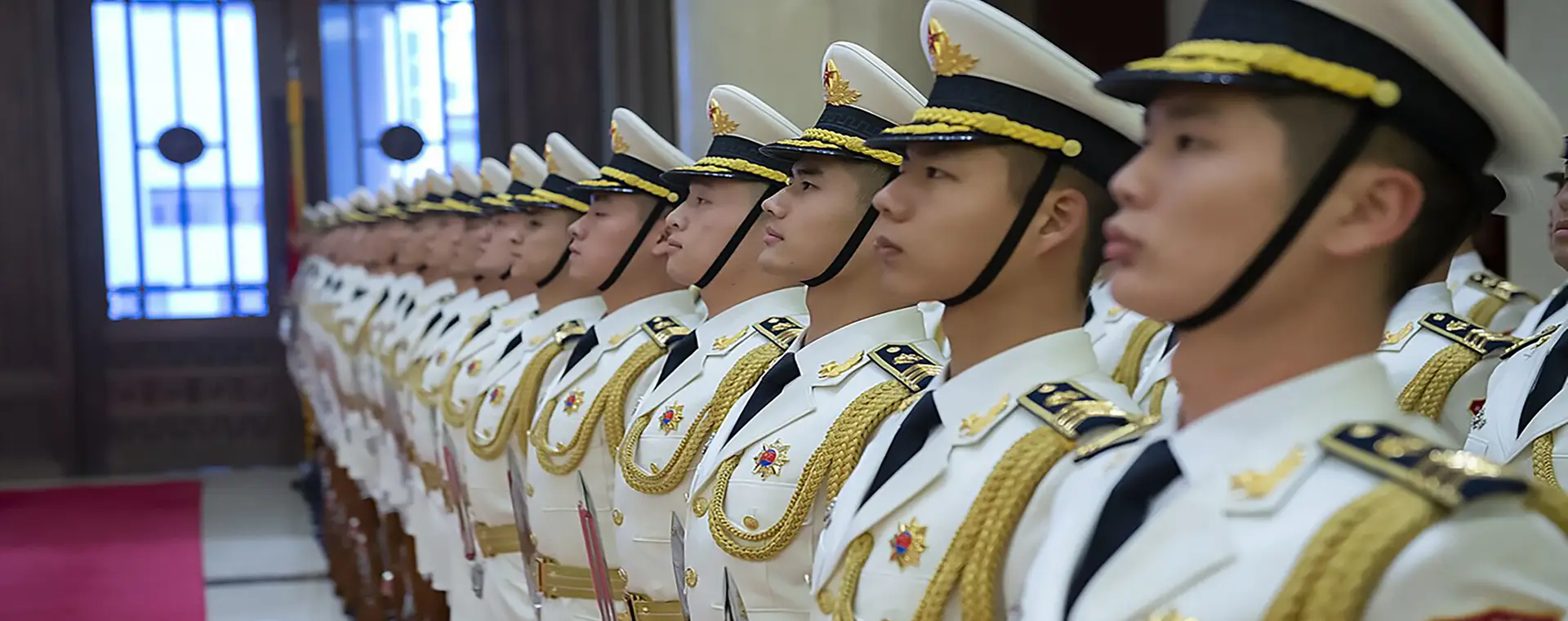
China's military expansion: pushing for a "world-class army"
Xi Jinping's Vision
Chinese President Xi Jinping has stressed that building a "world-class army" by 2049 is a key part of the "national renaissance" project that has guided his political agenda since he took over the leadership of the Communist Party in 2012. In 2015, the state underwent a massive military restructuring that reorganized the command structure and expanded the Communist Party's control over the military.
The rise of China's military power rests on two key elements:
developing a complete nuclear triad that is both viable and deterrent.
Build technologically advanced conventional forces.
The first element seeks to balance the deterrent value of the U.S. nuclear arsenal, while the second element tilts the conventional balance of power in the area of the first island chain in favor of China.
nuclear expansion
China's nuclear expansion presents a long-term challenge to the United States, which historically dominates the nuclear weapons sector. And according to the 2024 report of the Stockholm International Peace Research Institute (SIPRI), the number of Chinese nuclear warheads has increased from 410 in January 2023 to 500 in January 2024, with an expected 1,000 by 2030.
And while China's arsenal is still smaller than its U.S. counterpart, the pace of growth is the most prominent concern. China has improved its nuclear weapons delivery systems and developed its intercontinental ballistic missiles, multiple-warhead systems (MIRVs), and mobile launch platforms.
This diversification reflects a desire to expand nuclear-use options in potential conflicts, which could lead to an imbalance of political will, as China may be willing to take greater risks on Taiwan than the United States. And so Washington fears the erosion of its historic nuclear superiority vis-à-vis China.
Defense spending and the evolution of conventional power
China's escalating defense budget is raising concerns for the United States and its allies in the region. Military spending rose from 720 billion yuan in 2013 to 1.67 trillion yuan ($230 billion) in 2024.
And this spending has allowed China to significantly develop its traditional capabilities, as it now has the world’s largest navy in terms of number of pieces, with more than 370 ships and submarines, including more than 140 major combat pieces. Pentagon reports estimate that the number will reach 395 ships in 2025 and 435 ships by 2030.
China also has an extensive missile arsenal that includes:
DF-21 and DF-26 medium-range ballistic missiles.
DF-17 hypersonic missile.
Ground-based cruise missiles such as the DH-10 and DF-100 with a range of up to 2,000 km.
And with these developments, China is able to challenge U.S. military dominance in the region, and its influence often extends to violating the sovereignty of neighboring countries.
Worsening tensions: China and its neighbors on the brink of clash
East China Sea
China's military expansion has contributed to increased regional tensions, especially with the daily presence of the Chinese Coast Guard near the disputed Senkaku/Diaoyutai Islands, drawing sharp criticism from Japan.
And in November 2023, President Xi, while inspecting the East China Sea Coast Guard Command, called for enhanced law enforcement to support Chinese maritime claims. And then, the Coast Guard Command put forward a plan for a continued presence in the area and inspections of Japanese fishing vessels, in a move aimed at normalizing Chinese claims in these areas.
These policies have left Japan with no choice but to increase its defense budget, while the situation poses a direct threat to global trade.
South China Sea
The situation is even more serious in the South China Sea, through which a third of world trade passes. China has increased its “gray” maritime operations, sparking significant tension among the countries bordering the region.
And Philippine President Ferdinand Marcos Jr. said in November 2023 that the situation had become “more serious” as a result of China’s “coercive tactics and dangerous maneuvers.” This has prompted Manila to tighten its military cooperation with Washington, Tokyo and several other countries.
Taiwan Strait
Tensions have been running high as China has intensified its military drills on Taiwan. And in December, China carried out its largest naval deployment since 1996, coinciding with the Taiwanese president’s overseas tour.
Taiwan is of global importance as it produces more than 60% of the world's semiconductors and more than 90% of advanced chips. About 40% of global shipping passes through the Taiwan Strait.
Any dispute here may result in:
disrupting global supply chains,
a crisis in the technical industries,
International intervention could include the United States and its allies.
Sophisticated Responses to Escalating Tensions
Regional efforts
China's aggressive policies have led to broad regional moves, including:
Increase defense budgets.
Development of space and cyber capabilities.
acquisition of long-range missiles.
Strengthening defense alliances.
joint exercises with the United States.
Polls reflect widespread support for these measures in Japan, South Korea, and Australia.
And Japan plans to raise its defense spending to 2% of GDP by 2027, focusing on missile defense, long-range strike capabilities, and multi-domain strategies. Australia, the Philippines, South Korea, and Taiwan have increased their military spending and increased their cooperation with the US.
International reactions
Europe has also begun to reassess its defense policies, fearing that a conflict in the Indo-Pacific would deplete the U.S. military resources on which the EU relies against Russia.
Sino-Russian naval exercises in the Baltic Sea and Beijing's support for Russian positions have also raised additional concerns for the Europeans.
In response, Europe turned to:
Increased defense spending.
Protecting supply chains.
Reducing China-related economic risks (the “risk reduction” policy).
Support freedom of navigation in Asia.
The expansion of China's nuclear arsenal forces NATO to adapt to the triple nuclear deterrent phase.
conclusion
China's military expansion and assertive policies in Asia represent a pivotal shift in the regional and global balance of power. Xi Jinping's vision of building a “world-class army” has pushed the region toward a new arms race, forcing neighboring countries and world powers to reassess their defense strategies and build stronger alliances.
And as the Indo-Pacific becomes the epicenter of global geopolitical conflict, defense partnerships like QUAD and AUKUS become essential to maintaining the rules-based international order and deterring any attempts to change the situation by force.
Accelerated developments in this region will determine the future of global security for decades to come, and represent a test of the international community's ability to meet common challenges and maintain peace and stability.

The Iraqi Institute for Dialogue, the logistical sponsor of the Baghdad International Book Fair, opens its own pavilion at the fair
Official agreement between Iraqi Institute for Dialogue and the Iraqi Media Network to sponsor The Seventh Annual International Conference of “Baghdad Dialogue” 2025

The Iraqi Institute for Dialogue publishes "The Diplomatic Portfolio" by Dr. Karrar Al-Badiri

Invitation to the 79th issue of Dialogue of Thought
Prime Minister: The path of development will make Iraq a regional political and economic powerhouse
Speech of the Director of the Iraqi Institute for Dialog at the Sixth Baghdad International Dialog Conference
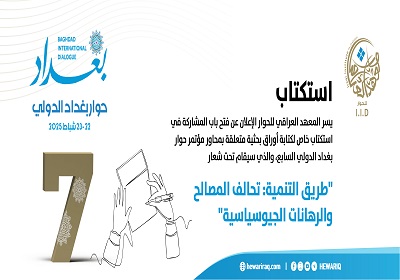
Seventh Baghdad International Dialogue Conference Call for Papers
Comments