


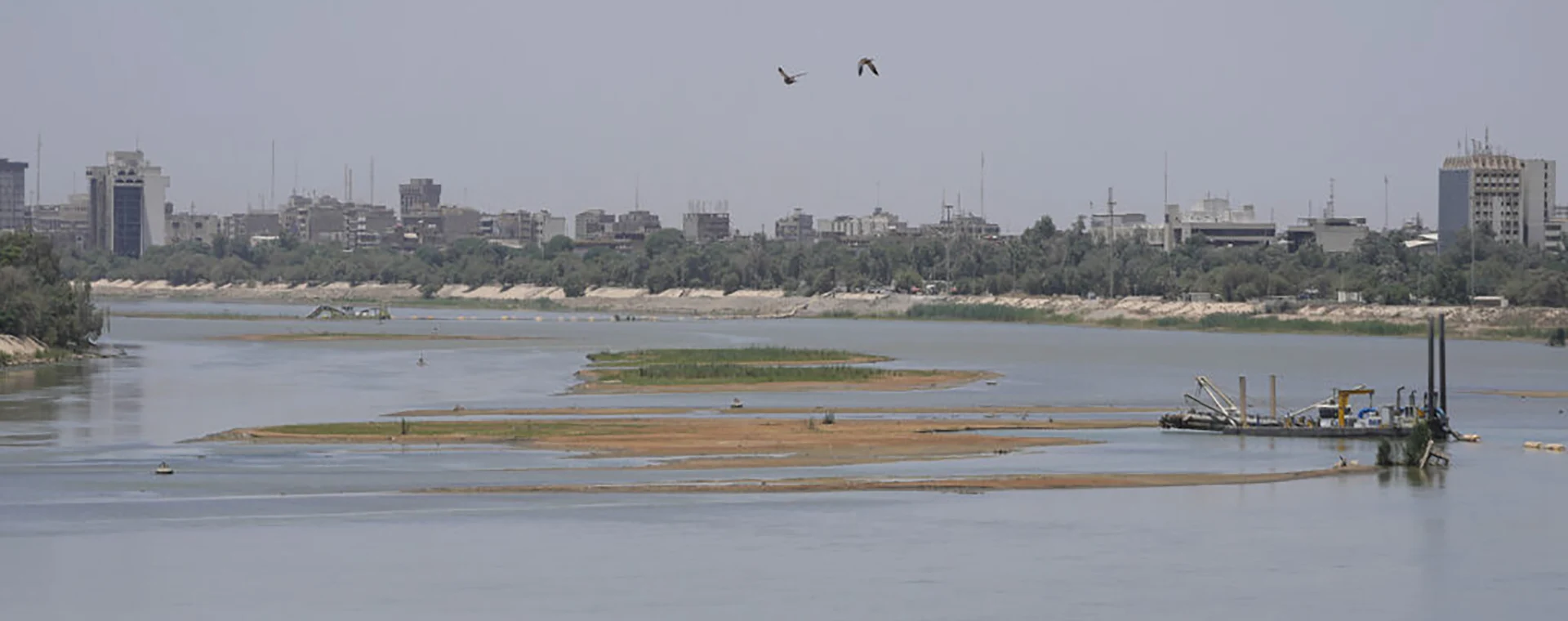
Can the Iraq-Turkey agreement contribute to enhancing Iraq's water security?
Author: Winnie Cheng - Assistant Director of the Iraq Program at the Arab Gulf States Institute
Publisher: Arabian Gulf States Foundation in Washington
Published: 10 April 2026
Iraq is facing a severe water shortage crisis, with reserves expected to run out by August. "The crisis, which has previously displaced large numbers of people from southern Iraq and the marshlands, agricultural workers, and low-income rural families, is already foreshadowing dire consequences for all Iraqis, even the political elite."
In April 2024, Iraqi Prime Minister Mohammed al-Sudani and Turkish President Recep Tayyip Erdogan signed the Iraq-Turkey Water Cooperation Framework. The MoU, which is extendable for 10 years, was the first formal comprehensive water sharing framework between the two countries in decades, outlining long-term water management projects, joint planning teams, and coordinated water use. "Although Iraq and Turkey have previously reached limited agreements and informal understandings on water issues, they lacked joint monitoring and implementation mechanisms, leading to further disagreements and their eventual failure."
In November 2025, Iraqi Foreign Minister Fuad Hussein met with Turkish Foreign Minister Hakan Fidan to sign a second memorandum of understanding, detailing comprehensive implementation mechanisms to build on the 2024 memorandum. The mandate of the previous parliament has expired, the powers of the current caretaker government are limited to managing the "day-to-day affairs" of the state, and it cannot make long-term political decisions.
As Iraq approaches water depletion in August, faces the challenges of climate change, water policies, and its oil-based economic model, can this framework be applied before the imminent deadline to help ensure Iraq's water future? Or will delays and structural challenges undermine its ability to avert crisis?
Inside the water crisis
Water insecurity in Iraq stems in part from water policies and climate change. Turkey's Southeastern Anatolia Project, a massive system of dams and irrigation projects developed over decades, has radically altered the streams of the Tigris and Euphrates rivers. Through massive installations, such as the Ataturk Dam on the Euphrates River and the Ilisu Dam on the Tigris River, the project has contributed to a severe water shortage in Iraq since at least the turn of the second millennium, with the amount of water flowing down by an estimated 56%. To the east, Iran constructed the Darian and Sardasht dams, limiting the flow of tributaries into the Tigris River basin. To the west, the Syrian Tabqa Dam regulates the flow of the Euphrates before it reaches Iraqi territory. And what makes the situation in Iraq even more fragile is that Turkey, Iran and Syria are each facing a worsening water crisis, the result of decades of over-extraction, mismanagement and worsening climate change pressures.
Iraq still uses a version of the ancient Babylonian irrigation system, a centuries-old gravitational irrigation system that diverts river water to flood fields, resulting in significant water waste due to evaporation, leakage and poor flow control. The dwindling amounts of water Iraq receives from the Tigris and Euphrates rivers, on which many dams have been built, can no longer support this inefficient system. Historically, agriculture in Iraq has relied on the flooding of the Tigris and Euphrates rivers. However, Iraq has not seen continuous floods since 1988. Although rainfall earlier this year helped raise reservoir levels, they are still below their capacity, and the threat of drought remains. In addition, the slow flow of water from upstream dams, coupled with poor drainage in traditional irrigation systems, is causing water stagnation. This, combined with evaporation from extreme heat, has led to the formation of highly saline lands, hampering agriculture and displacing many Iraqis.
The water crisis in Iraq is further exacerbated by the structure of its rentier political economy. "Since the nationalization of oil in the 1970s, and especially since 2003, Iraq has relied on oil revenues rather than taxes." Currently, 90% of government revenues are derived from oil exports, which are redistributed to citizens through public sector jobs, as well as subsidizing fuel, electricity, and water. This has led to the emergence of a social contract based on the relationship between state revenues and the country's production. Subsidies are an acquired right, while rationalization of water consumption is seen as a breach of this contract. And with Iraq’s accelerating population growth – projected to reach 48.9 million by 2028 – excessive water consumption is also increasing.
Publisher: Arabian Gulf States Foundation in Washington
Published: 10 April 2026
Iraq is facing a severe water shortage crisis, with reserves expected to run out by August. "The crisis, which has previously displaced large numbers of people from southern Iraq and the marshlands, agricultural workers, and low-income rural families, is already foreshadowing dire consequences for all Iraqis, even the political elite."
In April 2024, Iraqi Prime Minister Mohammed al-Sudani and Turkish President Recep Tayyip Erdogan signed the Iraq-Turkey Water Cooperation Framework. The MoU, which is extendable for 10 years, was the first formal comprehensive water sharing framework between the two countries in decades, outlining long-term water management projects, joint planning teams, and coordinated water use. "Although Iraq and Turkey have previously reached limited agreements and informal understandings on water issues, they lacked joint monitoring and implementation mechanisms, leading to further disagreements and their eventual failure."
In November 2025, Iraqi Foreign Minister Fuad Hussein met with Turkish Foreign Minister Hakan Fidan to sign a second memorandum of understanding, detailing comprehensive implementation mechanisms to build on the 2024 memorandum. The mandate of the previous parliament has expired, the powers of the current caretaker government are limited to managing the "day-to-day affairs" of the state, and it cannot make long-term political decisions.
As Iraq approaches water depletion in August, faces the challenges of climate change, water policies, and its oil-based economic model, can this framework be applied before the imminent deadline to help ensure Iraq's water future? Or will delays and structural challenges undermine its ability to avert crisis?
Inside the water crisis
Water insecurity in Iraq stems in part from water policies and climate change. Turkey's Southeastern Anatolia Project, a massive system of dams and irrigation projects developed over decades, has radically altered the streams of the Tigris and Euphrates rivers. Through massive installations, such as the Ataturk Dam on the Euphrates River and the Ilisu Dam on the Tigris River, the project has contributed to a severe water shortage in Iraq since at least the turn of the second millennium, with the amount of water flowing down by an estimated 56%. To the east, Iran constructed the Darian and Sardasht dams, limiting the flow of tributaries into the Tigris River basin. To the west, the Syrian Tabqa Dam regulates the flow of the Euphrates before it reaches Iraqi territory. And what makes the situation in Iraq even more fragile is that Turkey, Iran and Syria are each facing a worsening water crisis, the result of decades of over-extraction, mismanagement and worsening climate change pressures.
Iraq still uses a version of the ancient Babylonian irrigation system, a centuries-old gravitational irrigation system that diverts river water to flood fields, resulting in significant water waste due to evaporation, leakage and poor flow control. The dwindling amounts of water Iraq receives from the Tigris and Euphrates rivers, on which many dams have been built, can no longer support this inefficient system. Historically, agriculture in Iraq has relied on the flooding of the Tigris and Euphrates rivers. However, Iraq has not seen continuous floods since 1988. Although rainfall earlier this year helped raise reservoir levels, they are still below their capacity, and the threat of drought remains. In addition, the slow flow of water from upstream dams, coupled with poor drainage in traditional irrigation systems, is causing water stagnation. This, combined with evaporation from extreme heat, has led to the formation of highly saline lands, hampering agriculture and displacing many Iraqis.
The water crisis in Iraq is further exacerbated by the structure of its rentier political economy. "Since the nationalization of oil in the 1970s, and especially since 2003, Iraq has relied on oil revenues rather than taxes." Currently, 90% of government revenues are derived from oil exports, which are redistributed to citizens through public sector jobs, as well as subsidizing fuel, electricity, and water. This has led to the emergence of a social contract based on the relationship between state revenues and the country's production. Subsidies are an acquired right, while rationalization of water consumption is seen as a breach of this contract. And with Iraq’s accelerating population growth – projected to reach 48.9 million by 2028 – excessive water consumption is also increasing.
Details of Agreement
The November 2025 Executive Mechanism Memorandum aims to enhance Iraq's water security, reclaim agricultural land, and improve water and resource management. Its mechanisms deal directly with long-disputed assessments between the parties and provide financing measures.
The Turkish government has been highly critical of Iraq's water consumption and old irrigation systems, and so, as part of the agreement, Turkey agreed to help repair and modernize Iraq's water management systems. And Turkish companies approved by the Iraqi authorities will be contracted to develop water projects and modern irrigation techniques. Iraq will fund these companies, either through its annual budget or through a joint Iraqi-Turkish fund. Iraq will deposit the proceeds of the sale of crude oil to Turkish buyers in this fund, and the dues of Turkish contractors will be paid from it.
This model mimics the Iraq-China partnership; However, the Iraq-China Fund requires a fixed minimum of 100,000 barrels of oil per day to fund the account. In return, the Iraqi-Turkish fund will sell a variable quantity of barrels of oil, which means variable oil revenues. This is intentional, as it allows the two countries to adjust the size of the project in proportion to the available revenues, avoids committing Iraq to a fixed export quota, and reflects the fact that oil flows to Turkey may change as a result of geopolitical tensions and infrastructure constraints. In addition, if Iraqi oil is re-exported from Turkey to European markets, Iraq will receive 65% of the profits resulting from exceeding the prevailing global reference price. A joint committee representing the two countries will supervise the implementation of the project, while the Iraqi Ministry of Finance will manage its funding.
The November 2025 Executive Mechanism Memorandum aims to enhance Iraq's water security, reclaim agricultural land, and improve water and resource management. Its mechanisms deal directly with long-disputed assessments between the parties and provide financing measures.
The Turkish government has been highly critical of Iraq's water consumption and old irrigation systems, and so, as part of the agreement, Turkey agreed to help repair and modernize Iraq's water management systems. And Turkish companies approved by the Iraqi authorities will be contracted to develop water projects and modern irrigation techniques. Iraq will fund these companies, either through its annual budget or through a joint Iraqi-Turkish fund. Iraq will deposit the proceeds of the sale of crude oil to Turkish buyers in this fund, and the dues of Turkish contractors will be paid from it.
This model mimics the Iraq-China partnership; However, the Iraq-China Fund requires a fixed minimum of 100,000 barrels of oil per day to fund the account. In return, the Iraqi-Turkish fund will sell a variable quantity of barrels of oil, which means variable oil revenues. This is intentional, as it allows the two countries to adjust the size of the project in proportion to the available revenues, avoids committing Iraq to a fixed export quota, and reflects the fact that oil flows to Turkey may change as a result of geopolitical tensions and infrastructure constraints. In addition, if Iraqi oil is re-exported from Turkey to European markets, Iraq will receive 65% of the profits resulting from exceeding the prevailing global reference price. A joint committee representing the two countries will supervise the implementation of the project, while the Iraqi Ministry of Finance will manage its funding.
Moreover, in response to Iraqi criticism that Turkish dams have limited water flow, and accusations that Turkey is not complying with a 2014 memorandum of understanding that guarantees Iraq a “fair and equitable share of water,” Turkey agreed to release 1 billion cubic meters of water to Iraq.
Not an oil-for-water deal
Many media reports inaccurately portray this water-sharing agreement as an "oil-for-water" agreement. The agreements must be approved by the Iraqi parliament, while the memorandums of understanding are approved by the cabinet. The term "oil for water" also suggests that Iraq is replacing its crude oil with access to Turkish waters. But the two countries have long been at loggerheads: Turkey asserts that the waters are transboundary and stresses its position upstream as a means of control, while Iraq insists that the waters are international and should be shared fairly among all the countries bordering them. The negotiating offices did not discuss this contentious point during the drafting of the memorandum of understanding.
Not an oil-for-water deal
Many media reports inaccurately portray this water-sharing agreement as an "oil-for-water" agreement. The agreements must be approved by the Iraqi parliament, while the memorandums of understanding are approved by the cabinet. The term "oil for water" also suggests that Iraq is replacing its crude oil with access to Turkish waters. But the two countries have long been at loggerheads: Turkey asserts that the waters are transboundary and stresses its position upstream as a means of control, while Iraq insists that the waters are international and should be shared fairly among all the countries bordering them. The negotiating offices did not discuss this contentious point during the drafting of the memorandum of understanding.
Iraq's inherently volatile, oil-dependent economy also threatens the agreement's implementation and the country's water security. Iraq's dependence on oil revenues means that if it cannot deposit funds in the Iraq-Turkey fund for the project, it will have difficulty financing the water infrastructure systems contracted with Turkey. Oil reserves are the main source of revenue for the country, and any shortfall in them, such as insufficient production, low oil prices or delayed revenue collection, directly threatens the sustainability of these systems. And while the recent memorandum of understanding with Turkey is a strategic gain on paper, it has yet to do so, and Iraq’s oil reserves are limited.
The water crisis in Iraq has reached the level of a national emergency, requiring immediate and coordinated political action. The Iraq-Turkey Water Cooperation Framework provides a critical opportunity to stabilize the country’s water future, but its success hinges on the formation of a timely government and a stable economic model. In the near term, officials should speed up approval of the agreement, initiate targeted reforms of the irrigation sector in areas with the most water scarcity, and reduce water subsidies associated with over-consumption. In the mediumto long term, Iraq must work to diversify its economy.
And as August approaches, any delay increases the risk of severe water shortages. And without swift action, Iraq is likely to face serious depletion of its water reserves, which will lead to dire economic and social consequences.
Most Read

1
The Iraqi Institute for Dialogue, the logistical sponsor of the Baghdad International Book Fair, opens its own pavilion at the fair
2
The Iraqi Institute for Dialogue publishes "The Diplomatic Portfolio" by Dr. Karrar Al-Badiri
3
Official agreement between Iraqi Institute for Dialogue and the Iraqi Media Network to sponsor The Seventh Annual International Conference of “Baghdad Dialogue” 2025
4
Prime Minister: The path of development will make Iraq a regional political and economic powerhouse
5
Invitation to the 79th issue of Dialogue of Thought
6
Seventh Baghdad International Dialogue Conference Call for Papers
7
Praise for the Baghdad International Dialogue: Strengthening Iraq's pivotal role and a meeting point for visions
8
Comments