


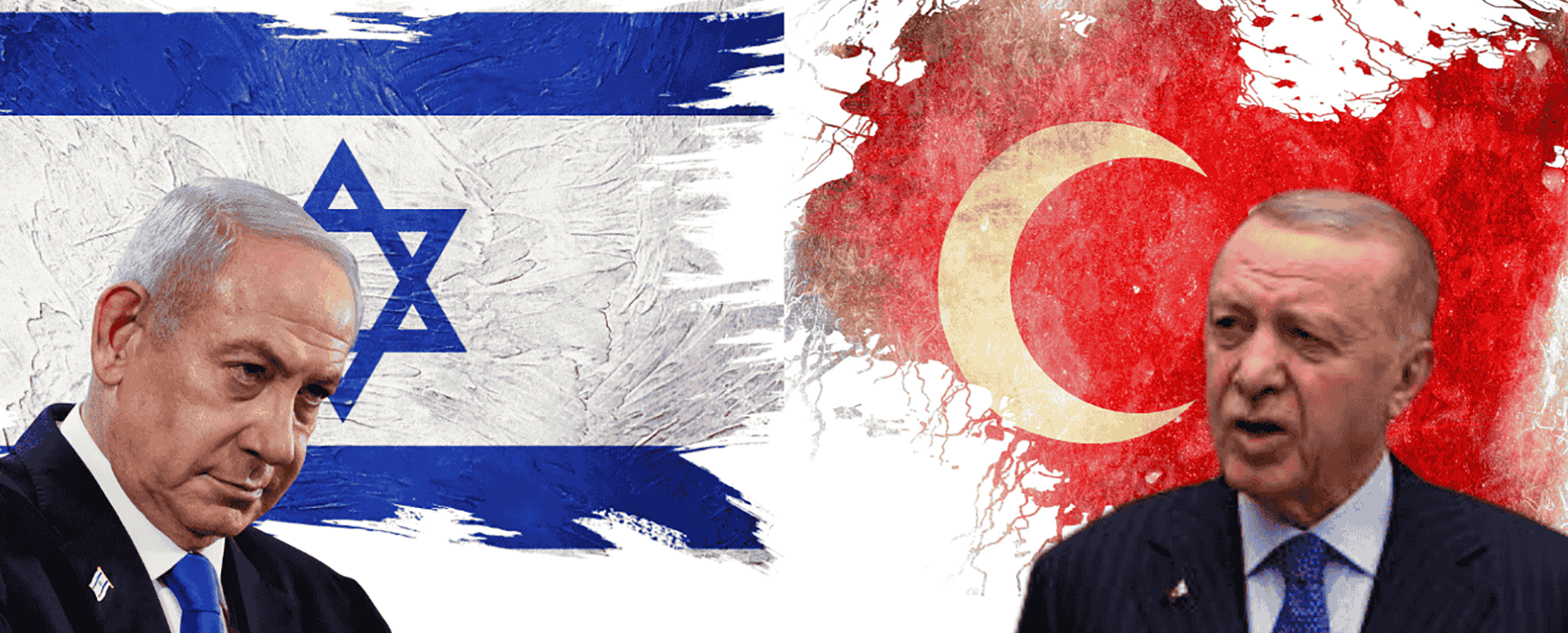
Nightmare scenario: A reading into the possibilities of a direct military confrontation between Turkey and Israel
In the past three years, Turkish-Israeli relations have reached the threshold of diplomatic normalization to the point where there is now talk of the risk of a direct military confrontation.
While the verbal sparring between the two countries' leaders continues, the prospect of a military confrontation between them has become a topic of discussion.
On April 11, Israeli Prime Minister Benjamin Netanyahu accused Turkish President Recep Tayyip Erdogan of aiding the "terrorist regime" in Iran and "killing its Kurdish citizens."
Speaking to the Turkish parliament on 15 April, Mr Erdogan said: "Without looking at their hands and faces stained with the blood of 73,000 Palestinians in Gaza, they are rudely accusing our country through our Kurdish brothers."
Experts who spoke to the BBC about the latest developments say that the risk of confrontation between Turkey and Israel has increased "more than ever", but at the same time the two sides are trying to prevent a possible conflict.
"Instead of a cold peace, we are witnessing a cold rivalry"
Verbal tensions between Turkey and Israel intensified after Hamas attacks on Israel on October 7, 2023 and Israeli military operations in Gaza. Besides the sharp statements and recriminations of the last three years, the process of diplomatic normalization has stalled and Turkey has announced a cut in its trade with Israel.
Dr. Tugce Ersoy, associate professor of international relations at Katib Chalabi University in Izmir, considers the current situation between the two countries to be the result of the predominance of internal interests over diplomatic principles.
"This escalation in tension, confrontational tone and verbal sparring actually serves as fuel for the internal politics of both parties," she adds. On the Turkish front, this situation is linked to the claims of the regional leadership.”
Ms. Arsoy, author of Conflicting Identities in Israel: Palestinians and Jews, says that Turkey and Israel see each other as "players who destabilize the existing regional stability," and adds about the current state of relations: "We have always described Turkish-Israeli relations as 'cold peace', but now we are witnessing 'cold rivalry'."
Alon Pinkas, a former Israeli diplomat, says that Benjamin Netanyahu's statements presenting Turkey as a competitor are "dangerous." Pinkas, who was Israel's consul general in New York between 2000 and 2004 and headed the offices of former foreign ministers, adds: "This kind of literature is very dangerous, especially when Mr. Erdogan responds with inflammatory words and makes the situation worse."
"Netanyahu-Erdogan verbal spat increases risk of conflict"
Amnon Arran, a professor of international relations at St. George's University in London, also believes that these verbal arguments are intended for domestic consumption: "From the point of view of Turkey and Erdogan, the aim of this sharp language is to satisfy the ideological base of the AKP; Just as Netanyahu is using a similar tone in an effort to attract support and boost his standing with far-right supporters.”
Mr. Aran, author of “Israeli Foreign Policy since the End of the Cold War,” says that relations between the two countries are now at their worst since the Mavi Marmara crisis (between 2010 and 2016), and adds: “In my opinion, both Netanyahu and Erdogan are acting with great irresponsibility through these speeches. Such literature only increases the likelihood of conflict between the two countries and fuels it.”
Syria, Cyprus and the Eastern Mediterranean
Experts who spoke to the BBC said any potential conflict between Turkey and Israel could be at points where each country’s self-designated spheres of influence intersect.
"The risk of confrontation between Turkey and Israel is higher than ever," says Tugce Ersoy.
And with its emphasis on the low probability of an all-out war, it points to increased competition, especially in Syria, Cyprus and the Eastern Mediterranean, and says: “Here we are witnessing an attempt to create opposing axes. “The two countries are trying to create some kind of geopolitical shield against each other.”
As Ms. Ersoy states, “In Israeli strategic documents, Turkey is now classified as an enemy, and this is a fact.”
"In my opinion, the possibility of military conflict has increased compared to the past, but it is still avoidable," says Amnon Aran. Referring to meetings on the mechanism for preventing tension between Turkish and Israeli military delegations in 2025 in the Republic of Azerbaijan, he says: "As far as I know, efforts are underway, at least at the military level, to prevent any incident or miscalculation that may lead to conflict."
On Israel's view of Turkey, Arran says: "A large part of the political and military elite in the government and the Israeli army gradually views Turkey as a hostile and dangerous power."
Alun Pinkas offers an example to illustrate this danger: "Suppose Turkey accompanied aid ships bound for Gaza or Lebanon. "If Israeli naval vessels want to push back against this fleet and Turkish vessels fire in their direction, Israel could retaliate and a limited war could erupt." But I don't think that's going to happen."
Alon Pinkas believes that the militaries of Turkey and Israel are behaving “more rationally” than the politicians of the two countries. And yet, he warns that a similar scenario in Syria, where the two countries' planes may face off, could lead to a "nightmare scenario."
The New Iran Speech
Naftali Bennett, former Prime Minister of Israel, claimed on February 17, before the start of the US-Israeli war against Iran, that Turkey was the "new Iran." In one of his posts, Benjamin Netanyahu also accused Turkey of supporting Iran.
Hakan Fidan, the Turkish foreign minister, said on April 13 in an interview with Anadolu Agency: "Israel cannot live without an enemy after Iran, so it is forced to make a speech. We see that not only Netanyahu’s government, but even some of his opponents are trying to present Turkey as a new enemy in their political language.”
Former diplomat Alon Pinkas states that unlike Iran, Turkey has not "sworn to destroy Israel" and has no such goal as developing a military nuclear weapon to use against Israel. And he says, “Even someone who disagrees with everything Erdogan has said about Israel knows that Turkey is not a hostile country. “Anyone who puts Turkey on the same level of threat as Iran is acting recklessly and dangerously.”
Amnon Arran also says that Turkey is not the "new Iran": "I don't think so. And I don't imagine that government officials in Israel really believe in that or mean it. Because Turkey is a NATO member, has strong relations with America, and conducts most of its trade with the European Union.”
Mr. Aran believes that the feather of this kind of view in some Israeli officials and analysts is due to President Erdogan and Ankara's sharp positions against Israel, including Netanyahu's likening to Hitler and his previous criticism.
"It is clear that Turkey is not the new Iran," says Toghce-Ersoy. "This analogy is likely aimed at separating Turkey from the Western regime and isolating it. I particularly believe that the pro-Israel analytic articles published in the Western press are paid and tendentious.”
“We don’t expect improvement in the short term.”
In circumstances where the threat of conflict has become a serious debate, is there a possibility of rebuilding trust between the two countries?
"I can say things will get better when Netanyahu leaves power, but as you pointed out, Naftali Bennett took a sharper tone than Netanyahu toward Turkey," says Alon Pinkas.
Israel is scheduled to hold a maximum general election on October 27, and a coalition led by Naftali Bennett and Yair Lapid is expected to face Benjamin Netanyahu's coalition.
Amnon Arran believes that the change in relations will not come from the current governments, but will come after their successors come to power.
"A better climate should not be expected in the short term," says Toghce-Arsoy. Asserting that relations have "never been perfect" throughout history, she describes the current situation as a "structural break" and adds: "For relations to enter the path of reconstruction, a new security structure is needed, in other words mutual trust must be reconstituted."
source: BBC Persian

The Iraqi Institute for Dialogue, the logistical sponsor of the Baghdad International Book Fair, opens its own pavilion at the fair
The Iraqi Institute for Dialogue publishes "The Diplomatic Portfolio" by Dr. Karrar Al-Badiri
Official agreement between Iraqi Institute for Dialogue and the Iraqi Media Network to sponsor The Seventh Annual International Conference of “Baghdad Dialogue” 2025
Invitation to the 79th issue of Dialogue of Thought
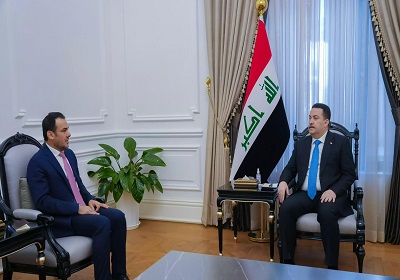
Prime Minister: The path of development will make Iraq a regional political and economic powerhouse
Seventh Baghdad International Dialogue Conference Call for Papers
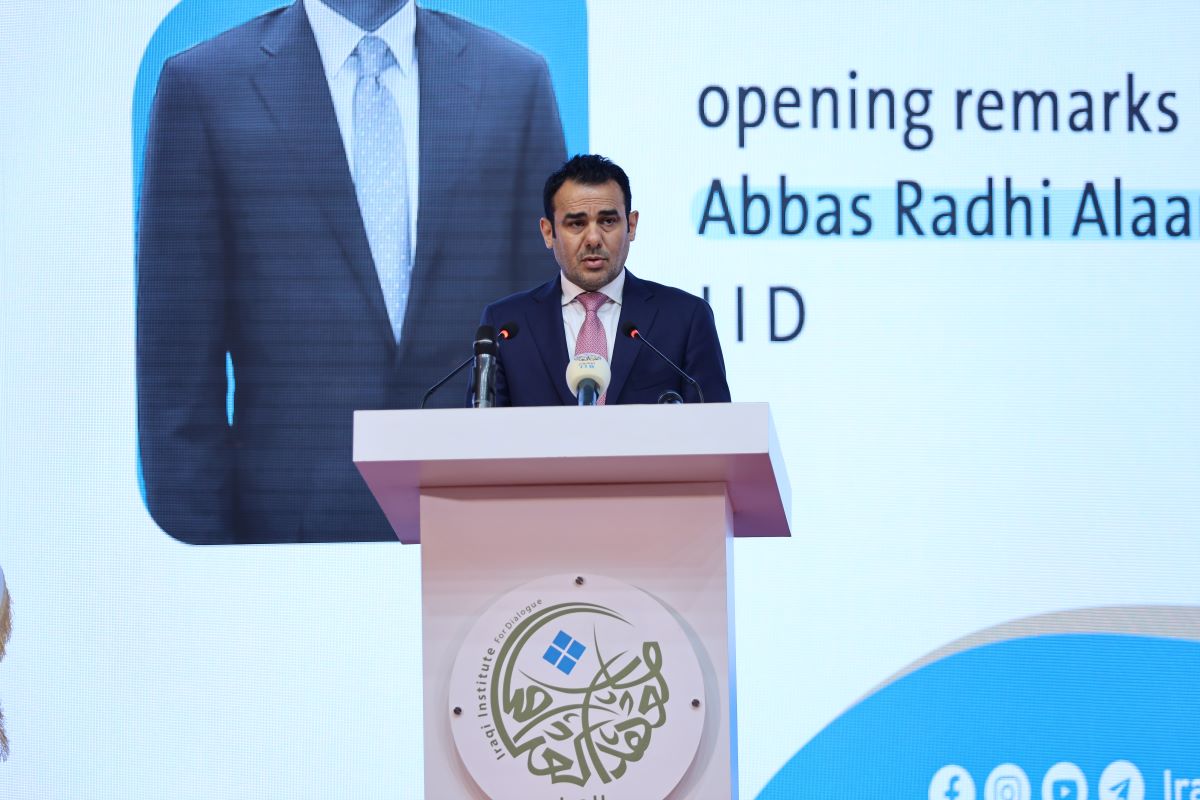
Speech of the Director of the Iraqi Institute for Dialog at the Sixth Baghdad International Dialog Conference
Comments