


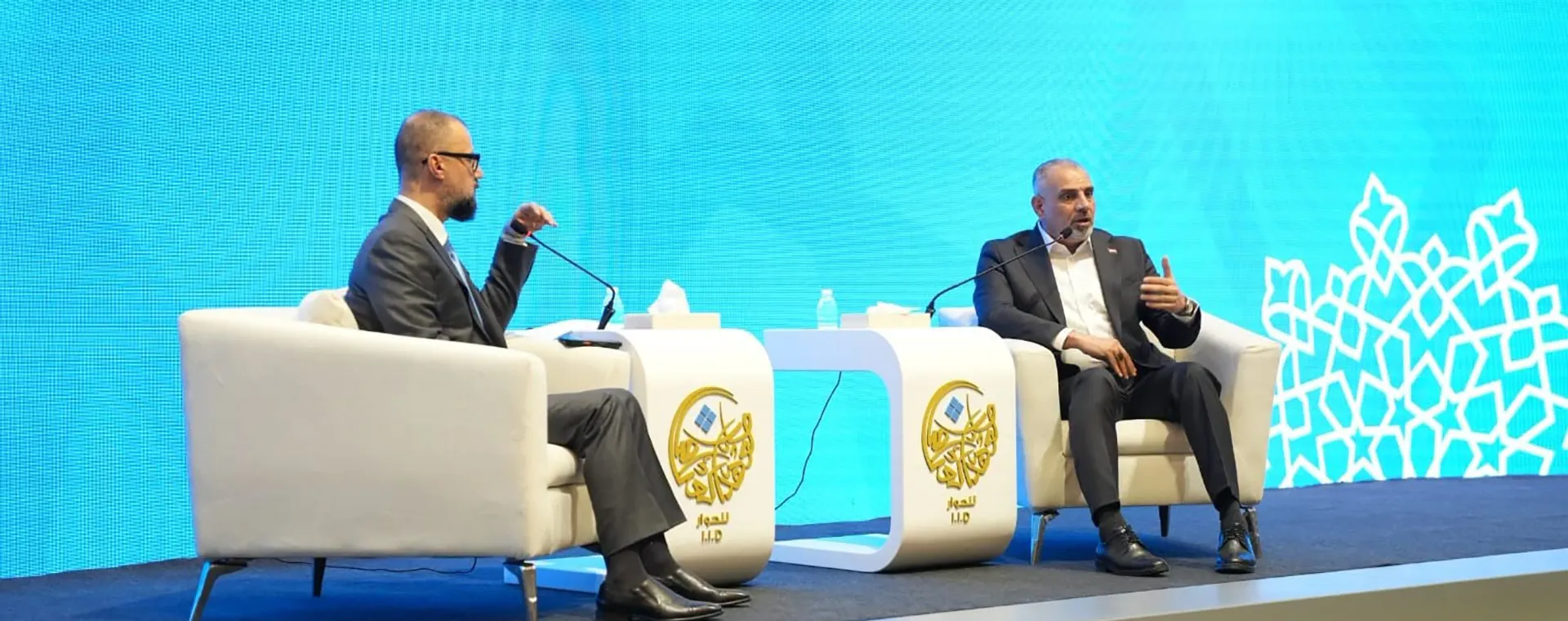
From the establishment of the Hashd to the control of weapons and the budget Adnan Fayhan opens the files of the state, the region and electricity in the eighth dialog of Baghdad
During his interview with the journalist Renas Ali, during the activities of the eighth Baghdad Dialog Conference, the First Deputy Speaker of the House of Representatives, Mr. Adnan Faihan, touched on a number of political, security, economic and legislative files, speaking about the establishment of the popular mobilization and the service and retirement law for its members, and the limitation of weapons to the state, as well as the completion of the ministerial cabin and the relationship between Baghdad and the Kurdistan region, parliamentary oversight, budget, security targets and the file of electricity and oil.
Establishment of the Crowd.. Exceptional Conditions and Sacrifices
"The Iraqi government reached out to the factions in 2014 with the aim of coordinating in the face of terrorism and preventing it from reaching Baghdad," Faihan said, calling for "remembering the beginnings of the popular mobilization and the sacrifices made by the factions," noting that "the fatwa of the competent jihad was the first point of building the popular mobilization, and was established in an exceptional and urgent circumstance."
And he added that "the PMF was the egg of the captains in liberating the territories, with an emphasis on not reducing the role of the security services," while pointing out that "the PMF Law No. 40 gave legal legitimacy to the PMF, but it did not regulate a specific mechanism for its members," and did not include articles related to retirement, affiliates and salaries."
Service and Retirement Law: 12 Years of Waiting
In the file of the service and retirement law, Fayhan explained that "the exceptional circumstances and the events of October made the enactment of the PMF retirement law and the organization of the work of its members outside the priorities of the government," noting that "the PMF members have 12 years of service and sacrifices, and until now they are treated as contracts and cannot obtain advances and others."
He stressed that "the service and retirement law is a necessity, but the obstacle to its legislation was internal pressure and personal accounts," explaining that he was among the committees that worked to organize the law, but differences prevented its passage, due to a point related to granting the Prime Minister a legal justification to extend the service of the head of the crowd authority contrary to the controls, which led to the withdrawal of the law.
The Mobilization Between Institution and Political Exploitation
"The goal is to establish a law that regulates this institution and strengthens its capabilities away from political pressures," Faihan said, noting that "the objection was not to the service and retirement law itself, but to the use of the Authority for political use that harms it."
And he added that "there is a difference between the brigades and regiments of the Popular Mobilization that existed during the war period, and they are Iraqis and have a political orientation, and between regiments and brigades formed for purely political purposes," pointing out that "the Popular Mobilization became in the days of the elections like the 'Kia'," in reference to its electoral exploitation by some politicians.
He stressed that "preventing the enactment of laws for the sake of political interest is incorrect," noting that "there are political parties that prevent the adoption of the law," while stressing that the objection to the legislation "was not a personal targeting," but rather a rejection of the use of the crowd for political purposes, noting that the Council sent a book on the law, and that the Prime Minister will send a copy of it as soon as possible.
Arms Control: No Shiite War
In the weapons inventory file, Fayhan said, "The organization of weapons will be under the command of the commander-in-chief of the armed forces. There is no Shia war," he said, noting that "the exaggeration of the statements contributed to reaching the current state of tension."
He said that "the factions tried their wisdom and awareness, and one day they adhered to the government's decision," revealing that "the leaders of the coordinating framework were tasked with organizing the confinement of arms to the state."
And he explained that "weapons will be kept in state stores, and the popular crowd is part of the state, and weapons will be in the stores of the crowd," noting that what is important is "the mechanism that the government and factions will reach to organize weapons, stressing that everyone "is obliged to preserve the sovereignty of Iraq."
Cabinet Cab... Unfinished Merit
And in the political file, Fayhan stressed that "the Ministry of Interior and Defense has not decided their candidates so far, and there is a problem in the Kurdish component," calling for the continuation of dialogs in order to complete the ministerial formation, stressing that "the circumstances affected the failure to complete the cabinet, but it will be completed very soon."
And stressed that "our position is clear and frank from the completion of the cabin, either to come full nine ministers," noting that "our candidate is Dr. Laith Khazali, and who wants to object to provide logical reasons and not because of external parties."
Budget: A tool to reform financial management
On the economic issue, Fayhan said that "the 2026 budget is different from its predecessors as announced by the Prime Minister," noting that the budget "must develop the situation of Iraq, and is the first brake to regulate the Iraqi financial situation."
And he explained that "the evaluation control gives us a clear picture of the failure and success of the government," pointing out that the previous budgets were reaching the parliament "in the form of guesswork and expenses," while the amount of the budget and the mechanism of providing funds will determine "how to classify its expenses."
He pointed out that the limits of change before the House of Representatives are represented in the "reduction of the budget", within the process of discussing the sections of spending and revenues and the mechanisms of financing them.
Baghdad and Erbil: Salaries, Oil and Borders
Regarding the relationship between the federal government and the Kurdistan region, Fayhan stressed that "the management of borders and ports is one of the fundamental problems between the central government and the region," asking about the mechanism of salary distribution in the region, noting that "any item of the tripartite budget between the region and the center has not been applied."
He said that the problem "is not in the mutual visits between the region and the center, but in the curriculum," wondering whether the regional government has reached a conviction to change the curriculum with Baghdad to find real solutions.
And he added that "there is a problem with the region regarding oil fields that lie outside the borders of the region, who gave them the authority to do so?He called for separating the salaries of the region's employees from the political tensions and looking for solutions based on the constitution and law, asking: "Is there a state in the belly of a state?"".
He stressed the need for officials in the region to come up with new visions, while separating matters related to the budget and adhering to the constitution, in order to allow the processing of outstanding files between Baghdad and Erbil."
Saudi Targeting: The Fact-Finding Committee
In the targeting file that he talked about, Faihan said that "Hadi al-Ameri formed a fact-finding committee," indicating that each political party owns its media, while revealing the arrival of information from the Prime Minister on "Saudi targeting," and that the notification occurred three hours before the last strike.
And he added: "I asked about the time of notification, and they told me that the notification arrived before the last strike, so there is a delay in reporting," noting that "18 martyrs were the result of targeting," and wondering why no measures were taken to evacuate people after the warning arrived.
And he stressed that "if the targeting was for the non-crowd, we would form a committee, and there are no problems in forming a committee," also noting that "the House of Representatives was targeted," and that the formation of investigation committees should not be subject to political tensions.


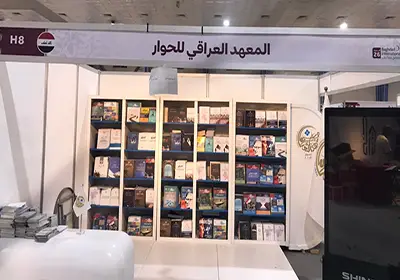
The Iraqi Institute for Dialogue, the logistical sponsor of the Baghdad International Book Fair, opens its own pavilion at the fair
Official agreement between Iraqi Institute for Dialogue and the Iraqi Media Network to sponsor The Seventh Annual International Conference of “Baghdad Dialogue” 2025
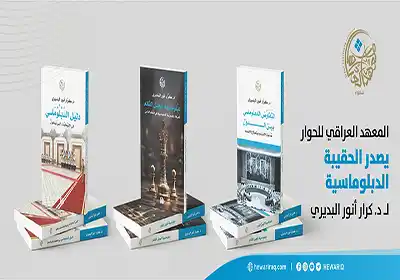
The Iraqi Institute for Dialogue publishes "The Diplomatic Portfolio" by Dr. Karrar Al-Badiri
Invitation to the 79th issue of Dialogue of Thought
Prime Minister: The path of development will make Iraq a regional political and economic powerhouse
Speech of the Director of the Iraqi Institute for Dialog at the Sixth Baghdad International Dialog Conference
Seventh Baghdad International Dialogue Conference Call for Papers
Comments