


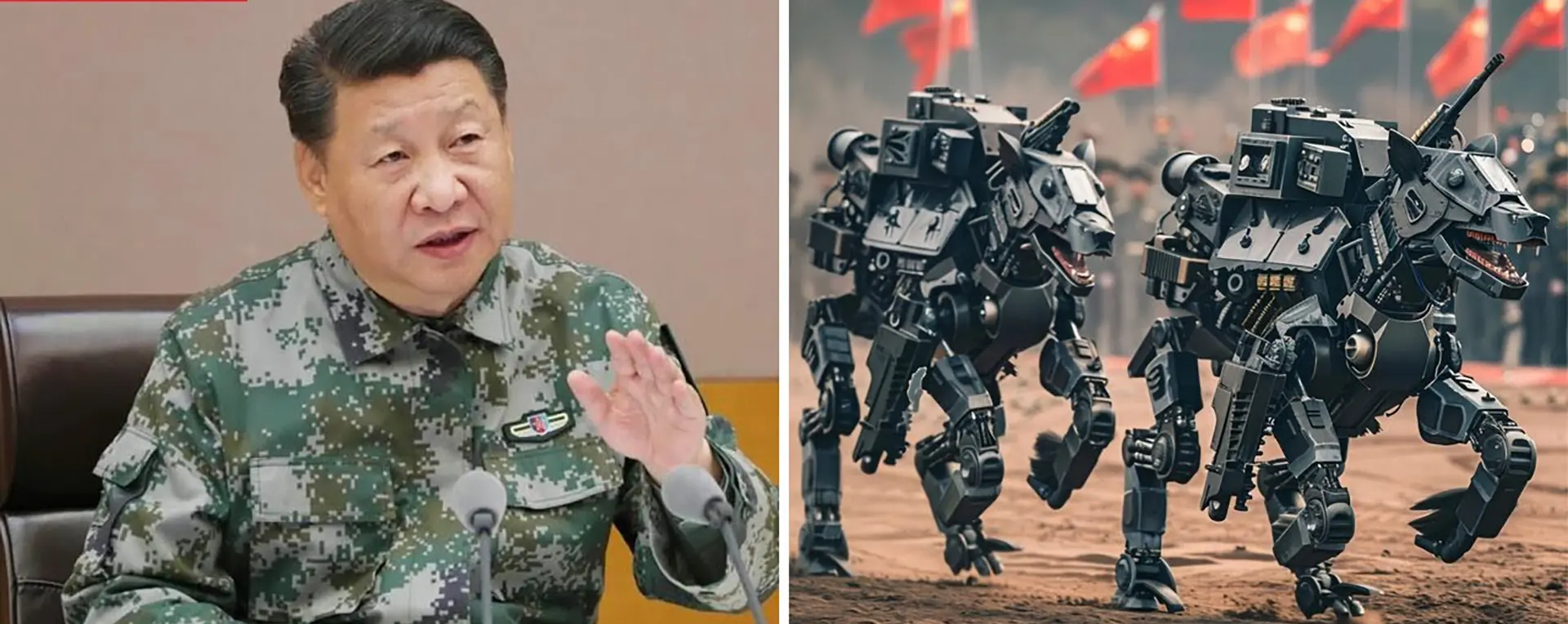
Human robot... China's next weapon?
China’s humanoid robotics industry is gradually moving from showbiz, which includes running, boxing and dancing, to the research stage of employing them on future battlefields.
And a Reuters review of more than 100 military procurement announcements, an academic study, a patent, a government document and material issued by defense industry institutions revealed that the Chinese military is expanding its research and testing related to the potential military use of these robots.
And this trend coincides with the growing importance of independent systems in modern warfare, after the Russian-Ukrainian war showed the increasing role of AI-powered drones in reconnaissance and attacks, as well as the use of robots in transporting supplies and evacuating the injured.
What is China developing?
China’s military is testing how well humanoid robots can implement field requirements and buying technologies to train them, with research focused on perception, handling objects and collecting large amounts of data that help them operate in unexpected environments.
These activities accelerated during 2025 and 2026, benefiting from a large local industrial base. And according to data in the report, Chinese companies accounted for about 95 percent of global shipments of humanoid robots in 2025, giving the PLA access to a fast-growing domestic sector.
But there is still no evidence of human robots being deployed in operational units of the Chinese military. And these machines still consume large amounts of energy, and also face reliability problems when working outside controlled environments.
Perceptions of urban combat
Urban combat stands out as one of the most important areas of potential military use for humanoid robots.
And a study prepared by researchers at the National University of Defense Technology in 2025 envisioned an intrusion force of six robots, including human robots, robotic dogs and unmanned vehicles, working alongside soldiers to enter buildings controlled by the adversary and combing them floor by floor.
The study predicted that these capabilities could be available within a period of five to ten years.
And in theory, robots with legs and arms can move inside buildings, tunnels, ships, climb stairs, and handle doors and tools. And yet, wheeled, crawler or four-legged robots remain less expensive and easier to use for reconnaissance and logistics missions.
And Chinese military analyses have discussed the possibility of these robots moving in the future from support roles to carrying out basic combat missions, while keeping the decision to use force subject to human intervention that verifies the target before allowing fire.
From Competitions to Military Procurement
Chinese military interest in this technology began to accelerate in 2024, when the National University of Defense Technology and the Academy of Military Sciences hosted a defense technologies forum addressing military applications of human robots.
And in 2025, the idea shifted to practical exercises, as the university organized a competition that simulated “sneaking behind the opponent’s lines”, and the robots were asked to enter a specific area, map it and locate targets.
Other scenarios included identity checks, security patrols and inspections of military installations, while the university described the competition as a pilot ground to prepare robots for future battlefield moves.
And in May 2025, the People’s Liberation Army (PLA) launched a tender to buy a humanoid robot that includes installing it and training technical personnel to use it. Another purchase advertisement sought a system of intelligent perception and execution of precise operations by robots.
And in June 2026, the Chinese military allocated about $300,000 for a system that collects and classifies camera, radar, motion and terrain data that robots can traverse.
And these steps suggest that research is not focused solely on the fabrication of mechanical structures, but includes the perception, data, and training systems needed to raise robotics’ efficiency in complex field environments.
Defense industry enters the race
The development of human robots has extended from military universities to Chinese defense industry enterprises.
The state-owned company Norinco has developed a human-like robot called Fushi, which the company's identification materials say is capable of carrying out guard and reconnaissance missions in various conditions, smart patrols and working in dangerous environments.
And Fushi can be controlled remotely, a feature that may help address one of the most prominent weaknesses of current robots: their limited ability to make independent and reliable decisions within complex environments.
And Malcolm Davis, a researcher at the Australian Strategic Policy Institute, believes that human robots are not practical systems for combat use at the moment, but they may become viable within five to ten years.
The Human Control Dilemma
The trend toward military robots raises legal and ethical questions about the limits of human control over the use of force.
"Even if these systems are remotely operated, increasing their autonomy will in the future force them to deal with complex situations involving civilians, wounded people, or fighters who have stopped fighting."
International humanitarian law obliges armed forces to distinguish between combatants and civilians and not to target wounded or surrendered people. The International Committee of the Red Cross (ICRC) has warned that autonomous weapons may have difficulty identifying surrenders, as their assessment depends on context, behavior and intent.
The United States requires that autonomous weapons be subject to legal reviews and realistic tests, with commanders and operators held responsible for exercising appropriate discretion when using force. China’s Ministry of Defense said AI-powered weapons should remain under human control.
An escalating international race
China is not alone in researching the military uses of human robots, as the U.S. military has launched a competition to develop “military-use human robotic capabilities” that can work alongside soldiers.
Suggested missions include reconnaissance, escort, obstacle removal and handling of hazardous materials, as well as supporting defensive and offensive operations in urban environments.
But China has a clear industrial advantage in the field of human robotics and four-legged robotics, while the Chinese company “Unity” is one of the most prominent global producers in the two sectors.
Preparing for future wars
The importance of China’s program lies not in the presence of combat-ready robots, but in Beijing’s initiation of building the research, technical and training infrastructure that may make these systems militarily usable in the future.
And the Chinese track relies on combining large manufacturing capacity, research by universities and defense institutions, artificial intelligence systems and machine perception, as well as collecting data on field environments.
And problems with balance, mobility, cognition, decision-making ability, endurance, and energy consumption continue to prevent the widespread military use of these robots.
Wang Yonghua, a researcher at the Chinese Academy of Military Sciences, said military deployment requires technological breakthroughs, reduced production costs and access to large-scale manufacturing.
Thus, China's strategy does not appear to be aimed at replacing soldiers immediately, so much as it is preparing for a combat environment in which humans and machines work together, especially inside buildings, tunnels and places that pose a high risk to troops.

The Iraqi Institute for Dialogue, the logistical sponsor of the Baghdad International Book Fair, opens its own pavilion at the fair

Official agreement between Iraqi Institute for Dialogue and the Iraqi Media Network to sponsor The Seventh Annual International Conference of “Baghdad Dialogue” 2025

The Iraqi Institute for Dialogue publishes "The Diplomatic Portfolio" by Dr. Karrar Al-Badiri

Invitation to the 79th issue of Dialogue of Thought

Prime Minister: The path of development will make Iraq a regional political and economic powerhouse

Speech of the Director of the Iraqi Institute for Dialog at the Sixth Baghdad International Dialog Conference

Seventh Baghdad International Dialogue Conference Call for Papers

Comments