


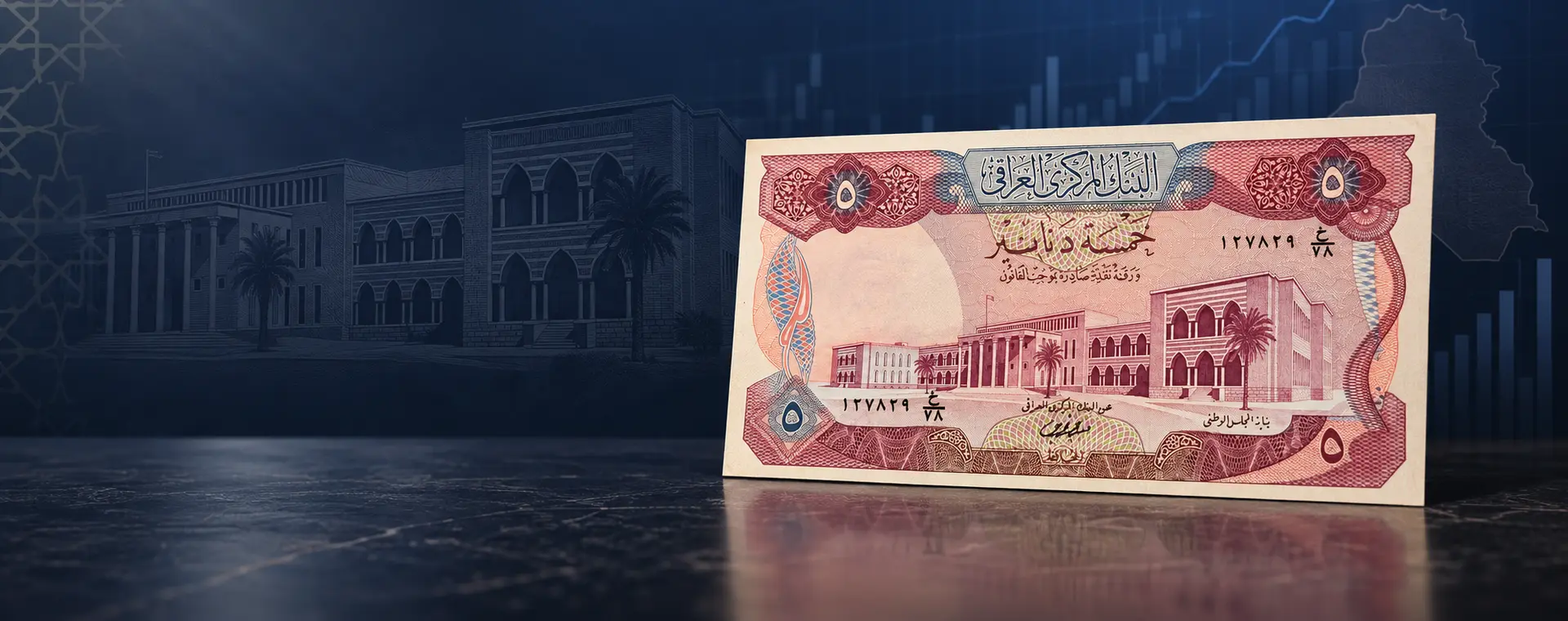
Delete zeros from the Iraqi dinar: between the technical instrument and the condition of structural reform
1. Introduction
Renewed talk of deleting zeros from the Iraqi dinar, which returned to the official forefront during 2026 through statements by members of the parliamentary Finance Committee and government officials, is an occasion to re-launch the Fundamental questionIs currency restructuring a self-sustaining tool to address accumulated monetary imbalances, or is it a formality that cannot overcome its apparent impact unless it is built on a solid reform foundation?
This paper does not proceed from a prior position of support or rejection, but rather seeks to dismantle the prevailing hypotheses about the feasibility of this policy, and compare them with documented international experiences, leading to practical recommendations applicable in the current Iraqi context.
This paper reviews the feasibility of restructuring the national currency by deleting zeros, in light of the return of this file to the forefront of the official debate in Iraq during 2026. Based on a literary review that combines the theory of the "money illusion" and the sign theory, and a comparison between the Turkish (successful) and Zimbabwean (failed) experiences, the paper concludes that deleting zeros is a neutral accounting and regulatory tool of value: its results are completely dependent on the extent to which it is associated with real financial and monetary reform that precedes it.
Based on the reports of the International Monetary Fund (IMF) and the European Bank for Reconstruction and Development (EBRD), the paper documents real reform steps taken by the Iraqi government and the Central Bank during the period 2023-2026 (the National Strategy for Financial Inclusion, the Reform of Government Banks, the Development Fund for Iraq), with objective reference to the gap that still exists between these efforts and the completion of the reform path. The paper presents a set of practical recommendations addressed to Iraqi decision-makers, led by the need to separate the time between structural reform and any formal monetary procedure, institutionalize the existing reform momentum, and activate the supervisory and auditing role before the replacement phase, not after.
2. Conceptual framework: what is the deletion of zeros
The deletion of zeros (Currency Redenomination) means replacing the existing currency with a new currency with a fixed conversion factor (such as the equivalent of a new dinar or a thousand old dinars), without affecting the real purchasing value of the currency. The commonly stated goal is to simplify accounting and monetary transactions, not to address inflation itself, a fundamental distinction that is often overlooked in public debate.
3. Literature review
The field of research on currency restructuring is divided into three complementary theoretical tracks: a behavioral-psychological track that explains individuals' response to digital change, a macro-economic track that links the instrument to the credibility of monetary policy, and a comparative track that builds its conclusions from multiple case studies. The present three papers are reviewed successively.
3.1 "Money Illusion Theory"
Individuals tend to judge value based on the nominal number presented rather than on real value, sometimes leading them to irrational consumption and saving decisions in the purely economic sense (Soman, Wertenbroch & Chattopadhyay, 2002). Fehr & Tyran, 2001)
A qualitative study conducted in Ghana after the restructuring of its currency documented how the change in currency affected consumers' perception of the value of their wealth, their adoption of price increases as normal, their spending patterns and their saving behavior, although the real value of their savings did not change (Dzokoto et al., 2010). Subsequent studies in Indonesia showed that while the restructuring was theoretically capable of enhancing the currency's image and revealing the real economic conditions, it also carried the risk of triggering buying panics or inflationary pressures if it was not accompanied by an adequate community awareness campaign (Prabawani, 2017; Prabawani et al., 2018).
This theoretical path bears a direct connotation to the Iraqi context: the pricing and behavioral risks referred to in section VI (6) of this paper are not general administrative assumptions, but an academically documented phenomenon directly related to the mechanism of "money illusion", and specifically call for accompanying community awareness campaigns not subsequent to any monetary action.
3.2 Signal Theory and Monetary Policy Credibility
A recent study of the Ghanaian, Turkish, and Zimbabwean cases proposed an analytical framework that integrates monetary, behavioral, and signal economics theory, allowing for the assessment of the impact of restructuring across three successive time stages: before, during, and after the transition in the short and long term (Impact of Currency Redenomination on Economic…, 2023).
According to this framework, the "signal" value of the restructuring process is positive and credible when it comes in line with actual fiscal and monetary policies that preceded it (as in the Turkish case), while it loses any signal value when repeated in isolation from real reform, and may even turn into a negative indicator that deepens mistrust (as in the Zimbabwean case where the procedure was repeated three times in four years to no avail).
3.3 Comparative literature based on case studies
In addition to the two theoretical tracks above, extensive literature has accumulated based on internal case studies, which dealt with multiple experiences from Ghana, Indonesia, Turkey, Zimbabwe, and Nigeria, up to repeated legislative attempts in Colombia that have not yet been completed (seven bills put forward since the beginning of the millennium without approval), which reflects that institutional hesitancy about this policy is not an Iraqi exception, but a recurring feature in many developing economies facing the same dilemma (Impact of Currency Redenomination..., 2023). In the Nigerian context in particular, a systematic review of the literature concluded that currency restructuring policies, when evaluated from a macroeconomic perspective, do not appear to create additional inflationary pressure in open economies, but their actual feasibility remains conditional on the high level of institutional and financial discipline in the country concerned.
This line of research concludes that it is entirely consistent with section IV(4) of this paper: that the “prior institutional discipline” variable is repeated across all successful and failed case studies alike, up to the level of the empirical law governing this field of research.
3.4 Summary of the literature review and the location of this paper
The three tracks above intersect around a common conclusion: that currency restructuring is a dependent variable rather than an independent one; It translates an existing fiscal and institutional discipline (as in Turkey), or reveals its absence (as in Zimbabwe), but it does not make it by itself in either case. This paper adds to this field of research a dimension that has not received sufficient attention in the existing literature, namely, the proactive oversight and auditing role during the transition as an intermediate variable that mitigates the behavioral effects of the money illusion documented in Section 3.1, rather than simply a post-decision administrative procedure.
4. Comparative Lesson: Two Contrasting Experiences
4.1 Turkish experience: reform first, then zeros
When Turkey deleted six zeros from the lira in early 2005, the decision was not out of context; It was preceded by years of an economic stabilization and fiscal consolidation program, supported by the International Monetary Fund, which succeeded in reducing inflation to single digits before embarking on monetary restructuring (ORF Middle East, 2026). This was reflected in the stability of the annual inflation rate at about 8.2% in 2005, compared to higher levels in previous years, while the economy recorded real growth of about 9% during the same year (Grokipedia, 2026).
4.2 The Zimbabwean experience: when zeros are repeated without reform
In contrast, Zimbabwe offers a completely opposite model. Between 2006 and 2009, the government restructured its currency three times in a row, deleting dozens of zeros at a time, without any treatment for the government funding deficit that the central bank was financing by printing money (Market Histories, 2026). The result was an accelerating exacerbation of inflation, which peaked in November 2008 at astronomical levels estimated at tens of millions of times a month, before the government was eventually forced to abandon its national currency entirely in favor of foreign currencies (Financial Pipeline, 2024). 2026).
4.3 Comparative Lesson
The crucial difference between the two cases lies in the timing and order of the reform: in Turkey, the deletion of zeros after the reform was the culmination of it; In Zimbabwe it came as an alternative to reform and as compensation for its absence. This difference is the critical variable that should guide any policy debate in the Iraqi context.
5. The Iraqi situation: a reading in the current data
5.1 Zero Delete Path: Where did the file arrive?
The file in Iraq is witnessing rapid developments during 2026. A member of the Parliamentary Finance Committee confirmed that the draft deletion of zeros is still under discussion within the Central Bank of Iraq, and has not yet reached the level of an official legal proposal before the House of Representatives (The National, 2026). It is estimated that the size of the total cash mass in circulation is approximately 113 trillion dinars, of which about 106 trillion dinars are traded outside the banking system, with calls to return about 10 trillion dinars of them to the official banking system (Shafaq News, 2026).
For his part, the Governor of the Central Bank of Iraq, in his previous statements during the Dohuk Conference on Economic and Financial Problems, stressed that the project is still under study and that its implementation depends on the maturity of the appropriate conditions, noting that the bank is working in parallel to develop the necessary infrastructure for it, specifically expanding digital payment channels and linking government salaries to banking applications, in addition to strengthening the legal and regulatory framework and publishing periodic data on reserves and inflation rates (Al-Alaq, 2025; US First Exchange, 2025 ) . This formal positioning reflects, in principle, a recognition of the need to sequence reform before the formal procedure — exactly the path that Turkish experience has shown to be feasible.
In contrast, Iraqi economists have expressed fundamental reservations, warning against treating the deletion of zeros as a fundamental solution to existing liquidity and public financing problems, at a time when major illicit wealth has still already been transferred to external accounts and assets that are not affected by any domestic monetary action (Iraqi News, 2026). This reservation intersects with the theoretical conclusion that this paper presents: that the monetary instrument cannot on its own replace deeper institutional, tax, and regulatory reform.
5.2 Positive government role: attempts at institutional reform and economic revival
Based on the theoretical framework presented in section III(3), the value of any future monetary action—including the deletion of zeros if later decided—depends on the extent to which it is associated with a genuine earlier course of reform. In this context, the documentary evidence available from independent international and supervisory institutions indicates that the Iraqi government and the Central Bank have already taken concrete steps in recent years that are consistent with this requirement, although they are still not complete.
On monetary stability: In recent years, the Central Bank of Iraq has succeeded in stabilizing the exchange rate, strengthening controls against money laundering and terrorist financing, as well as launching a cross-border payments platform — steps that the EBRD report described as the basis for the current reform momentum (EBRD, 2025).
In terms of financial inclusion: In June 2025, the Central Bank of Iraq launched the National Strategy for Financial Inclusion for the period 2025-2029, which aims to expand low-cost digital banking and financial services and promote microfinance (EBRD, 2025). This step responds specifically to the gap identified by this paper in Section VI (6) as one of the most prominent risks of any future monetary transition.
On banking sector reform: In February 2025, the authorities announced a plan to reform government banks and modernize the private banking sector, in cooperation with specialized international advisory institutions (including KPMG, Ernst & Young and the International Finance Corporation), which includes raising standards of transparency and alignment with international standards, and introducing new liquidity and capital requirements to protect depositors' funds EBRD, 2025; Rawabet Center, 2025).
In terms of diversifying sources of income, the government launched the Development Fund for Iraq in August 2023, which until the beginning of 2025 attracted about $7 billion in foreign direct investment through international memorandums of understanding (IMF, 2025; Shull Solutions, 2025), along with the Development Road project as a regional logistics hub aimed at reducing dependence on oil revenues in the medium and long term.
In terms of social indicators, the national poverty rate declined from 20.1% to 17.5% between 2018 and 2024, as a result of the expansion of spending on social protection programs (Washington Institute, 2025), which is a direct indicator of the state's ability to employ fiscal policy to protect the groups most affected by any future economic transformation, including any monetary transformation.
Taken together, these steps give the Iraqi government a position closer to the Turkish model (reform before action) than to the Zimbabwean model (action without reform), which is worth registering with scientific honesty.
5.3 The Remaining Gap: An Unbiased Objective Reading
However, it is imperative that the Scientific Secretariat not lose sight of the fact that the very international institutions that have documented these efforts continue to register substantial reservations. The International Monetary Fund (IMF), in the report of the annual consultations for Iraq for 2025, indicated that non-oil growth fell from 13.8% in 2023 to only about 2.5% in 2024, and that the share of non-oil revenues remains the lowest among oil exporting countries in the Middle East, North Africa and Pakistan region, and that the fiscal deficit rose to 4.2% of GDP in 2024, with public debt rising to (47.2% of GDP IMF, 2025;EBRD, 2025), and the Washington Policy Institute analysis noted that Iraq's reform momentum historically tends to decline as oil prices recover, in a pattern that has been frequent since the 2020 Financial Reform White Paper (Washington Institute, 2025).
This gap between the efforts made and the results achieved does not refute the positive trend initiated by the Government, but it does confirm that the path is still in the middle rather than at the end -- which is exactly what makes the timing of any future decision to delete zeros a sensitive issue that needs clear indicators of achievement before proceeding, not just declared intentions.
6. Operational risks in transition
Regardless of the position on the feasibility of the decision, any currency exchange involving concrete operational risks deserves proactive treatment:
Pricing risks: The tendency of some economic actors to bring prices closer to the top during the period of cognitive confusion associated with the transformation, which requires intensive field and electronic market control during this particular stage.
Technical and institutional risks: the need for comprehensive and simultaneous modernization of banking systems, ATMs, electronic payment platforms, government and corporate accounts, which requires broad institutional coordination (Shafaq News, 2026).
Confidence risk: In an environment already characterized by a preference for direct cash handling, forced substitution may be interpreted as a measure aimed at non-bank savings, which may push some towards alternative havens (gold, real estate, foreign currencies) rather than towards banks — unless the measure is preceded by actual bank confidence building.
7. Recommendations
Based on the above, this paper proposes the following path for Iraqi decision-makers:
1. Explicit time-lapse between reform and action: No timetable for the elimination of zeros before achieving measurable indicators in controlling the budget deficit and reducing unilateral dependence on oil revenues.
2. Activating control before replacement and not after: Building field and electronic pricing control protocols ready for immediate activation upon any official announcement, instead of sufficing with the subsequent reaction.
3. Accelerating financial inclusion as a precondition: linking any replacement timeline to concrete indicators in the ratio of bank deposits to the cash mass in circulation, not once the administrative decision has been issued.
4. Transparency and early institutional communication: Publishing documented periodic data (as the Central Bank has already begun) on any future path, to reduce the state of confusion allowed by sporadic and uncoordinated statements between different official bodies.
5- Involving academic and advisory institutions: Establishing a permanent channel of consultation between the Central Bank, universities and research centers to independently assess institutional readiness before any final decision.
6- Institutionalizing the current reform momentum instead of leaving it subject to oil fluctuations: Building on gains already documented (National Financial Inclusion Strategy, Government Banking Reform, Development Fund for Iraq) by linking them to specific and binding time performance indicators, thus breaking the repeated historical pattern of reform decline as oil revenues improve.
8. Conclusion
The comparison of the Turkish and Zimbabwean experiences shows that the deletion of zeros is not, in itself, an indicator of the success or failure of monetary policy, but a mirror of whether or not it was preceded by real financial reform. And for Iraq, where revenue fragility intersects with the expansion of the non-bank monetary economy, the real opportunity lies not in the timing of the announcement of the deletion of zeros, but in the sequence preceding it: financial reform, banking inclusion, and regulatory readiness, which make the new figure an honest expression of a more stable economy, not just a formal rearrangement of an unresolved crisis.
References
Al-Alaq, A. (2025, October). Statement at the Duhok Conference on Economic and Financial Problems. Central Bank of Iraq. As cited in US First Exchange (2025).
Dzokoto, V., Mensah, E., Boateng, K., & Opoku Asante, K. (2010). Deceiving our minds: A qualitative exploration of the money illusion in post-redenomination Ghana. Journal of Consumer Policy . https://link.springer.com/article/10.1007/s10603-010-9144-3
3. European Bank for Reconstruction and Development [EBRD]. (2025). Transition report 2025-26: Country assessment — Iraq . https://www.ebrd.com/content/dam/ebrd_dxp/assets/pdfs/office-of-the-chief-economist/transition-report-archive/transition-report-2025/country-assessments/Southern-&-Eastern-Mediterranean/transition-report-2025-26-CA-Iraq.pdf
Fehr, E., & Tyran, J. R. (2001). Does money illusion matter? American Economic Review, 91(5), 1239–1262.
5. Financial Pipeline. Hyperinflation in Harare (2024, April 11) . https://www.financialpipeline.com/hyperinflation-in-harare/
6. Grokipedia. (2026, January 17). Revaluation of the Turkish lira . https://grokipedia.com/page/Revaluation_of_the_Turkish_lira
7. Impact of Currency Redenomination on Economic Growth and Stability. Journal of Accounting and Financial Management, 9(10), 114–132. IIARD. https://iiardjournals.org/get/JAFM/VOL.%209%20NO.%2010%202023/THE%20IMPACT%20OF%20CURRENCY%20114-132.pdf
8. International Monetary Fund [IMF]. (2025, July). Iraq: 2025 Article IV consultation — Press release; staff report; and informational annex (IMF Country Report No. 25/183). https://www.imf.org/en/-/media/files/publications/cr/2025/english/1irqea2025001-source-pdf.pdf
9. Iraqi News. (2026, August 17). Economist: Dinar redenomination traps corrupt cash but faces obstacles. https://www.iraqinews.com/iraq/ziyad-al-hashemi-iraqi-dinar-redenomination-corruption-2026/
10. Market Histories. The Zimbabwe hyperinflation: How a nation printed 100 trillion dollar notes (2007–2009). https://www.markethistories.com/en/the-zimbabwe-hyperinflation-how-a-nation-printed-100-trillion-dollar-notes-2007-2009
11 Norafi. Zimbabwe's hyperinflation: A modern collapse. https://norafi.ai/artha/guides/zimbabwe-hyperinflation
12. ORF Middle East. Iran's currency redenomination: The zero-sum game. https://orfme.org/expert-speak/irans-currency-redenomination-the-zero-sum-game/
Prabawani, B. (2017). Money illusion post redenomination: An exploratory study. Advanced Science Letters.
Prabawani, B., Rachim, A. C. C., & Anggraeni, A. I. (2018). Redenomination and money illusion: Consumer perspectives in Indonesia. Journal of Economics, Business & Accountancy Ventura.
15. Rawabet Center. 2025, October. Iraq is implementing comprehensive banking reforms in cooperation with the Central Bank and international consulting firms. https://rawabetcenter.com/en/?p=10919
16. Shafaq News. (2026, August). Iraq revives debate over removing three zeros from the dinar . https://shafaq.com/en/Economy/Iraq-revives-debate-over-removing-three-zeros-from-the-dinar
17. Shull Solutions. (2025, September). Introduction to Iraq 2025 . https://shullsolutions.com/introduction-to-iraq-2025/
Soman, D., Wertenbroch, K., & Chattopadhyay, A. (2002). Currency numerosity effects on the perceived value of transactions. Advances in Consumer Research .
19. The National. (2026, August 18). Iraq considers deleting zeros from dinar as officials revive currency overhaul. https://www.thenationalnews.com/business/economy/2026/08/18/iraq-considers-deleting-zeros-from-dinar-as-officials-revive-currency-overhaul/
20. US First Exchange. Iraq's Central Bank revisits its plan to remove zeros from the dinar. https://usfirstexchange.com/iraqs-central-bank-revisit
21. Washington Institute for Near East Policy. (2025, September 18). Facing fiscal pressures: Iraq's struggle for reform ahead of the 2025 election. https://www.washingtoninstitute.org/policy-analysis/facing-fiscal-pressures-iraqs-struggle-reform-ahead-2025-election

The Iraqi Institute for Dialogue, the logistical sponsor of the Baghdad International Book Fair, opens its own pavilion at the fair
Official agreement between Iraqi Institute for Dialogue and the Iraqi Media Network to sponsor The Seventh Annual International Conference of “Baghdad Dialogue” 2025
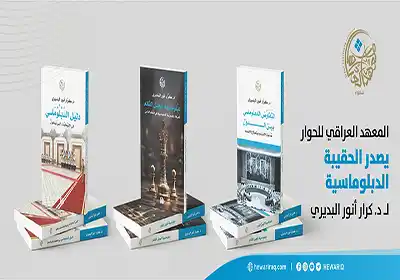
The Iraqi Institute for Dialogue publishes "The Diplomatic Portfolio" by Dr. Karrar Al-Badiri

Invitation to the 79th issue of Dialogue of Thought
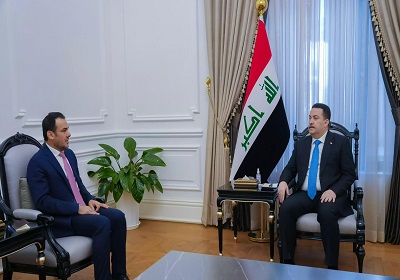
Prime Minister: The path of development will make Iraq a regional political and economic powerhouse
Speech of the Director of the Iraqi Institute for Dialog at the Sixth Baghdad International Dialog Conference
Seventh Baghdad International Dialogue Conference Call for Papers
Comments