


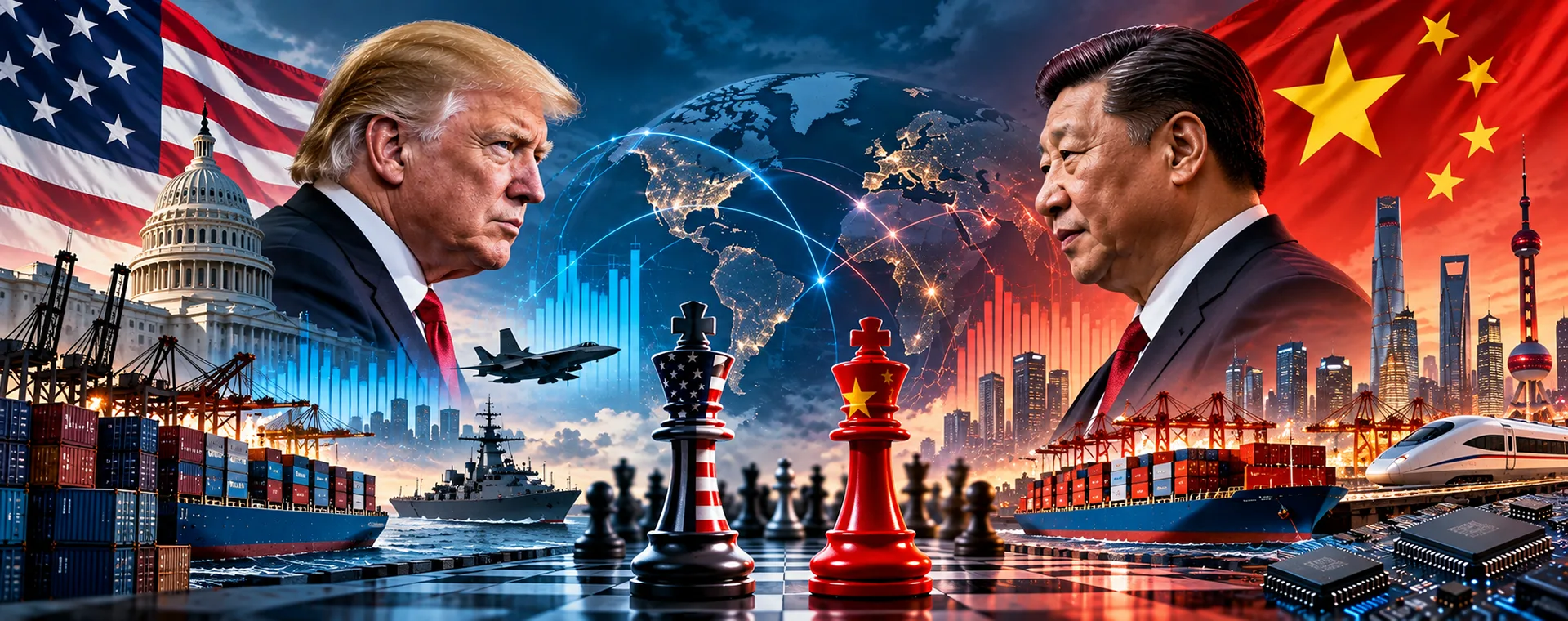
U.S.-China Relations: Facing International Challenges, Economic Rivalry or Strategic Cooperation? (Analytical reading)
The Sino-U.S. relationship has been shaped by the PRC’s formation, and even its roots stretch back to 1899 when Washington called for an “open door” approach that would allow all foreign powers privileged access to China.
President Woodrow Wilson (1921–1913 term) disappointed the Chinese patriots at the Versailles Conference in 1919 when the resulting treaty gave the demilitarized Shandong Peninsula from Germany to Japan, rather than to China.
But the administration of President Herbert Hoover (1933–1929) and its successor (the administration of President Franklin D. Roosevelt, 1933–1945) provided China with very substantial food aid during the Great Famine of the late 1920s, and America supported the republican government in China under Chiang Kai-shek when it re-established control in its campaign against local warlords called the "March to the North" in the same period. America supported the Republic of China against Japan during the Pacific War, by sending huge military aid to the "hump" region (the Himalayan Range and Sichuan).
It reached its peak in early 1979, when President Jimmy Carter's administration made a remarkable U-turn in relations. Carter improved diplomatic recognition from Taiwan to China, recognizing "one China," and it worsened in the wake of the Taiwan crisis in 1996, when China tested ballistic missiles on the island's periphery, and it became strained after Chinese authorities crushed the Tiananmen Square protests in June 1998.
This is one of the most sensitive issues from the Chinese point of view; In addition to the Tibetan issue. And according to former Chinese President Jiang Zemin, Taiwan is the most important and sensitive issue at the heart of Sino-US relations (Al-Hawari, 1998: 209). Especially after the end of the Cold War (Desouki, 2000: 183).
As for the policy of the United States of America on this issue; It is somewhat confusing (Abdul Hai, 2000: 156). It shows that the United States adheres to the (Shanghai) Declaration of 1972, which indicates that Taiwan is part of the Chinese motherland and its problem must be resolved peacefully away from the method of coercive annexation, as it adheres to the (Taiwan Law) of 1979.
against China, which points to the US responsibility for supplying Taiwan with the weapons it needs. This shows the contradictory position of the USA; It recognizes China’s unity but does not recognize China’s sovereignty over its entire territory (Desouki, 2000: 182).
It should be noted that the United States of America is keen to obstruct any rapprochement between Taiwan and China, despite the fact that the latter has for years raised the slogan (two social systems in one country), that is, Taiwan remains a capitalist system without any prejudice in the event of its unification with China, as was the case with Hong Kong when it was unified with China in 1997 (Landsberg and Burkett, 2005: 3).
It is enough to read what US President Richard Nixon wrote about the Taiwan issue: “There is in the Shanghai Communique of 1972 an acknowledgment that Taiwan is an integral part of China, that the United States expressed its support for the peaceful solution of the question of reunification, and that it should wait to take some steps that would raise the international status of Taiwan” (Abdul Hai, 2000: 156).
And the relationship today towards a future shrouded in uncertainty, especially after the administration of former President Obama decided to shift towards Asia, and it is vulnerable to several factors, most notably the extent of confidence between the two countries and the fear of each of the fluctuation of the balance of power in favor of the other in addition to the different models of governance between them. But both countries are eager to contain the competition because they are well aware that the alternative is conflict.[1, 2]
U.S.-China Strategy:
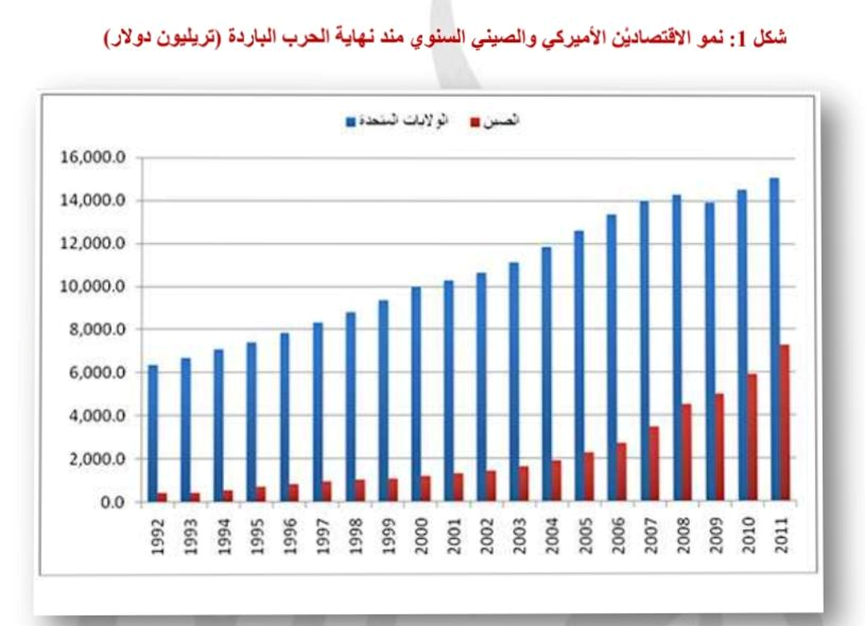
The launch of the Sino-U.S. Strategic Economic Dialog in 2009 came against the backdrop of a major U.S. economic downturn in 2009 and continued steady growth in China’s economy in a way that many U.S. businessmen believe could threaten U.S. sovereignty over the international economy that has been entrenched since the end of World War II. The Chinese economy, which was only 7.6 percent the size of the U.S. economy at the time of the collapse of the Soviet bear, now accounts for nearly half of the size of the U.S. economy.
And if growth rates in both countries continue at their current pace, China will push the United States out of the top of the international economic system in at most two decades (as Figure 1 indicates).[3]
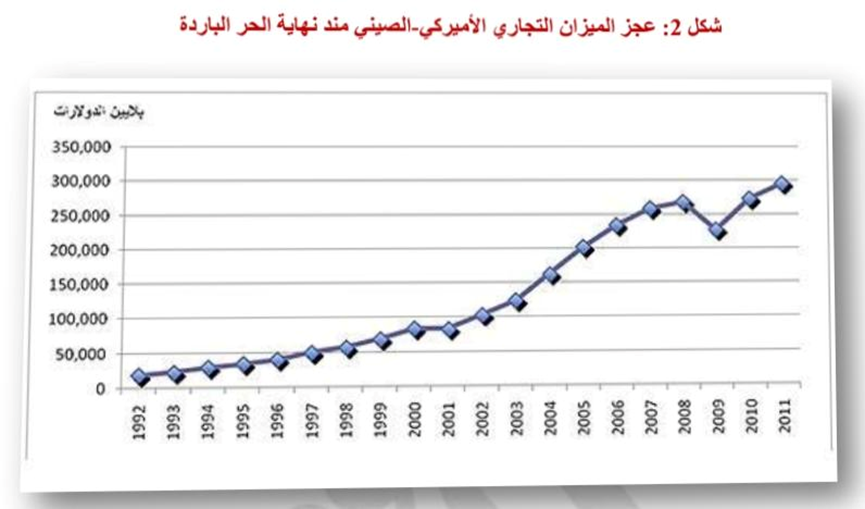
In addition, World Bank statistics indicated that by the end of 2009, China's foreign exchange reserves had risen to $9 trillion, a full $1 trillion more than in 2007. In 9007, China and Japan surpassed the United States as the number one trading partner. The trade balance between the US and China tilts in favor of expertise significantly (as Figure 2 indicates).
Much of China's trade surplus enables it to run across the US. And so in the minds of many Americans, China has become America’s main strategic economic rival. Some US politicians have exploited this fear of Chinese rise to blame China, particularly China's monetary policies that have kept the Chinese currency low against the dollar, as a major gain for the decline in US exports and the rise in the trade deficit with China.[4]
And the fourth round of dialog, held against the backdrop of the international economic crisis, focused on deepening and consolidating economic cooperation between the two countries on the one hand and joint cooperation to stimulate growth at the international level on the other hand. And China has been shown to be reluctant to respond to U.S. demands regarding floating the exchange rate of the Chinese currency, offering greater guarantees for intellectual property rights, opening Chinese markets to U.S. exports, and reducing perceived and hidden support for Chinese state companies. In return, Washington has promised to facilitate the transfer of advanced technology in civilian areas, and to reduce restrictions on China's exports. The bilateral talks also touched on coordinating the positions of the two countries regarding the economic crisis in the euro zone, and strengthening the role of the International Monetary Fund in coordinating economic policies between different countries.[5]
China recognized that economic competition could not be won without geostrategic influence to underpin its rise; Securing the needs of the economic ascent, especially energy supplies, requires political relations with the source and corridor countries, and a military presence to protect these supplies. And the same goes for exports, for which international influence is a key support to gain preference over others, or to remove politically motivated barriers. And the risks of intercepting Chinese exports and imports, directly or indirectly, by competitors such as the United States cannot be ruled out.
Therefore, China, which belatedly realized this, has embarked on an ambitious path to enhance its political, military and ideological/propaganda influence at the regional and international level to serve and protect its economic rise. And U.S. policy continues to hinder these Chinese endeavors, supported by important political allies and the world’s most powerful military machine, which it has used to hinder efforts to control the South and East China Seas and provide military support to China’s regional rivals such as Japan, Taiwan, South Korea and India.
And indeed, U.S. military dominance over China’s trade routes and resources poses a real threat to China’s strategic ascendancy, as obstructions along the Chinese path include: the vast technological gap between it and the United States, and the structure of an authoritarian regime that may not qualify it to absorb any domestic political shocks compared to a resilient American one.[6]
There is a lot of communication between the two countries and what is going on behind it!
Chinese President Xi Jinping's visit to the United States (September 23-25) comes at a moment when the relationship between Washington and Beijing transcends the traditional trade dispute; Tariffs, agriculture and investment are only part of a broader competition that includes technology, critical metals, energy, supply chains, Taiwan, Africa, global trade corridors, and even the dollar and U.S. Treasuries.
Together, the United States and China account for more than a third of global GDP, and their markets, investments, and supply chains are highly interconnected, but this interdependence runs in parallel with competition for power, influence, and position in the international system. But this decline does not necessarily mean that Washington has succeeded in reshaping the trade balance to its advantage; This is mainly due to a decline in imports rather than a similar rise in US exports to China, as well as the transfer of part of manufacturing and trade flows to other Asian countries, such as Vietnam.
The agricultural file remains one of the direct negotiation papers. After the Beijing summit, China committed to buying at least 25 million tons of U.S. soybeans a year through 2028, as well as other agricultural products worth at least $17 billion a year.
But as of August 2026, China had only implemented about a quarter of its annual commitment, making agricultural purchases usable as leverage or reward in negotiations between Xi and Trump
And so we expect limited announcements on agriculture, non-tariff barriers and some goods, but they exclude a comprehensive trade agreement that will rebuild the economic relationship at its roots.
A more sensitive profile is rare metals. The United States wants China to expand its supply to U.S. markets while reducing its dependence on them by seeking alternative sources in Africa and Latin America.
And the irony is that Washington needs, in the short term, continued Chinese supplies, while in the long term it is working to dismantle its dependence on Beijing, a task that the study believes needs years due to the nature of global supply chains and China’s dominance in this sector. The sensitivity of the crisis for Beijing stems from its heavy dependence on Middle East oil. In 2025, China imported about 42% of its oil needs from the countries of the region, while about 45 to 50% of its total crude oil imports pass through Hormuz, equivalent to about 5.4 million barrels per day.
But Beijing is not without alternatives; The study points to a strategic reserve equivalent to about 120 days of net oil imports, as well as more than 46 million barrels of Iranian crude in floating stocks at Asian terminals.
The war reveals another paradox in Chinese calculations. It harms China’s energy security, but at the same time it drains U.S. military resources and distracts Washington from the Middle East far from the Indo-Pacific and Taiwan.[7]
U.S.-China Rivalry on the African Continent:
We also do not forget that there is competition between them in the African continent and the exploitation of its lands in the extraction of oil, gas and minerals, as well as the exploitation of investment opportunities, as well as the agricultural sector, where the continent is characterized by fertile lands. And also the presence of military bases on both sides. And this is one example of the rivalry that exists in U.S.-China relations on that continent, especially in its south.
And this is what this relationship represents, and we know very well that there is a global economic competition between the two countries, where the United States of America is the first place economically, and then comes the People's Republic of China, and this competition and there is still military competition between them.
However, in the latest exchange of visits between the two countries, some deep transformations took place in the relations between the two countries, ensuring positive results and achieving the national interest of both parties, and working in the economic, investment and development sectors.
In conclusion, there is a strategic vision, which is clear that this competition may have caused a shift to cooperation ; Because every competition turns into cooperation, and it will not turn into conflict, conflict, or the like.
Margins and references
[1] François Guedmo, "Sino-American Relations: Historical Roots and the Uncertain Future," Al Jazeera Center for Studies, pp. 2-3, published on 27/10/2013, accessed 30/09/2026. https://studies.aljazeera.net/ar/reports/2013/10/2013102711238987451.html
[2] Hanan Muhammad Nimr Ayyad, "Sino-US Relations after the End of the Cold War: The Change in the US Position on China's Accession to the World Trade Organization," Master Thesis, Birzeit University, Graduate School, supervised by Helge Baumgarten, pp. 10-11, Discussion Date: 16/06/2007, accessed: 04/10/2026.
[3] David Skidmore and Mahmoud Hamad, "U.S.-China Relations and Strategic Dialog Tours," Al Jazeera Center for Studies, pp. 2–3, published 05/08/2012, accessed 30/09/2026. https://studies.aljazeera.net/ar/reports/2012/08/20128585721917803.html
[4] David Skidmore and Mahmoud Hamad, "U.S.-China Relations and Strategic Dialog Tours," op. cit., p. 4.
[5] David Skidmore and Mahmoud Hamad, "U.S.-China Relations and Strategic Dialog Tours," op. cit., p. 4.
[6] Mohammed Ghazi Al-Jamal, "The US-China Conflict and Its Impact on the International Order," Al Jazeera Center for Studies, published on 03/12/2020, accessed: 30/09/2026. https://studies.aljazeera.net/ar/article/4860
[7] Ibrahim Saif, "Chinese President in Washington. Impossible partnership and costly separation," Al Jazeera, published on 23/09/2026, accessed: 30/09/2026. https://studies.aljazeera.net/ar/article/6676

The Iraqi Institute for Dialogue, the logistical sponsor of the Baghdad International Book Fair, opens its own pavilion at the fair
Official agreement between Iraqi Institute for Dialogue and the Iraqi Media Network to sponsor The Seventh Annual International Conference of “Baghdad Dialogue” 2025

The Iraqi Institute for Dialogue publishes "The Diplomatic Portfolio" by Dr. Karrar Al-Badiri

Invitation to the 79th issue of Dialogue of Thought
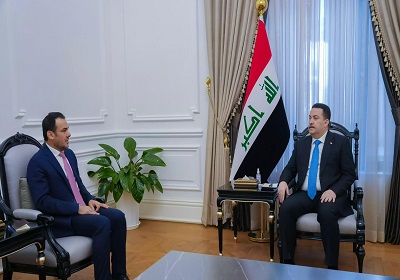
Prime Minister: The path of development will make Iraq a regional political and economic powerhouse
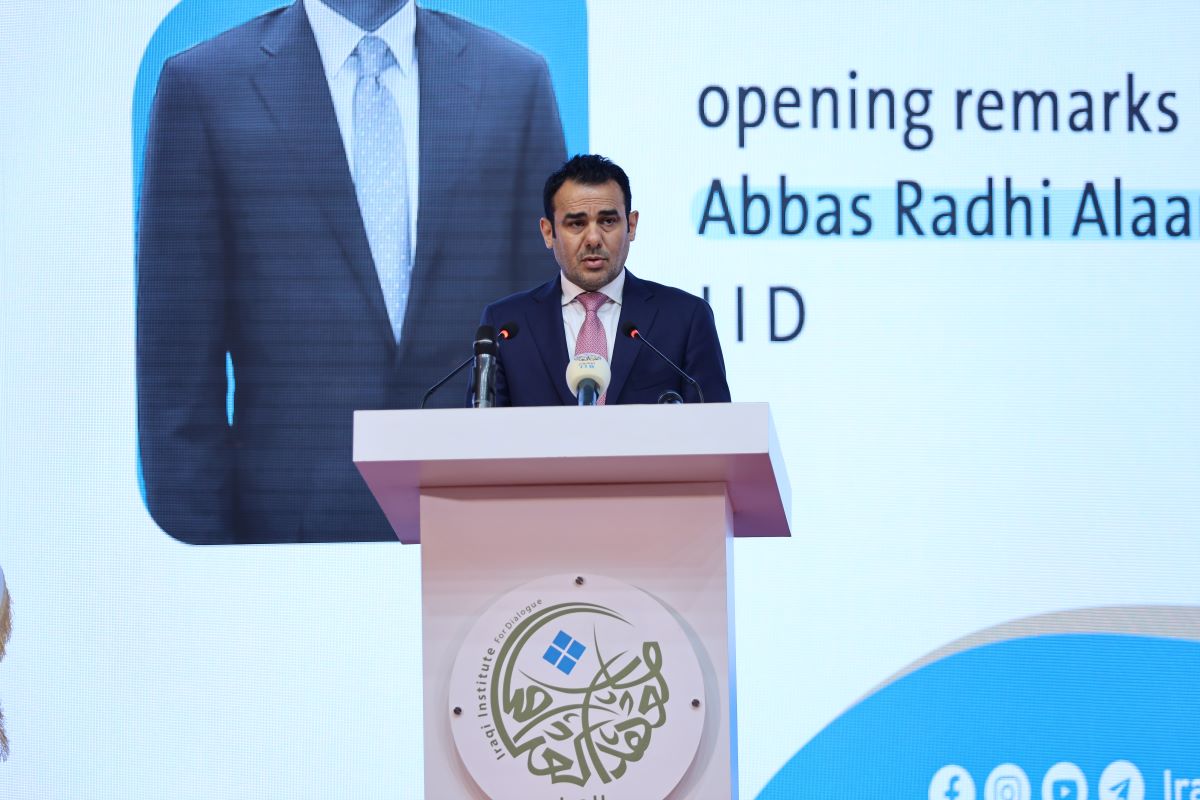
Speech of the Director of the Iraqi Institute for Dialog at the Sixth Baghdad International Dialog Conference

Seventh Baghdad International Dialogue Conference Call for Papers

Comments