


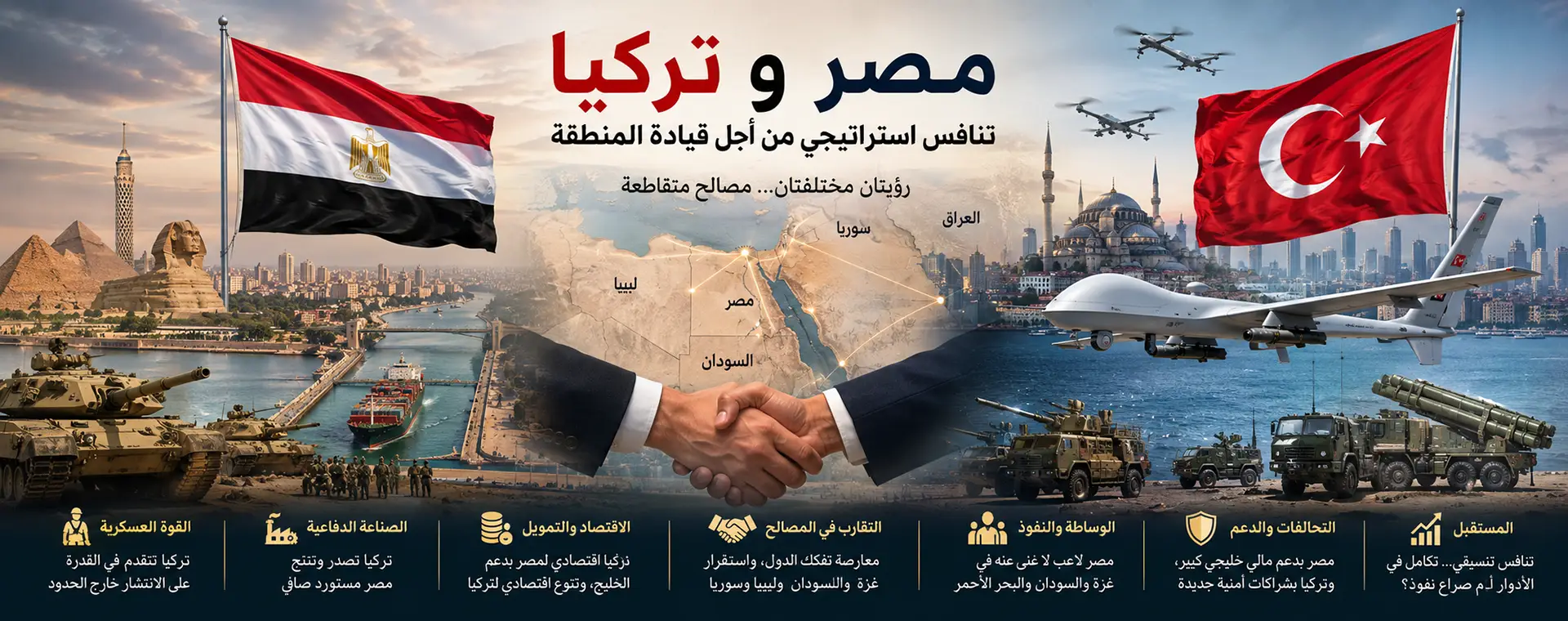
Egypt vs. Turkey: Rival Regional Leadership Strategies
Turkey has an advantage in hard power and deployability, and the crucial point in this area is its defense industry. Ankara is transforming arms exports and military deployments beyond its borders into political influence. And Egypt cannot keep up, so it relies on its geographical location and role in Gulf mediation and financing to maintain its pivotal position in regional diplomacy.
Neither country's strategy can fully dislodge the other, which explains why the two capitals are now moving more to coordination than confrontation.
Why compare them now?
In February 2026, Egyptian President Abdel Fattah al-Sisi and Turkish President Recep Tayyip Erdogan chaired the second meeting of the High-Level Strategic Cooperation Council in Cairo. The two countries signed defense agreements, setting a goal of raising bilateral trade to $15 billion by 2028.
Months later, Turkey joined Saudi Arabia and Pakistan in the Mecca Mutual Defense Pact, while Egypt remained outside. Simultaneously with the U.S.-Iran war, the Gaza ceasefire agreement, and the civil war in Sudan, these moves reopened an old question dating back to the era of the late Egyptian President Gamal Abdel Nasser: Which Sunni powers define and lead the region's agenda?
Comparison table
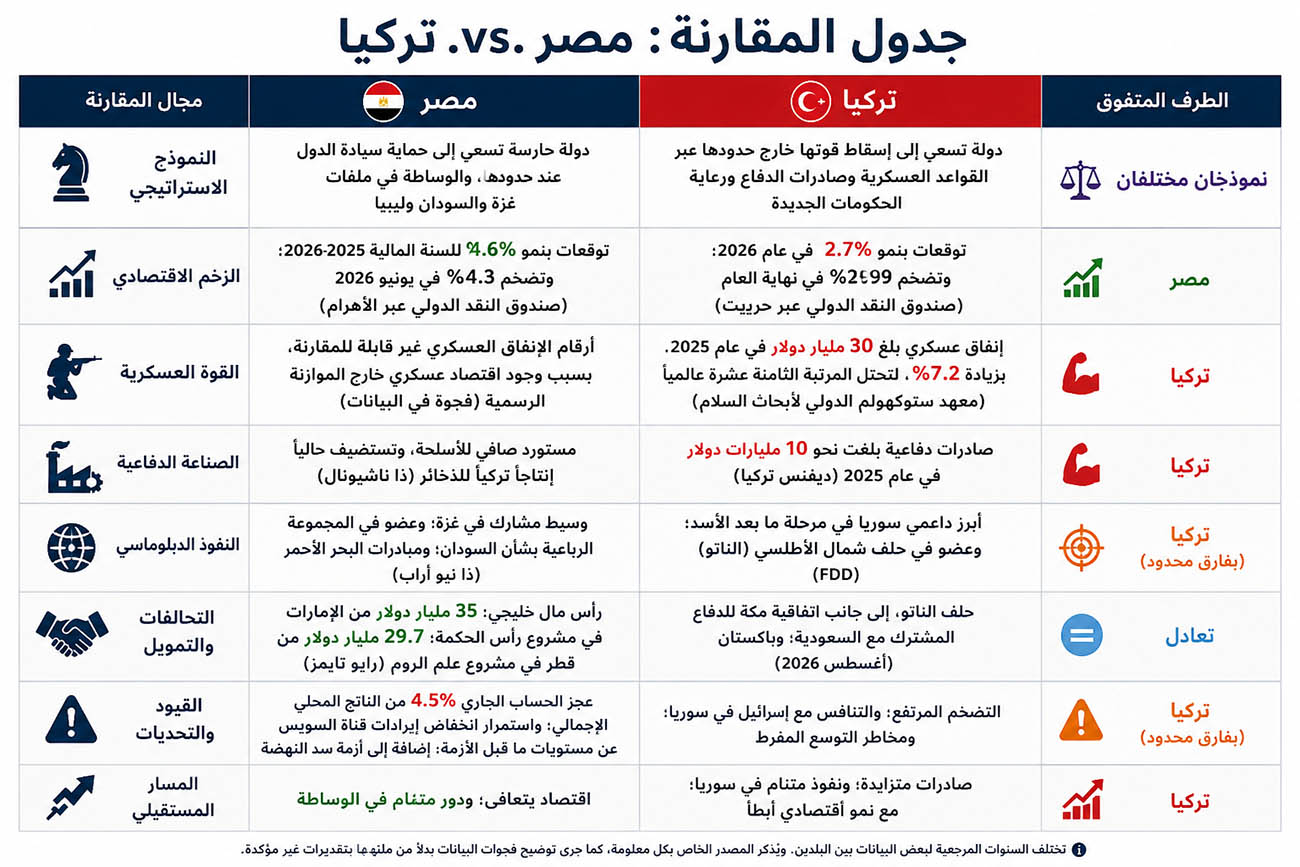
The reference years for some data vary between the two countries. The source for each information is mentioned, and data gaps have also been clarified rather than filled with uncertain estimates.
Comparison in terms of different areas
1. Strategic Model
Data:
"Egypt's priorities are defensive, concentrated at its borders." "For Cairo, Sudan is tied to the security of the Nile Valley and the Red Sea, and disagreements over the Ethiopian Renaissance Dam have led it to build alliances with Somalia and Eritrea."
In return, Turkey's defense minister told parliament that his country's military bases in Iraq and Syria would remain permanent for the foreseeable future.
Evaluation:
The two countries represent different models of regional leadership. Egypt seeks to be an indispensable actor, while Turkey seeks to have a direct field presence on the ground.
The Chatham House Institute argues that the Egyptian position is characterized by avoidance of risks and reactions, while the Turkish position is proactive and proactive, but it carries greater risks related to exceeding the limits of influence and capabilities.
The result: two different models.
Confidence level: High.
2. Economic momentum
Data:
The International Monetary Fund expects the Egyptian economy to grow by 4.6% during the fiscal year 2025-2026, supported by record remittances from Egyptians working abroad, the recovery of the tourism sector, and the gradual recovery of the Suez Canal.
As for Turkey, the IMF cut its forecast for Turkish economic growth during 2026 to 2.7%, with inflation expected to reach about 30% at the end of the year.
Evaluation:
Turkey has a larger and more diversified economy, but Egypt is achieving better economic momentum during 2026, and major Gulf deals provide it with external financial reserves that Ankara does not enjoy to the same extent.
And yet Egypt’s recovery still depends on the IMF program and Gulf capital, rather than private sector-led structural reforms.
The result: Egypt excels in economic momentum, and Turkey excels in economic size.
Confidence level: Medium.
3. Military Force
Data:
The Stockholm International Peace Research Institute (SIPRI) estimates that Turkey's military spending during 2025 is around $30 billion, driven in part by military operations in Iraq, Somalia and Syria.
Ankara maintains about 20,000 troops in northern Syria.
"The EAF is large, but much of its budget and economic activities lie outside official accounts and data, making direct comparisons between the two countries' military expenditures inaccurate."
Evaluation:
Turkey can deploy its military forces beyond its borders and maintain this deployment for long periods.
"The Egyptian military, on the other hand, was designed primarily to deter and defend borders, not to carry out long-term expeditionary military operations outside the country."
The result: Turkey.
Confidence level: High.
4. The Defense Industry: The Decisive Factor
Data:
Turkey's exports of defense and aviation industries amounted to about $10 billion in 2025, and rose to $11.2 billion during the twelve months ending in July 2026.
Baikar alone recorded exports of $2.2 billion during 2025.
And in return, Egypt has become one of the customers of Turkish defense industries, as the Turkish State Military Industries Company signed an agreement to establish a factory to produce 155 mm ammunition in Egypt.
Evaluation:
Arms exports are one of the tools through which Turkey is transforming its industrial capabilities into political influence, from Libya and Somalia to NATO countries in Europe.
And Egypt does not have a similar tool in terms of impact. Turkey's supply of arms to Egypt itself reveals the extent of the disparity between the two countries in this area.
The result: Turkey.
Confidence level: High.
5. Diplomatic influence
Data:
Egypt, along with the United States, Qatar and Turkey, participated in the mediation that led to the ceasefire agreement that temporarily halted the war in Gaza and is also participating in the Quartet on the Sudan.
And in return, Turkey has become Syria’s most prominent military partner, and remains a member of NATO.
Evaluation:
"In Gaza, Egypt's geographical location at the border, along with its intelligence channels, makes it irreplaceable."
Turkey, on the other hand, is expanding its influence into more numerous regional arenas. And its post-Assad patronage of Syria represents the most significant new gain in regional influence that either country has made since 2024.
The result: Turkey by a narrow margin.
Confidence level: Medium.
6. Alliances and Finance
Data:
Abu Dhabi pledged $35 billion through the Ras al-Hikma project, while Qatar pledged $29.7 billion for the Rum Flag project.
And in return, Turkey signed the Mecca Joint Defense Agreement with Saudi Arabia and Pakistan in August 2026, while Egypt remained outside the agreement, noting that there are constitutional and legal issues that prevent its accession.
Evaluation:
Egypt's backers are financiers who provide the financial resources needed for its stability, while Turkey's partnerships are security allies with whom it shares strategic commitments.
And in doing so, Egypt has better financing, while Turkey has more room to maneuver.
The result: a tie.
Confidence level: Medium.
7. Limitations and Challenges
Data:
Egypt's checking account deficit is estimated at 4.5% of GDP during the fiscal year 2025-2026.
And Suez Canal revenues are expected to recover only gradually, rising from $4.1 billion this year to $11 billion by the 2030-2031 fiscal year.
The constraints facing Turkey are of a political and military nature. "Israeli strikes have prompted Ankara to halt plans to establish military bases in central Syria, and it is currently expanding its relations with Khalifa Haftar in Libya, testing Cairo's patience."
Evaluation:
"Egypt's constraints are structural and financial in nature, limiting its regional ambitions."
Turkish restrictions are mostly risks that Ankara chooses to take as a result of its expansionist ambitions and desire to enhance its influence.
The result: Turkey by a narrow margin.
Confidence level: Medium.
Areas of convergence between the two countries
The two countries now agree to oppose the disintegration of their fragile neighbors. And during his visit to Cairo, Turkish President Recep Tayyip Erdogan spoke of a full consensus on preserving the unity of Libya, while Egyptian President Abdel Fattah al-Sisi identified the files of Gaza, Sudan, Libya and Syria as arenas where the positions of the two countries converge.
Both sides want to reconstruct Gaza without displacing its population, and both view the disintegration of Sudan as a threat to regional security.
And the volume of trade exchange of about $9 billion, and Turkish investments in Egypt, which are close to $4 billion, along with joint military exercises, such as the “Golden Eagle” exercises, give additional momentum to bilateral relations.
But as Al-Ahram points out, what is happening is a rapprochement, not an alliance. The two countries still have differences over Libya, Syria and the maritime border.
Where does the gap widen and where does it shrink?
- Defense industry – widening gap: Turkish export growth far exceeds any similar Egyptian capabilities, while Egypt has become a buyer of Turkish weapons.
- Economic momentum – gap narrowing: Egypt's faster growth and lower inflation rates are starting to narrow the economic gap with Turkey.
- Syria – Gap widening: Egypt has no role similar to the Turkish patronage that Damascus enjoys.
- Gulf alignment – unsettled competition: Egypt has Gulf funding, while Turkey has a defense agreement with Riyadh. It remains unclear which factors are more important in the calculations of Gulf capitals.
What does this mean for different parties?
Gulf States:
The Gulf states can rely on Egypt for regional stability and benefit from Turkey's military capabilities and defense industries, allowing them to deal with both sides without having to choose one.
EU, Greece, Cyprus:
The Egyptian-Turkish rapprochement weakens the traditional alliance in the eastern Mediterranean that was forming to confront Ankara, and raises the level of challenges associated with maritime conflicts.
Investors:
Egypt offers a macroeconomic stabilization story supported by Gulf financing, while Turkey offers growth opportunities in the defense industry sector, but with inflation-related risks.
What could change these estimates?
In Egypt's Interest:
- Suez Canal revenues return to levels approaching pre-crisis levels.
- Egypt's accession to the Mecca Agreement on its own terms.
- Cairo's success in brokering a permanent settlement in Sudan, or the completion of the second phase of the Gaza agreement.
For Turkey's Greater Interest:
- Ankara's success in establishing permanent military bases in Syria with Israel's consent or non-objection.
- Turkish defense industry exports exceeded the $15 billion barrier.
- Low inflation rate to less than 20%.
Back to competition and confrontation:
- Turkish military support for Khalifa Haftar in Libya has crossed Egyptian red lines in the east of the country.
- The two countries support opposing parties in Sudan.
conclusion
Turkey currently has the advantage in competing for regional leadership, as it is able to build, sell, and deploy power, while Egypt cannot keep up with it in these areas.
But Egypt's strategy of making itself indispensable is not necessarily weaker, but different in nature. There can be no settlement on Gaza, no ceasefire in Sudan, no security arrangements for the Red Sea without Cairo's participation.
The most likely scenario in the coming phase is the distribution of roles between the two countries; Turkey provides military capabilities and field influence, while Egypt provides access to stakeholders and political and diplomatic legitimacy.

The Iraqi Institute for Dialogue, the logistical sponsor of the Baghdad International Book Fair, opens its own pavilion at the fair
Official agreement between Iraqi Institute for Dialogue and the Iraqi Media Network to sponsor The Seventh Annual International Conference of “Baghdad Dialogue” 2025

The Iraqi Institute for Dialogue publishes "The Diplomatic Portfolio" by Dr. Karrar Al-Badiri

Invitation to the 79th issue of Dialogue of Thought
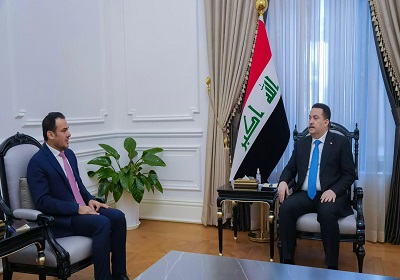
Prime Minister: The path of development will make Iraq a regional political and economic powerhouse
Speech of the Director of the Iraqi Institute for Dialog at the Sixth Baghdad International Dialog Conference
Seventh Baghdad International Dialogue Conference Call for Papers
Comments