

Dialogue of Thought interviews Mr. Hashim Hashemi, Secretary General of the Islamic Virtue Party
Dialogue of Thought magazine conducted an extensive interview with Mr. Hashim al-Hashemi, Secretary General of the Islamic Virtue Party, which was published in Issue 14 of September 2010.
Dialog text
Dialogue of thought:Democracy is not only a system of government but also a way of life... How well is it applied in Iraqi political daily life?
Mr. Hashim Hashimi:As with all incoming civilizational products, democracy is confronted with many doubts about its acceptability as a philosophy based on basic premises, including (the origin of freedom - the rule of the people - the rule of the majority) and as applied mechanisms represented by elections, the exercise of power and others.Perhaps the Iraqi civilizational product over thousands of years and the huge intellectual heritage that Iraqis have contributed to the world intellectual heritage on the one hand has exacerbated the sensitivity of this ancient people towards Westernization and the product coming from the civilization of other nations and on the other hand it may be the innate human tendency towards tyranny and monopolization of benefits that grew in Iraq over centuries in an environment that is best suited to teach the monopolization of power and the practice of coercion. This is taking into account the strong influence and clear dominance of the Islamic movement on the Iraqi national scene and the intellectual and jurisprudential frameworks of this movement for all human activity (what is expressed in the actual incidents) has stood in judgment of the applications and mechanisms of American democracy.For all this, it is difficult to identify a specific party to try and hold it responsible for the chaos that pervades the current Iraqi scene and we live its details almost every day.
Democracy needs infrastructures, programs, and education to make it easy to implement and live on the ground.
Dialogue of thought:The theory of political pluralism argues for diversity in values, practices and institutions in the state and society... What is your opinion of pluralism in Iraq?
Mr. Hashim Hashimi:The inevitability of pluralism in democratic life can be inferred from several aspects, including the fact that freedom in all its forms is an inherent right of the nation, and among the sources of freedom are freedom of expression of opinion, freedom of belief, personal freedom...In order to prevent democracy from slipping into chaos, it is important for the boundaries to be clear and known, for example, the limit of freedom is harming, bypassing or infringing on the freedom of others, and the limit of freedom is harming, bypassing or infringing on the freedom of others. And so on.
The reality of what is happening in Iraq that harms the concept of pluralism, partnership and others is the absence of a clear separation between things and the lack of respect for boundaries (ignorance or abuse), and from here arises arbitrariness, alienation and various concepts that are at the origin of a takfiri heritage, or chaos and abuse of private right, which is another type of alienation, so we said that the need for institutions, work programs and educational curricula to ensure that all of them remain within the correct path of democracy.
Dialogue of thought:There are common features of all democratic systems of government, do you see these features in the Iraqi democratic system?
Mr. Hashim Hashimi:It is known that the democratic transition in Iraq did not come by self-will, but was a forced transition imposed by an external will, the will of the United States of America, and it is natural that this will works to apply ready-made templates to accomplish this transition, and this is one of the reasons that made democracy in Iraq difficult to implement.
A number of Islamic thinkers with whom we share a vision find common features between democracy and Islam in thought and in practice... Yes, there may be a difference in the intellectual bases and origins of these features, but this does not cancel the existence of commonality at all.
As for the existence of these features between the democratic model in a number of countries of the world and Iraq, there is no doubt that the democratic experience in Iraq retains its commonalities with other experiences. Perhaps the fog that surrounds the Iraqi scene has blurred the image of these commonalities, but it has not canceled them, as it is possible to distinguish a number of common features such as pluralism, majority rule, elections and others.
Dialogue of thought:Majority/opposition twins at the heart of the democratic process?
Mr. Hashim Hashimi:Among the commonalities that have blurred are the important roles played by both the loyalists and the opposition in the political process, the impact of these roles on government performance and the level of services provided to citizens, and the use of political competition between the two parties in a constructive manner for the benefit of the political and democratic process in the country.
The issue of the government and the opposition lies in two main aspects. The first is the belief of political elites in the inevitability of alignment to facilitate the achievement of electoral and political benefits, and the second is the level of public awareness that understands and deals with the reality of alignment.
In the first aspect, partisan, personal, and factional interests continue to govern the decision to align, as long as government means, among other things, the ability to self-actualize, self-benefit, and achieve partisan and factional gains, and as long as the opposition means standing on the weaker side of the political system with its back exposed and no chance of survival during the electoral cycle, and the government can use the second aspect to portray the opposition as a group of troublemakers who constantly oppose bills in Parliament and hinder the government's efforts to entertain and improve the people and various charges that
What is happening in Iraq is a quote from this dark scene, and it may take decades of hard work before the political process in Iraq produces working teams in the name of the government and the opposition that exchange roles to serve the political process.
Dialogue of thought:The constitutionalization of power and political life in democratic systems means regulating the coexistence and balance between power and freedom within the framework of the state.
Mr. Hashim Hashimi:For the above reasons, democratization in Iraq needs two solid foundations on which to build. The first is what we have already mentioned under the heading of infrastructure, and the second is the contract that is referred to to adjudicate disputes, define powers and ensure the separation of powers, which is the constitution that represents the rules approved by the political elites representing the people along with the will of the nation that voted in favor of it.
What is important in constitutional life is not the content of the constitution, but the guarantees that must be provided to abide by its provisions. Therefore, I believe that the greatest burden falls on the nation in caring for the constitution and maintaining it from violation through the formation of opinion and pressure groups, as well as the work of civil society organizations, parties and other institutions of the political system, and the danger may not be limited to violating the constitution, but rather to disrupting it and stripping political life of its controls.
Dialogue of thought:Democratic systems believe in the virtue of dialogue and consider it an important mechanism for the development of political life... Don't you think that dialogues between political elites in Iraq have become a field for repeating arguments and exchanging accusations?
Mr. Hashim Hashimi:The Iraqi political arena is buzzing with activity even in periods of political hibernation because political competition is still intense, and dialogue is the only authorized means of achieving political goals. What is remarkable about the advantage of dialogue is that it often brings the interlocutors to intermediate areas of convergence, so political parties do not lack a way to achieve comfortable or satisfactory settlements, especially if the conviction that elections are a periodic entitlement and that it is never too late to achieve goals becomes entrenched in the minds of the people.
In light of all the details and conclusions that we have presented in this body, the rules and mechanisms of dialogue are still unclear to us, and the dialogue itself is an art that requires training and long practice to be mastered, which is why we find deviating from the context and deviating from the general pattern is almost the dominant characteristic in national forums: However, this did not prevent us from diagnosing a clear maturity in this area in the Kurdistan Alliance, for example, as it has achieved many of its goals by making good use of the art of dialogue, and this in itself is a national gain and an achievement for the political process.
Dialogue of thought:Political decision-making in democratic systems is subject to democratic mechanisms and controls... Why is political decision-making in Iraq still not democratic?
Mr. Hashim Hashimi:It is the duty of political parties (concerned more than others with the most important decisions) to educate their members and affiliates to adhere to the rules and mechanisms of decision-making in preparation for their recruitment in state institutions and prepare them to take fateful decisions in those institutions, that the absence of the educational aspect and leniency in the task of training and developing party competencies and capabilities leads to the arrival of unqualified personalities to positions of responsibility, this applies to all joints of the state without exception, especially the parliament and is not limited to executive institutions only.
The government and parliament have a responsibility to develop the competencies of political elites by enacting laws that regulate the work of these parties and their entitlements, because they will ultimately be among the state's resources and tools.
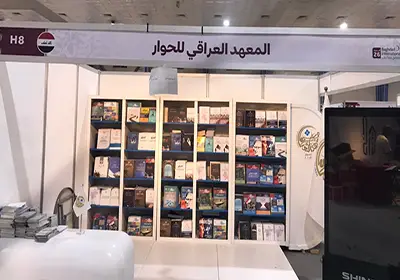
The Iraqi Institute for Dialogue, the logistical sponsor of the Baghdad International Book Fair, opens its own pavilion at the fair
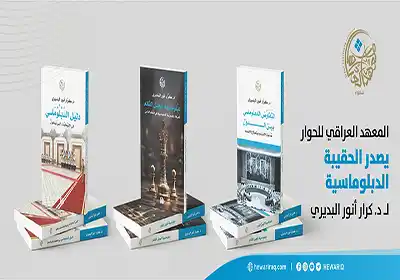
The Iraqi Institute for Dialogue publishes "The Diplomatic Portfolio" by Dr. Karrar Al-Badiri
Official agreement between Iraqi Institute for Dialogue and the Iraqi Media Network to sponsor The Seventh Annual International Conference of “Baghdad Dialogue” 2025
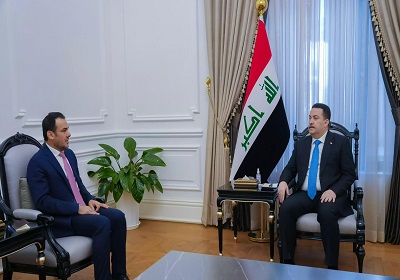
Prime Minister: The path of development will make Iraq a regional political and economic powerhouse
Invitation to the 79th issue of Dialogue of Thought
Seventh Baghdad International Dialogue Conference Call for Papers
Praise for the Baghdad International Dialogue: Strengthening Iraq's pivotal role and a meeting point for visions
Comments