


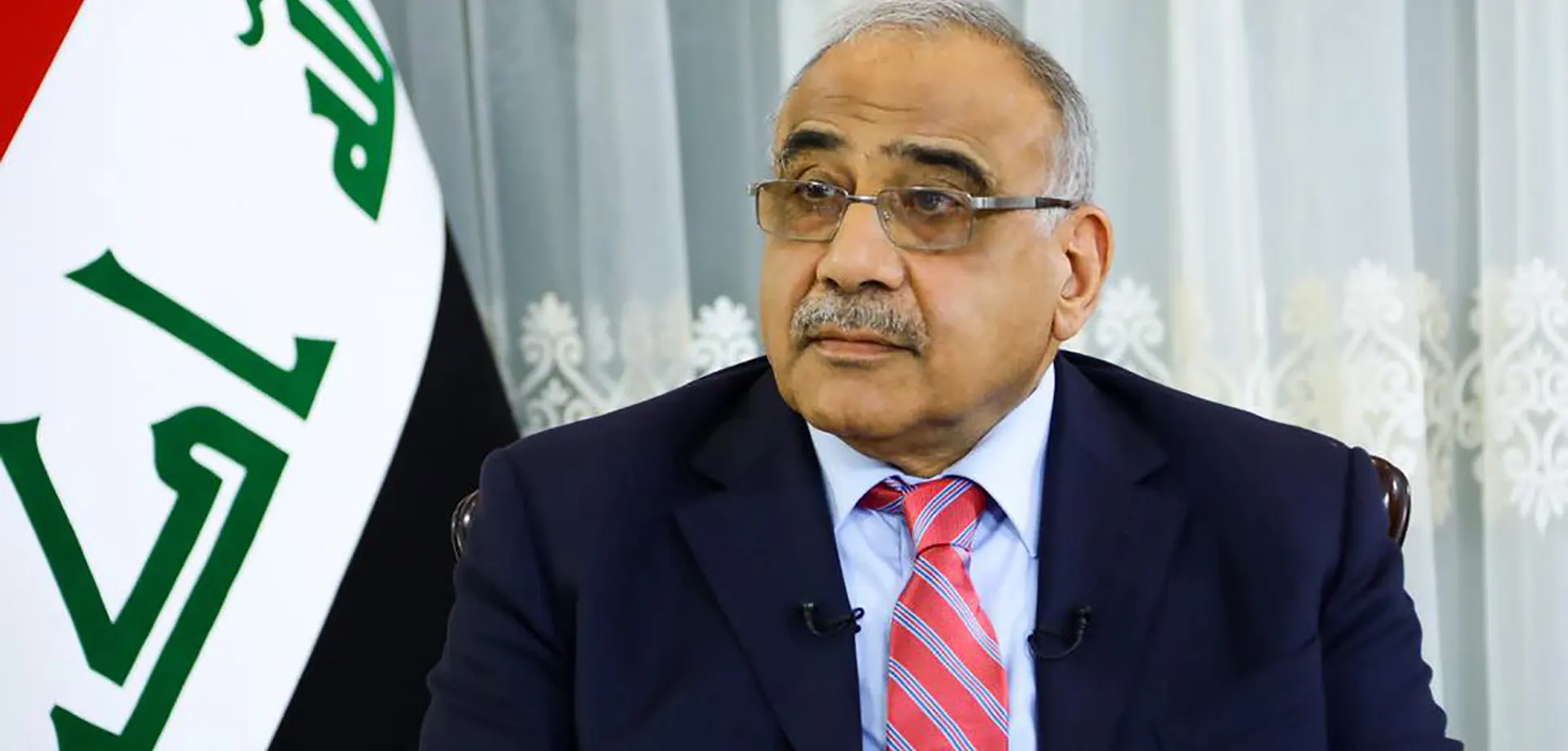
Dr. Adel Abdul Mahdi, Vice President of the Republic
In the context of its interest in Iraq's political and cultural transformation, Dialogue of Thought continues its dialogues with national figures, decision-makers and intellectuals to discuss issues that affect the structure of the Iraqi state and its democratic process.
In this context, in its fifteenth issue, published on December 15, 2010, the magazine conducted an interview with Dr. Adel Abdul Mahdi, then Vice President of the Republic, in which he talked about the concept of political culture as the framework that defines the nature of the relationship between the state, society and the individual, and its role in consolidating national awareness, organizing public affairs and building a political system consistent with public interests and Iraq's historical and social realities.
The following is a transcript of the interview
Dialogue of thought: What are the tributaries of political culture in general?
Dr.. Adel Abdul Mahdi:Geography, history, people, demographics, temperament, psychology, values, so-called popular moods or public values, strengths and weaknesses, land and sea factors, superstructures and infrastructures. It is the laws, rules or traditions of governance, power and the state, whether in maintaining or changing them and the methods of doing so. It is the management and international relations or regional and international systems and the system of values that change according to time, place and history.
Political culture has evolved a lot. If at one time it was Al-Ahkam al-Sultaniyya by al-Mawardi, or the Laws of Dawawawin by Ibn Mamati, or the Introduction by Ibn Khaldun, or Sabah al-Asha by al-Qalqashandi, or the Plans of al-Maqriziyya, and hundreds of works related to the affairs of the Imamate, the Caliphate, the Sultanate, the Emirate, the State, the people, administration, war and peace issues and other affairs, today it has evolved in time and space as these and other new affairs have become new... The concept of the state has evolved from the concept of the dominant hand, generally through force, dominance or inheritance, to the concept of the state conditioned by a constitution and specific laws. The concept of the state has evolved from a metaphysical or physical external right to a temporary contract granted by the citizen to the ruler through the ballot box and the concepts of democracy, the circulation of power and the separation of powers. The concept of the citizen and belonging to a country, people or group has evolved from human dependence on the ruler to the ruler's dependence on the citizen and the people in a process of historical development or accumulation that has never known a straight line in its ascent or march.
The concepts of human and women's rights, international relations, opposition rights, groups and cultures have evolved, and the fields of political culture have increased, branched and intersected with other circles, making the circle of political culture today a very wide circle not only related to governance and power, as Machiavelli saw in "The Prince", but also to revolution, as Lenin saw in "The State and Revolution" as one of hundreds or even thousands of examples. It is not about the movement of fleets and airplanes to extend influence, conquest and control, but about the arts of resistance and freedom from it, whether in the style of Gandhi in confronting the British occupation. Or the style of Imam Khomeini (may his soul rest in peace) in the face of the Shahanshahi or American domination. Or the Palestinians' confrontation with the Israeli occupation, and so on.
Dialogue of thought: What distinguishes political culture from ideology?
Dr.. Adel Abdul Mahdi:Political culture has to do with the political structure, developments and methods of operation. As for ideology, it has to do with the overall philosophy, the nature of man's view of life and the afterlife, and the science of tangible and intangible ideas. Politics is the science of the state or the politicization of the state (from the act of politicizing the matter or politicizing the horse) and thus the people. Ideology is the mental, philosophical or religious convictions that have references and formulate goals that organize human life in relation to the issues of creation, life, death, the afterlife, etc. Ideologies are the beginnings of building states, and states create their ideologies.
Dialogue of thought: Some societies suffer from a weak political culture. What do you think are the reasons for this weakness?
Dr.. Adel Abdul Mahdi:The strength or weakness of political culture is related to the existence of political life at all and the practice of political tools by members of society. There is a big difference between a person who reads about elections as a means of choosing a ruler and a person who practices elections and has the right to choose and determine who to nominate to govern, let alone be a candidate and seek to achieve the sciences and arts to achieve specific goals.
As for the means necessary to develop political culture, one of the first conditions is the possibility of practicing politics in a positive and public sense, not in the sense of a secret life that constitutes a single or limited aspect of political practice. When the possibility of practicing politics in a broad and broad sense is available, development takes place through practices, institutions, studies, preparation, cadre education, promotion and training systems, and work practice in various types of activities or events.
Dialogue of thought: What are the characteristics of Iraqi political culture?
Dr.. Adel Abdul Mahdi:Political life in Iraq has declined with the decline of its political system. The political system, which was already weak since the establishment of the kingdom or the modern Iraqi state, and even weaker before that, instead of developing towards more positive accumulations that create traditions of political work and its various tools such as elections, legislative councils, various authorities, means of opinion and expression, freedom of the press and parties, the circulation of power, the constitution, institutional work and building institutions of public opinion, instead of all that, we saw the concept of political work shrinking in front of the increase in theories of military coups and seizing power by the army ... or the means of violence and rebellion, then the one party and then the one individual, and the control of all aspects of life to adapt them to the wishes of the ruler. Or the means of violence and rebellion, then one party and then one individual, and control over all aspects of life and adapting them according to the wishes of the ruler, to increase the practices of repression, prisons, executions, assassinations, curbing freedoms and closing all areas of political work and thus the constructive and positive political culture.
Therefore, we notice that the characteristics of the political culture we have today reflect the reality of the political system that the country has experienced. This is a long research, and we can only point out some of the characteristics, not all of them. There are characteristics related to the continuity of the values of the past, such as authoritarianism, individualism, the absence of constitutionalism, institutionalism, theory of government, and the constitutional contract. This individualism and lack of institutionalization is not only found in state institutions, but also in parties and movements. The relationship with the people is not representative or voluntary, but exploitative or utilitarian.
We also notice the decline of the concept of community, nation or people in front of the concepts of sect, clan, clan, clan and region. Either because of the inability of the group or the nation to contain the sub-structures, or because the latter are strong and block the way for the former. Unclear concepts about the role of religion in politics and politics in religion Political characteristics cannot be simplified by the relationship between nomadism and civilization, women and men, clan and society, religion and state, and backwardness and progress, as summarized by the late great sociologist Ali al-Wardi. I think it is deeper than that, but it is related to the constitutional contract that is completely appropriate to the nature, characteristics and conditions of the people or society, which can serve and develop its affairs, which was not achieved neither in the 1920s, nor in the royal stage and all republican stages or in the stage after the change, so systems of control and authoritarianism prevailed rather than successful systems of governance and management. Politics remained stalemated, obstructed, and not motivated as it should be, and did not transform into a system capable of renewed production with a self-motivated momentum that is not only sustainable, but renewed with broader and more productive energies.
We note, for example, the fragility of the anchor or framework structures. The concept of "public opinion" in its functional sense is largely missing due to the lack of unity of interests, fears and constants, and sometimes even the confusion of the concept of people and identity, despite the fact that Iraq, in its demographic and geographical reality, is a country whose history extends back thousands of years. Public opinion is an institution, not just the impressions of this or that team, or the "hurries" that appear in the satellites made by an ambitious journalist or a satellite that wants to attract viewers to it. "Public opinion" is an institutionalized expression resulting from the feeling of the nation or the people that there are constants and commonalities on which everyone has a common position.
"Public opinion" is like the concept of instinct, spontaneity or instinct that defends its interests, not because a party or leader demanded action, but because all historical and value accumulations and collective consciousness formed at a specific moment and time move by instinct and spontaneity, which allows a leader, leader or party to invest it, understand the pulse of the masses and direct the wave or open the sails in the right directions. It is far from the common usage today when saying that "public opinion" does not accept such and such, or when saying that "our street" does not agree with such and such. These are all attitudes that reflect the existing chaos.
Public opinion, whether explicit or implicit, violent or peaceful, vocal or silent, is the nation's immunities and basic defenses that prevent anyone from manipulating the fundamentals of the group, the people, or the country's interests. It may correspond to the concept of "meeting", and I did not say "community" or "society" in order to be aware of the difference between the two. In our contemporary vocabulary, "meeting" can correspond to social interests or social order, and "public opinion" is sensitive and vigilant to any movement that could affect the system of interests and constants, not as we see today, where basics and rights are attacked, while we see people, parties, media, and decision centers all busy with matters, sayings, and repeated, meaningless, superficial and trivial words that do not represent the essence of the basic interests of the country and the people. We have "public opinion" when the blood returns to the veins or the pillars, constants, institutions, traditions and customs are built and the nation rises to the call of "Wamatusama", it makes no difference whether the historical account is true or fabricated, what matters to us is the meaning. There is a "public opinion" when "Mrs. Thatcher" is objected to, not because she arrested innocent people, but only because she wanted to legalize ID cards. The British are very sensitive to their freedoms and to the possibility that these freedoms may be violated by means that are perfectly legitimate but may later be used to violate those freedoms. "Public opinion" is an institution, as when we say "the institution of marriage" has its constants, so that each person does not create his own pattern of marriage, but there are accumulations, constants, foundations and limits that make marriage a marriage and adultery an adultery, known by the illiterate and the educated, Bedouin and urban, religious and non-religious, men and women.... etc.
"Public opinion" is largely absent in the lives of Iraqis due to the absence of many of the pillars that make it, so we have only known two patterns. The first is the absence of the political system through tyranny and monopoly, so that public opinion becomes the opinion of the tyrannical ruler, and the second is chaos and division, as we are witnessing to a large extent today. Everything else is a mixture of these two patterns.
In Iraq, we did not build on the rich and rich history of high-end political systems known in Islamic experiences, nor did we learn from international experiences that developed their political systems, which characterized our case with distorted or nascent characteristics that are not allowed to develop due to the continued chaos of ideas, concepts and practices despite the attempts made to take shelter in a constitution and institutions that are still fragile and vulnerable to violation and encroachment.
Dialogue of thought: Do you think political culture in Iraq is in crisis, or is the Iraqi political intellectual in crisis?
Dr.. Adel Abdul Mahdi:Both are in crisis. The political culture did not exist in its true depth and effectiveness because the political system was absent and missing (if it was formed at all before that), if we consider that the system of authoritarianism and monopolization of political life can really be characterized as a political system that deserves this name.
We have not yet stabilized the political system on which to build and accumulate. The political intellectual in the functional sense - and not in the personal or individual sense - does not really exist because the political intellectual is meant to have a specific role in a political system through which he performs a functional role in a functional institution. This question would be akin to saying, "Is there a crisis in the theater or in the dramatists?" The truth is that theater makes dramatists, and the latter make theater. There is no real existence in the functional sense of one without the other. The first is the cause of the second and vice versa. This is if we want to go beyond the exceptions and individual cases moving outside the system in time and space. There may be a political intellectual, but he is a product of a past experience that no longer exists. Or a political intellectual who is associated with a political activity outside the place and space in which the system moves.
Ended on 10/11/2010 at 8:15 am in Baghdad after a session yesterday evening in the Barzani House, which indicates the depth of the crisis of the Iraqi political intellectual and the crisis of political culture and the political system, after we attended the session of "leaders". Thank you for the efforts to spread the political culture that is largely missing in this unjust Iraq to itself and oppressed by others. I apologize for the speed of the answers and may sometimes be inaccurate due to the short response time, as I started responding at six in the morning and ended at a quarter past eight in the morning.
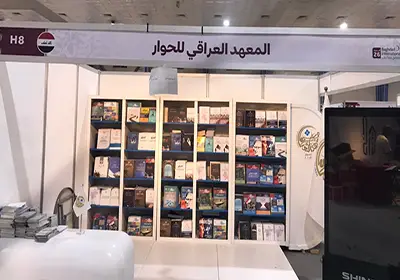
The Iraqi Institute for Dialogue, the logistical sponsor of the Baghdad International Book Fair, opens its own pavilion at the fair
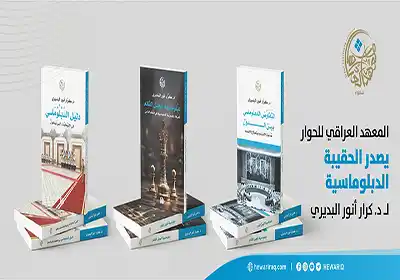
The Iraqi Institute for Dialogue publishes "The Diplomatic Portfolio" by Dr. Karrar Al-Badiri
Official agreement between Iraqi Institute for Dialogue and the Iraqi Media Network to sponsor The Seventh Annual International Conference of “Baghdad Dialogue” 2025
Invitation to the 79th issue of Dialogue of Thought
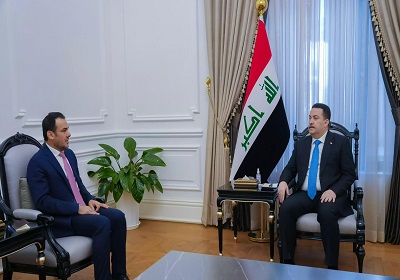
Prime Minister: The path of development will make Iraq a regional political and economic powerhouse
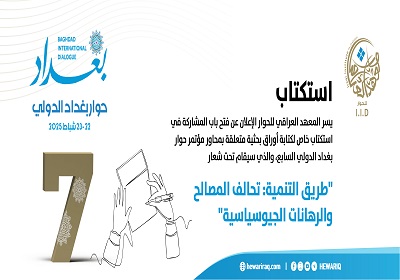
Seventh Baghdad International Dialogue Conference Call for Papers
Praise for the Baghdad International Dialogue: Strengthening Iraq's pivotal role and a meeting point for visions
Comments