


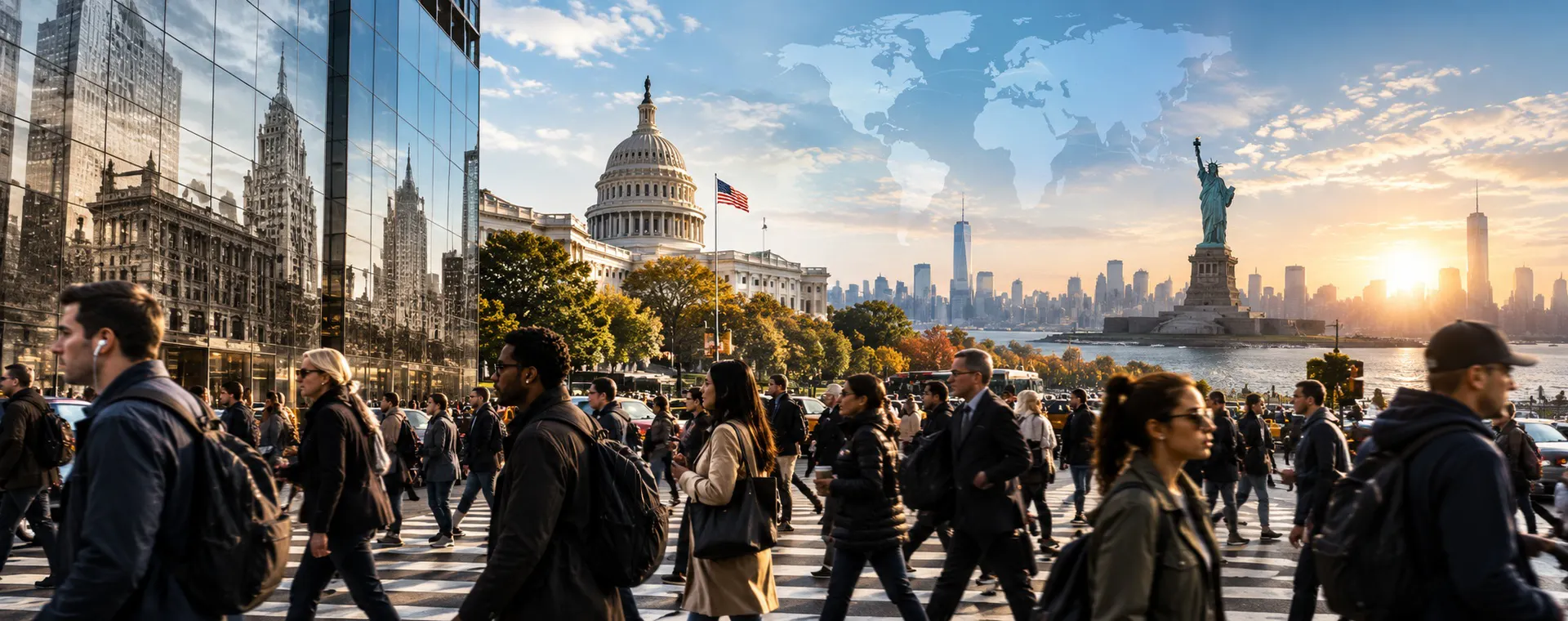
Understanding Life "Retrospectively" and Living It "Toward the Future": U.S. Commitments in a Post-Trump World
“Life can only be understood by looking back, but it must be lived by looking forward.” — Soren Kierkegaard
Although it will probably take another two years, the Trump era will inevitably end. And when that happens, the U.S. willingness to address the accumulated political damage will be the “first task” it has to undertake. Moreover, showing the country this necessary willingness, or not showing it, would have repercussions not only for the United States, but for the entire world.
How did we get to this point of erosion and bitterness? The right answer is no secret. And for Americans to live “toward the future,” they will first have to understand life “by looking back.”
It is time to prove this answer right. The American system of government that was formed under Trump, driven by policies aimed at presidential gain and personal promotion, has produced a toxic mix. From this paradoxical overlap between the rule of the rich and the rule of the crowd, no national or international benefits could be expected.
And there's more. Looking ahead, firm candor and objective analysis will be essential. Ultimately, U.S. recovery from Trump's first and second presidential terms requires a thorough review that goes beyond personalities, parties, and ideologies. This review should address, among other things, something that works beneath the surface of visual politics. This is, in essence, a latent reluctance to make political decisions based on history, science and law.
And with such an intractable reluctance to change, Donald Trump’s authoritarian culture of manipulative simplification and emotional obedience has dragged the United States backwards.
More specifically, what should be done to limit the damage the United States has already suffered under Trump and to prevent the suffering he has caused from continuing beyond his term?
As Thomas Jefferson and other founding fathers have recognized, a republic needs a real education and a familiarity with history. In principle, although the vast majority of Americans know how to read, this same majority frequently chooses not to read anything of cognitive or intellectual significance. And in the White House, or at least in those parts of its buildings that have yet to be demolished, President Donald Trump continues to show a persistent indifference to the intellectual foundations of the United States.
And there's more. This is evident from the artificial justifications Trump makes for violating the sovereignty of other nations by using hostile military force. This president has clearly ignored Article VI of the US Constitution, known as the “constitutional supremacy clause,” and the relevant rulings of the US Supreme Court.
Based on William Blackstone's explanations of eighteenth-century English laws, which are at the root of American law, international law has always been part of the domestic law of the United States.[1]
And for law-abiding American citizens, the Trump era should be seen as a "symptom" of a deeper flaw, not as the "disease" itself.
And to answer that question meaningfully, explanations that point to Americans’ intellectual and cultural illiteracy should not be excluded. For good analytical reasons, these explanations are not necessarily exaggerated or wrong.
To illustrate the essence of the problem, we Americans today live in a frenzied, deceptive and elusive country, where one of the two main political parties categorically refuses to stop the mechanisms of national and international injustice that continue to operate unabated.
This rejection is fueled by a president who deliberately avoids the use of words of honesty, dignity and knowledge, in behavior that is intentionally contrary to the requirements of democracy that still exist.
Accordingly, the only viable remedy for the United States that has been so badly damaged is the presence of citizens energetically seeking national leadership that transcends hollow political slogans and jokes that lack substance and are embarrassing.
And in principle, Trump’s apparent displays of aversion should not be hard to explain. In an American culture in which interest in thought and knowledge is constantly declining, his apparent lack of interest in education, law, and science has become a political advantage.
“Could there be one truth in human governance that is more humiliating or dangerous than this?»
"Can we trust such a president to manage nuclear negotiations and crises with Russia, North Korea, Iran and China?»
And as for Trump’s claims of violating the law on Greenland, the president has repeatedly asserted that he has executive power to choose military options.
And in a very bad, but increasingly conceivable scenario, the United States could enter a military confrontation with Denmark or other NATO countries. And that would be an irrational conflict in which the United States might, de facto, find itself allied with Vladimir Putin's Russia.
And the author certainly sees signs of such convergence in the positions of Trump and Putin, in the context of the aggressive Russian war on Ukraine.
Trump also supports a pattern of global politics based on crude, hostile nationalism, which creates a chaotic “state of nature” and systematically weakens all law-based mechanisms for nuclear arms control.
And now that we've reached the eleventh hour, there's still a lot to be done. Americans, among other things, must become more insistent on analysis and rational thinking.
And if the United States fails to fulfill that primary responsibility, Trump’s successor may find himself forced to make critical decisions about war and peace. And then, as the next president tries to move “into the future,” he may be forced to issue a resolution that triggers the world’s first nuclear war.
Where do we stand now, and where do we go? Trump’s impulses toward unreason and anti-reason have exposed stark and misleading contradictions.
And while many Americans may remain confident in their hopes of overcoming “affordability” problems, even the wealthiest among them may feel disadvantaged.
And with a surrender to a bleak and spectacularly violent future, including the unbearable prospect of endless unnecessary wars, even the most successful Americans are forced to deal with multiple forms of potentially deadly uncertainty.
To repair a fractured country, candor, intellectual ability, and sophistication will be essential. For the moment, however, we, the “people”, are generally not motivated by high-level accounts of human virtue.
Most of the time, we Americans are no longer looking for guiding paths that lead to courage and balance. Instead, too many individuals who have strayed still accept this president's rushed orders, including illegal military orders, and passively accept a risky life, based on ritual obedience and emotional submission.
Whatever decisions are currently made in politics, we Americans are not moving forward guided by Ralph Waldo Emerson's dictum of “thin thinking and simple living,” but rather driven by unfortunate waves of anxiety and disruption.
And “we the people” may, at least sometimes, want to slow down and enjoy the beauty of life, but the system of government that Trump has exhausted has imposed on us a cruel rhythm of blind compliance.
If left unfettered, the expected end of this mind-impairing disorder will be bouts of rule ruled by criminal practices, and outbursts of uncontrollable international wars.
And there's more too. We Americans live in a society that could have taken a different path.
At one time, we had the ability to cultivate individuals who went beyond being just a submissive “crowd,” as Soren Kierkegaard put it, or a “mass” without features, as Karl Jung put it, or a obedient “herd,” as Friedrich Nietzsche put it.
At that point, Emerson described Americans as a people guided by Platonic “virtue” and Jeffersonian “self-reliance.”
And in living “toward the future,” the veracity of the allegations will remain unexamined by one of the United States’ most intractable enemies.
Our continuing tendency to believe that personal and societal salvation must be achieved through politics is a disturbance whose consequences can be fatal.
And of course, there are many important social and economic issues that require governmental and electoral treatment, but the country’s deeper problems must also be addressed at the individual human level.
And this idea is not complicated: the macroworld should always come on the heels of the microworld. And this sequence can never be changed.
And looking back and moving into the future, Americans will finally have to realize that Donald Trump was only the apparent symptom of a much deeper disease the country is suffering.
To save a genuinely threatened republic, it would not be enough to get rid of a president who, in the writer's assessment, is behaving in a manner that clearly violates the law, and whose behavior is often irrational.
it will also be necessary to overcome a long-established national mindset, which favors the “crowd” society's degrading entertainment over the human-uplifting “life of the mind.”
And if we are genuinely concerned about “Doomsday,” whatever form it takes, whether it’s nuclear war or otherwise, Americans should not seek survival through cartoon superheroes.
To sum up, the United States cannot be saved from itself by fictional characters from the cinema or through the presidential election alone.
And as with the Roman god Janus, depicted with two faces looking one past and the other into the future, this country will need to understand life “looking back,” while continuing to live it “toward the future.”
And in the context of dealing with the post-Trump global order, only a combination of these two perspectives can steer the United States toward more sustainable options to protect its real survival.
Margins and legal referrals
[1] On the incorporation of international law into U.S. law, particular consideration is given to Article VI of the U.S. Constitution, known as the “Constitutional Supremacy Clause,” and the 1900 case of The Paquete Habana.
And in The Paquete Habana, the U.S. Supreme Court said, “International law is part of our law, and it must be ascertained by the competent courts.”
The Paquete Habana, 175 U.S. 677, 678–679 (1900).
The cases of The Lola, 175 U.S. 677 (1900), and Tel-Oren v. Libyan Arab Republic, 726 F.2d 774, 781, 788 (D.C. Cir. 1984), in Judge Edwards' concurring opinion.

The Iraqi Institute for Dialogue, the logistical sponsor of the Baghdad International Book Fair, opens its own pavilion at the fair

Official agreement between Iraqi Institute for Dialogue and the Iraqi Media Network to sponsor The Seventh Annual International Conference of “Baghdad Dialogue” 2025

The Iraqi Institute for Dialogue publishes "The Diplomatic Portfolio" by Dr. Karrar Al-Badiri

Invitation to the 79th issue of Dialogue of Thought
Prime Minister: The path of development will make Iraq a regional political and economic powerhouse
Speech of the Director of the Iraqi Institute for Dialog at the Sixth Baghdad International Dialog Conference
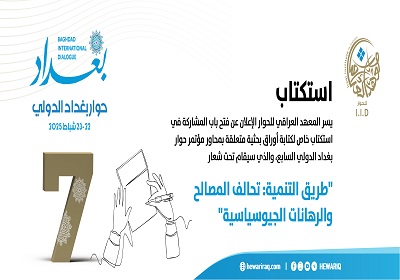
Seventh Baghdad International Dialogue Conference Call for Papers
Comments